Home / Shop / PDF Downloads / PDFs for Adult Clients
Risk Assessment (PDF Download)
$8.00
A one-time price of $8.00 will be added to your order.
Categories: Handbook PDFs, Professional Books
Manufacturer: Safer Society Press


- Description
- Specifications
Risk Assessment
R. Karl Hanson
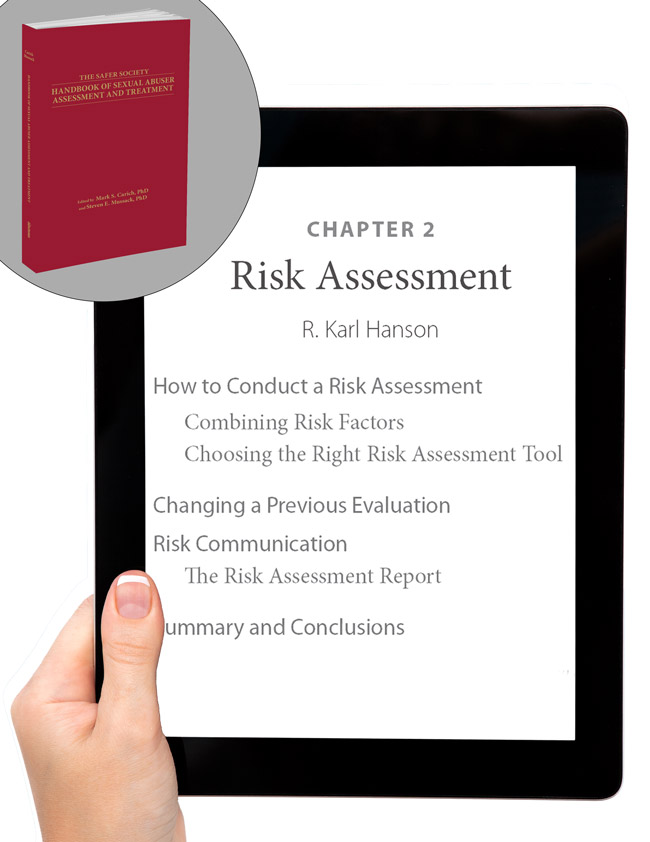
This is a PDF version of Chapter 2 of The Safer Society Handbook of Sexual Abuser Assessment and Treatment.
 For many professionals working with individuals involved in sexual offenses, assessing the risk of reoffending is a significant aspect of their role. Risk assessments serve as the structured, professional responses to perceived threats, guiding safety and treatment decisions. Chapter 2 of the Safer Society Handbook of Sexual Abuser Assessment and Treatment outlines established methods for conducting a high-quality sexual offender risk assessment, providing the foundation for professional decisions that affect clients, their families, and community safety.
Two Core Functions of Risk Assessment
A comprehensive assessment addresses two central questions that inform all aspects of treatment and supervision:
- Estimating Likelihood of Recidivism: Since the future is uncertain, evaluators communicate findings in terms of probabilities. For example, risk may be conveyed as "of 100 offenders similar to Mr. X, we can expect 23 to be convicted of a sexual offense within five years."
- Identifying Treatment and Supervision Targets: Also called case formulation, this requires understanding the client's risk-relevant propensities— particularly criminogenic needs—which are essential for focused, effective interventions.
Conducting a Risk Assessment
Structured approaches to risk assessments are widely considered more accurate than unstructured methods. Chapter 2 summarizes the key principles necessary for creating these measures, starting with the base rate of reoffending—generally between 10% and 15% after five years. As described in the chapter, risk factors are grouped as follows:
- Age: Younger age is associated with greater risk.
- Sexual Criminality: Includes prior sexual offenses, early onset, and deviant interests.
- General Criminality: Factors such as lifestyle instability, delinquency, hostility, poor response to supervision, and other personality issues.
Selecting and Applying Assessment Tool
The selection of a tool depends on the goals of the assessment. This chapter explains the two main strategies:
- Empirically Derived Actuarial Tools: Instruments like the Static-99R and Static-2002R use a mechanical procedure to combine items into an overall score that directly links to expected recidivism rates. The Static-99R is often the preferred initial choice for estimating absolute recidivism rates due to its large reference sample.
- Structured Professional Judgment (SPJ): Tools such as the Sexual Violence Risk–20 (SVR-20) focus evaluators on relevant risk factors, leaving the final judgment to the clinician. SPJ measures are flexible and useful for case management, as they address many factors relevant to intervention.
Additionally, the chapter covers measures designed to track progress and identify targets for change:
- STABLE-2007: Assesses risk-relevant propensities, such as intimacy deficits and problems with sexual self-regulation.
- ACUTE-2007: Monitors current adjustment (e.g., victim access, hostility) to determine if risk-relevant propensities are active.
- Violence Risk Scale–Sex Offender Version (VRS-SO): Combines static and dynamic items and has evidence showing that observed changes during treatment relate to changes in recidivism risk.
Revising and Communicating Risk
When multiple assessments conflict, evaluators must decide whether the disagreement is due to imperfect reliability or new information. While new offenses can revise risk assessments upward, the most well-established factor that justifies a downward revision to risk is remaining offense-free in the community for five years. Revisions can also be made based on an individual's positive response to treatment and community supervision, such as completing treatment or attaining treatment goals.
Good risk assessments must communicate findings clearly to diverse audiences. Clinicians should consider the potential impact of their report if read by others and must always write the report expecting that the subject of the report will read it. Communication methods should include:
- Nominal Categories: Labels such as low, moderate, and high risk.
- Quantitative Indicators: Using absolute recidivism rates (e.g., "23 out of 100"), percentile ranks, and risk ratios.
Risk assessment reports should present balanced portraits of risk and protective factors and identify choices that could support prosocial change.
This PDF chapter provides professionals with practical, reliable strategies for risk assessment and clear communication, supporting informed decisions that promote treatment success.
This chapter covers the following topics:
- How to Conduct a Risk Assessment
- Combining Risk Factors
- Choosing the Right Risk Assessment Tool
- Changing a Previous Evaluation
- Risk Communication
- The Risk Assessment Report
- Summary and Conclusions
- How to Conduct a Risk Assessment
After purchasing this product, you will have three days to download it. After that, you will need to contact Safer Society Press to receive your copy.
18 pages plus bonus material
PDF Format
Order#: WP162-02
Related Publications
-
Earn CEUs
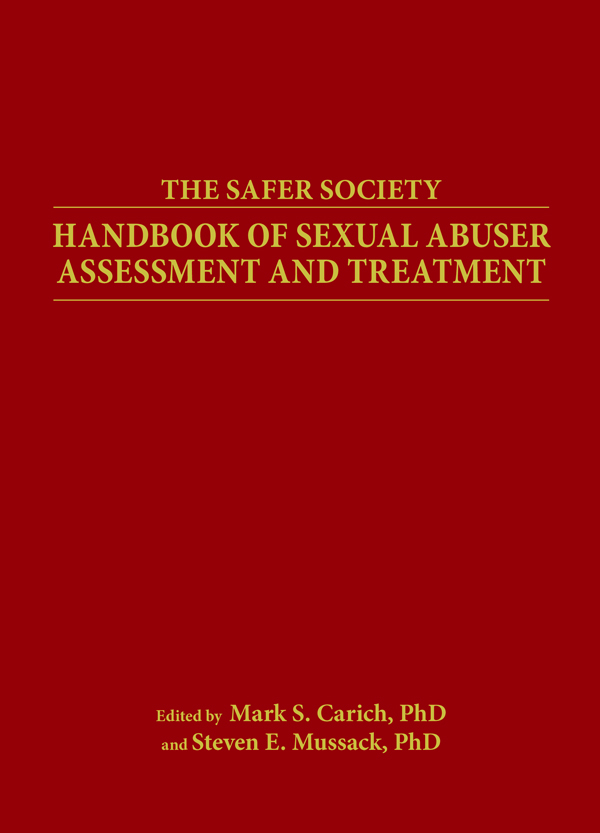
Safer Society Handbook of Sexual Abuser Assessment and Treatment
Bulk discount as low as $35.00Successfully Added to your Shopping CartAdding to Cart... -
EARN CEUs
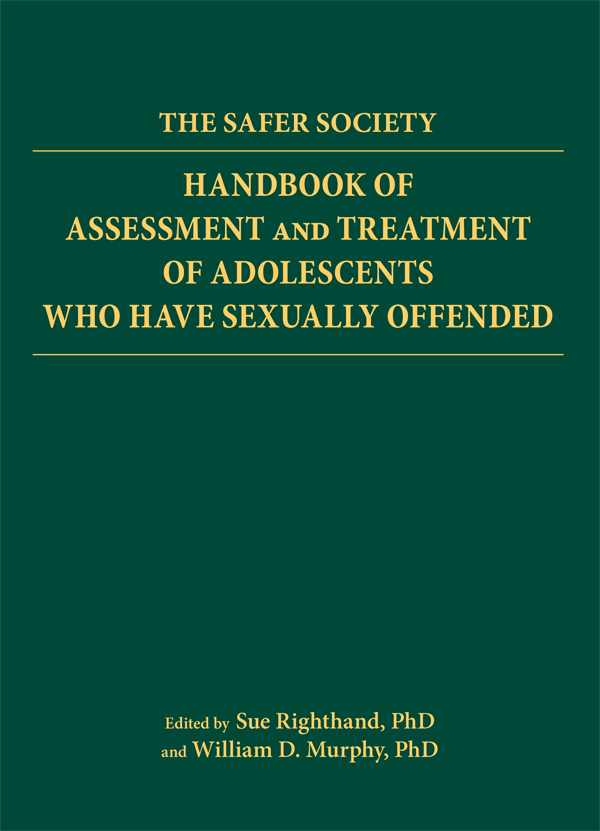
Safer Society Handbook of Assessment and Treatment of Adolescents Who Have Sexually Offended
Bulk discount as low as $35.00Successfully Added to your Shopping CartAdding to Cart... -
Gendered Treatment Assessment - A Protocol for Women Who Have Sexually Offended
Bulk discount as low as $35.00Successfully Added to your Shopping CartAdding to Cart...