

Navigating the Darker Elements of the Manosphere: Helping Young Men to Be “Good Dudes”
Dr. Alex Rodrigues developed this training to help professionals understand the manosphere and support clients exposed to its damaging narratives. Through an overview of key figures, historical context, and underlying psychological drivers, Dr. Rodrigues explores why young men are drawn to these online spaces and how these beliefs take hold. The training concludes with evidence-based strategies for fostering healthier conceptions of masculinity, centered on accountability, empathy, emotional expression, and respect across all genders.
Building Healthier Workplace Cultures Through Empathic Leadership
Empathic workplace leadership is fundamental to effective treatment and supervision, especially when the work can cause trauma in the professionals doing that work. When staff work in high-pressure environments, a leadership approach grounded in empathy can inspire professionals to be their best. However, the results of a recent Safer Society survey on workplace stressors and motivators highlight a critical issue: professionals working to prevent abuse often view management as a greater source of stress than of support.
Presenters Anette Birgersson and Christin Santiago—professionals with extensive experience in all aspects of leadership—developed this training to address this challenge directly. Their work underscores that empathic, trauma-informed leadership is essential not only for supporting professionals but also for enhancing staff retention, building trust and resilience throughout an organization, and delivering consistent, effective services to clients.


Working with Adult Men Involved in Domestic Sex Trafficking: Practical Guidance for Assessment, Treatment, and Management
Katie Gotch developed this training to provide an overview of human trafficking and the elements of trafficking, a comprehensive overview of the current research, and practical knowledge about adult men convicted of sex trafficking crimes in the United States, and to provide guidance and strategies for assessing, treating, and managing of adult men involved in domestic sex trafficking.
Ms. Gotch also reviews relevant topics such as the cultural/historical context of sex trafficking, psychopathy, and emphasizes trauma-informed approaches in assessment, treatment, and supervision.

The Art of Group Therapy in Practice: A Conversation with Steven Sawyer
Professionals who help individuals address harmful behaviors—including sexual offending, domestic violence, substance abuse, and other addictive behaviors—commonly use group therapy in their work. This approach offers many benefits: group members learn from others with similar experiences, gain understanding from peers who can relate to their challenges, and develop accountability for their actions and lives. When the focus of group therapy centers on the group itself, rather than a facilitator who teaches lessons and imparts information, members are better able to find their own motivation for meaningful change.
Over the course of 40 years, Steven Sawyer has advanced group therapy practices for people who have engaged in harmful behaviors, and is best known for his work in the prevention of sexual offending. His career has included international training and consultation, as well as authoring and co-authoring three of the field’s principal books on group therapy. This long and influential career ultimately culminated in his latest work, Mastering the Art of Group Therapy: A Guide for Facilitators.
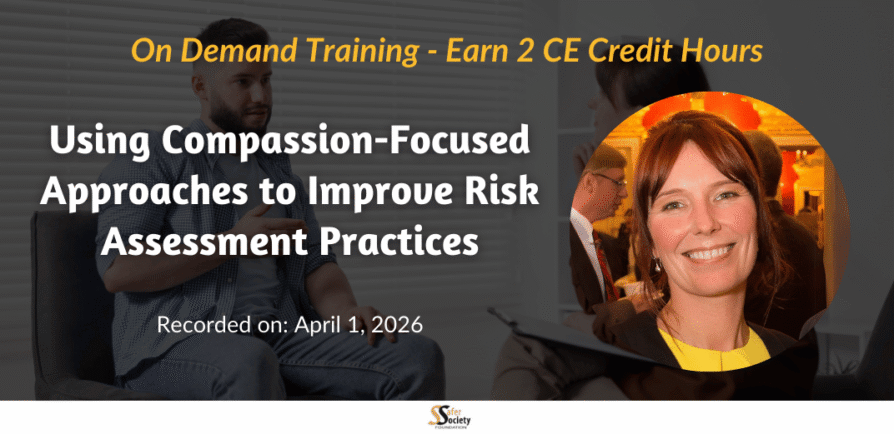
Using Compassion-Focused Approaches to Improve Risk Assessment Practices
Dr. Hocken, one of the world’s top authorities in Forensic CFT, developed this training out of concern that current assessment practices often fail to adequately integrate risk, need, and protective factors in ways that promote meaningful change and address the root contributors to risk.
The training begins by outlining the theoretical foundations of CFT and its conceptualization of human harmfulness. It then takes a look at how compassion-focused approaches enhance risk assessment by shaping the orientation of the practitioner, and by providing a trauma-informed perspective on criminogenic need.
The training culminates in a practical model for putting all these concepts to the purpose of applying them to compassion-informed risk formulation and integrating it with Structured Professional Judgment (SPJ) tools.