“Safer Society is grateful for the donations from Bar Harbor Bank & Trust employees,” said Sarah Snow Haskell, Director of Operations at Safer Society. “The generosity of those in our community, whether big or small, inspires our team to continue our mission of creating a safer society free of sexual and social violence. The support received will help fund our resources for building hope and resilience in youths in Vermont and around the globe.”
How to Approach Colleagues with Ethical Concerns
The speakers provide valuable insights gained from years of experience in helping professionals address ethical dilemmas. The speakers share practical strategies for approaching and resolving conflicts in line with ethical codes, and learn how to effectively navigate complex ethical challenges in your professional journey.
Happy Thanksgiving From Safer Society
With the passing of another year, we once more enter the season of festivities that begin, here in the United States, with Thanksgiving Day. No …
Overcoming Imposter Syndrome
Dr. Stoddard, the author of Imposter No More: Overcome Self-Doubt and Imposterism to Cultivate a Successful Career, shares her insights into the imposter experience and offers practical strategies for overcoming self-doubt and imposterism. The webinar provides a platform for understanding imposterism differently, such as the observation that whatever one worries they’re not good at is what they actually care about.
Getting Our Language and Messaging Right
Talking with the public, policymakers, the media, and even our colleagues is rarely easy; poorly chosen words at the wrong time can derail our messages and credibility. In this webinar, Dr. Kelly Socia offers ideas for how we can use the right language to avoid landmines. He discusses strategies for addressing controversial and stigmatizing topics, aiming to ensure that the intended message is clearly understood.
Pornography, Social Media, and Teens: What Could Go Wrong? And What Can Be Done to Make it Go Less Wrong?
Social media is the method of communication preferred by adolescents and young adults, and many social media apps have become a primary means for viewing sexually explicit media. Rather than searching for content that matches their developing sexual interests, many adolescents simply scroll through whatever is on their feed, often finding sexually explicit material. This workshop will address the impact pornography and social media are having on teens.
Becoming Skillful with Motivational Interviewing (MI)
Motivational Interviewing has been found to improve treatment outcomes across many therapeutic needs, including substance use disorders and domestic violence. Yet, despite there being much discussion in the field about the importance of evidence-based practices such as MI, there is far less discussion about how people actually learn to use these practices. How do people find their own motivation to become more effective at motivational interviewing? What does it take to develop solid MI skills? Reading a book about MI is not nearly effective as attending a training, and better still is the opportunity to practice skills in a safe and engaging environment. This webinar is one such environment.
What Can We Learn from One of Our Field’s Founders?
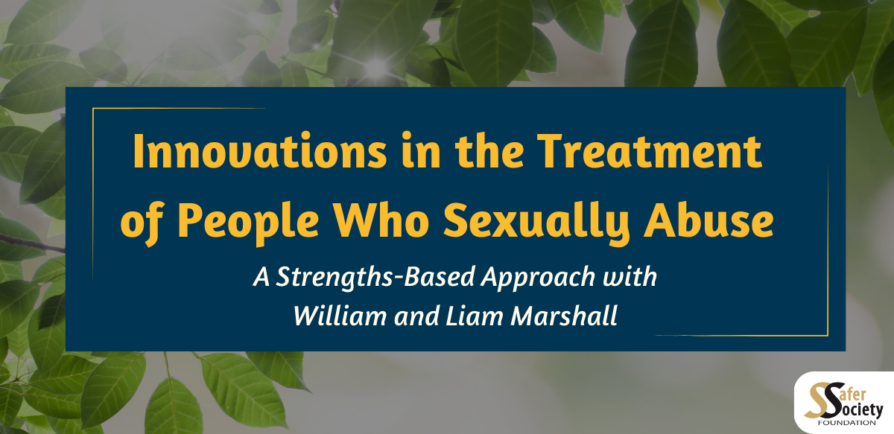
Bill’s work has shed light on understanding and assessing abuse-related sexual interests, how and why treatment can work, the characteristics of effective therapists, and the importance of strengths-based treatment approaches. Those who studied with Bill quickly found that he personified the values and principles of the most effective scientist-practitioners. In this webinar, David Prescott interviews Bill and Liam Marshall, Bill’s son and long-time colleague, about Bill’s life and career.
47 Years of Treating Sexual Abuse by Juveniles: Who Are These Kids and How Do We Help Them?
In this online training, veteran author and practitioner Timothy Kahn provides education on how best to understand and help children and adolescents who have sexually abused. Drawing on nearly five decades of experience in the field, he reviews what all professionals need to know and why, drawing upon key recent research studies. He will first focus on “risk points” within adolescent development that can lead to abusing as well as discuss issues such as sexting, pornography, and the eroticization of children. Along the way, he will also discuss the necessity of self-care skills, including a healthy sense of humor. The training then focuses on understanding the course of treatment and secrets of effective group therapy, with extensive discussion of establishing professional boundaries.
Self-Care When You Need It Most
Global and local issues, as well as the aftermath of the pandemic, have affected professionals and clients alike. Professionals are providing services to disenfranchised people and populations while enduring unprecedented stressors. The presenters have a long history of studying self-care at the front lines of challenging environments and helping professionals to develop their skills in caring for themselves.