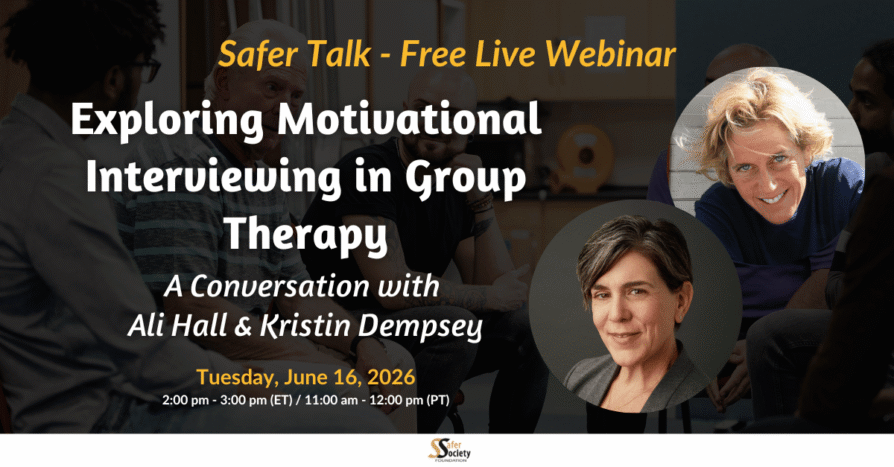
Exploring Motivational Interviewing in Group Therapy: A Conversation with Ali Hall & Kristin Dempsey

Group therapy plays a central role in the treatment of justice-involved clients and related programs. Similarly, Motivational Interviewing (MI) is a treatment of choice for numerous conditions and is widely used in forensic settings. However, relatively little has been written about the most effective ways to integrate MI into group therapy.

Building on their training on this topic, Ali Hall and Kristin Dempsey return for a conversational session introducing their work in this area. In this webinar, they explore how MI principles can enhance group therapy practice.

Helping Parents Recognize and Respond to Sexual Behavior in Children and Youth

Research has shown that a lack of accurate knowledge about child sexual development negatively affects a parent’s ability to both prevent and detect abuse. When parents don’t know what’s typical at a given developmental stage, they may either overreact to age-appropriate behavior (creating shame and confusion) or underreact to behavior that signals a real concern (missing opportunities for early intervention). The good news is that professionals can do something concrete to address it.

In the Safer Society training, Helping Caregivers Cope with Sibling Sexual Abuse, social worker Arliss Kurtz, MSW, RSW, RYT-500, draws on her clinical experience and current research to outline how professionals can help parents build the knowledge and confidence they need to respond to their children’s sexual behavior, whether it falls within the range of normal development or raises cause for concern.

Managing Unhealthy Sexual Arousal: A Sex-Positive Approach to Treatment

Dr. Jackson and Dr. Ballinger developed this training to support professionals in adopting sex-positive, non-judgmental approaches to help clients in managing unhealthy patterns of sexual arousal patterns. Many individuals who have sexually abused have had limited sex education and few opportunities to understand the role of sexuality in their lives. Against this backdrop, it is more constructive for clients to view healthy sexuality as a goal to pursue and achieve, rather than regarding sexual arousal as something to avoid for the rest of their lives.

Conducting Forensic Evaluation Interviews

Seasoned evaluators Amy Griffith, PhD, and Seth Wescott, LMLP, ASTA-F, developed this training to assist professionals in refining their skills and to offer insights on enhancing their practice. Conducting forensic interviews with adults presents unique challenges that differ from traditional clinical practice, and becoming familiar with them can be akin to learning a new language. Determining what information is relevant and the right process to obtain it can make the difference between an effective and ineffective assessment.

The Intersection of Brain Injury and Domestic Violence: Adapting Assessment and Treatment

Russha Knauer—Director of Colorado’s lead state agency on traumatic brain injuries, MINDSOURCE Brain Injury Network—developed this training to address a critical gap in understanding, assessing, and working with adults who perpetrate domestic violence and have TBIs. During this training, Knauer highlights how brain injuries are often misinterpreted or overlooked, as their symptoms may appear similar to those of mental health conditions, substance use disorders, and other criminogenic needs.

Russha Knauer, CDHS

Russha Knauer is the Director of the MINDSOURCE Brain Injury Network, the State of Colorado’s lead state agency on brain injury. Housed within the Colorado Department of Human Services, MINDSOURCE serves several functions with the overall aim of improving the care for people living with brain injuries. Russha came into this work after serving for over 20 years in various roles across the juvenile justice and criminal legal systems.

Non-Offending Relatives Coping After a Child Sexual Abuse Material Conviction

In this webinar, Dr. Kavanagh explores how these relatives experience intense shame, trauma, and stigma that permeate all areas of their lives. Her research offers practical recommendations for improving support systems for affected families—helping them to cope, rebuild their lives, and potentially play a role in the desistance of the person who offended from future CSAM use. This work also contributes to a deeper understanding of secondary trauma among relatives of individuals who commit sexual crimes.

Returning to the Heart of the Work: Sustaining Your Motivational Interviewing Spirit and Values

The spirit of Motivational Interviewing (MI) refers to the relational stance or way of being with clients when helping them to find their own reasons to grow and make changes to their lives. 
Not just the practitioner’s mindset, the spirit is often said to involve a “heart set.” It involves approaching each client in the spirit of partnership, acceptance as a fellow human being, compassion, and empowerment. These qualities are at the center of best practices; yet as many professionals know, maintaining this spirit can be difficult.

If you’ve ever felt like your MI spirit was running on empty, you’re not alone. Even the most experienced practitioners hit those days when partnership feels impossible, acceptance seems out of reach, and compassion for others gets buried under their own struggles. As this training illustrates, the MI spirit isn’t a destination we arrive at once and then we’re home free. It’s a road you travel despite the potholes along the way..

Sarah Cameron and Annabys Jordan created this training to offer something many practitioners desperately need: a judgment-free way to reflect on their work and monitor their professional growth.
Introduction to CE-CERT: Skills for Reducing Burnout and Secondary Traumatic Stress

Ms. Lauren Garder is very familiar with the stressors inherent in abuse-prevention work. Drawing on her experience in domestic violence and fatality review, she offers this introduction to CE-CERT out of a continuing commitment to supporting the wellbeing of professionals in this field.

CE-CERT (Components for Enhancing Career Experience and Reducing Trauma) was originally developed by Brian C. Miller, PhD. It provides a framework of concrete skills and practices designed to reduce job-related stress and enhance the satisfaction of helping work. The goal of CE-CERT is not merely to survive one’s vocation, but to find it deeply rewarding and sustainable.