
If you work with families, you’ve heard the question. A parent pulls you aside after a session, or calls between appointments, unsure how to say what they need to say: their child has been doing something sexual, and they don’t know whether it’s normal. The worry in their voice is unmistakable. So is the discomfort.
These moments put professionals in a position to make a real difference by providing parents with tools and language that will help them sort through and address the behavior they’re seeing.
Research has shown that a lack of accurate knowledge about child sexual development negatively affects a parent’s ability to both prevent and detect abuse. When parents don’t know what’s typical at a given developmental stage, they may either overreact to age-appropriate behavior (creating shame and confusion) or underreact to behavior that signals a real concern (missing opportunities for early intervention). The good news is that professionals can do something concrete to address it.
In the Safer Society training, Helping Caregivers Cope with Sibling Sexual Abuse, social worker Arliss Kurtz, MSW, RSW, RYT-500, draws on her clinical experience and current research to outline how professionals can help parents build the knowledge and confidence they need to respond to their children’s sexual behavior, whether it falls within the range of normal development or raises cause for concern.
The Traffic Light Framework: A Practical Tool for Parents and Professionals
Among the many useful resources Kurtz shares in the training is the traffic light framework for categorizing children’s sexual behavior. Originating from the work of Toni Cavanagh Johnson and widely adopted in the field, this system uses a simple green/yellow/red structure to help parents and professionals assess whether a child’s behavior is age-appropriate, concerning, or harmful.
Green (age-appropriate). These behaviors are driven by curiosity, spontaneity, and exploration. A young child touching their own genitals, asking questions about body parts, or showing interest in the physical differences between boys and girls would typically fall into this category. Children can be easily redirected from these behaviors, and the behaviors tend to be intermittent rather than persistent. As the ATSA Task Force on Children with Sexual Behavior Problems notes, healthy childhood sexual play and exploration are spontaneous, mutual, non-coercive, do not cause emotional harm, and do not involve advanced sexual behaviors.
What counts as normative varies by developmental stage and cultural context. What is healthy behavior for a preschooler may be atypical for an older child, and what may be tolerated in one culture may be discouraged in another. William Friedrich reminds us in Psychological Assessment of Sexually Abused Children and Their Families that harmful and intrusive sexual behavior, however, is not normative in any culture.
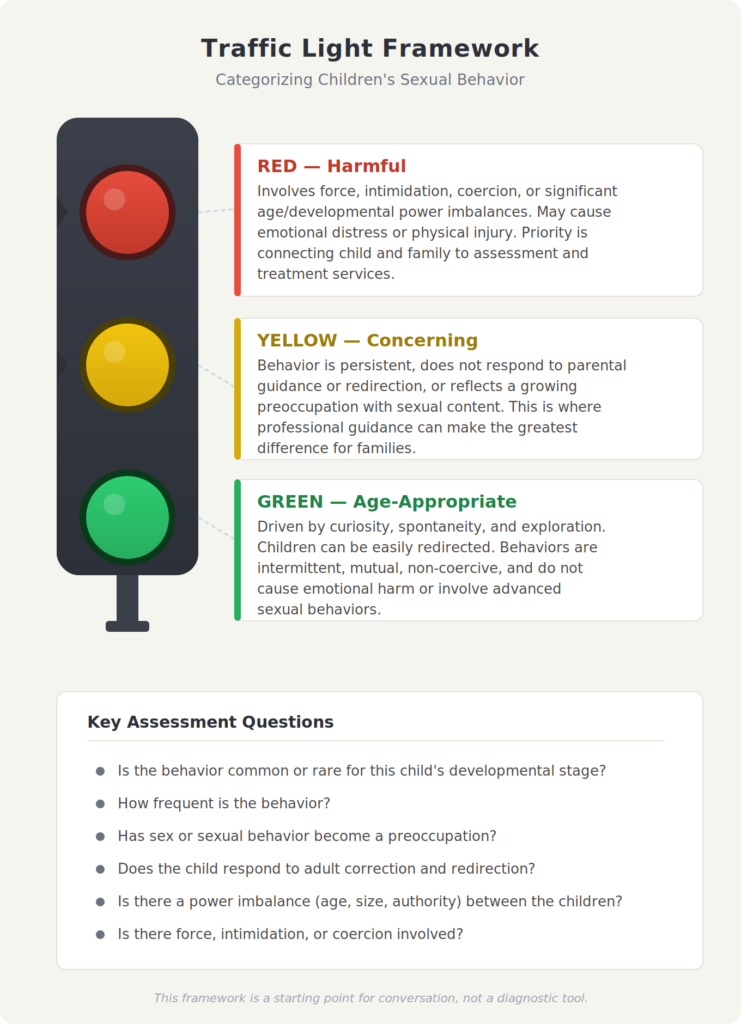
Yellow (concerning). When sexual behavior becomes persistent, doesn’t respond to parental guidance or redirection, or reflects a growing preoccupation with sexual content, it moves into the yellow zone. Here are several questions professionals can use when evaluating concerning behavior:
- Is the behavior common or rare for this child’s developmental stage?
- How frequent is it?
- Has sex or sexual behavior become a preoccupation?
- Does the child respond to adult correction, or does the behavior continue despite intervention?
The yellow zone is where parents often feel the most uncertain. It is also where professional guidance can make the greatest difference, helping parents distinguish between behaviors that require watchful attention and those that call for clinical assessment.
Red (harmful). Behaviors in the red zone involve force, intimidation, coercion, or significant age and developmental power imbalances. These behaviors may cause emotional distress or physical injury and can interfere with the social development of the children involved. Depending on the child’s age and jurisdiction, some of these behaviors may constitute criminal offenses. When professionals or parents identify red-zone behaviors, the priority is connecting the child and family to appropriate assessment and treatment services.
Stop It Now, a nonprofit organization committed to preventing child sexual abuse, developed a tip sheet called “Signs That a Child or Teen May Be At-Risk to Harm Another Child” that can help adults recognize these red-zone warning signs. These include behaviors that suggest confusion about social rules (e.g., “Takes younger children to ‘secret’ places or hideaways”), indicators that signal the child themselves may be anxious or distressed (e.g., “Becomes anxious about being with a particular young person”), and behaviors that suggest impulsive or aggressive sexuality (e.g., “Shares alcohol, drugs, or sexual material with younger children or teens”). Resources such as this help both parents and professionals better understand what “red light” behaviors may look like and when to seek expert support.
The traffic light system is not a diagnostic tool. It is a starting point for conversation, one that gives parents a shared language for talking with professionals about what they are observing. When parents understand the general categories, they are better equipped to notice concerning patterns early and seek help before behaviors escalate.
How Professionals Can Help Parents Respond
Professionals can help parents in starting conversations with their children about bodies, boundaries, and consent. Building a foundation of open communication about sexual health begins from an early age, starting with teaching children accurate names for all body parts. As Kurtz puts it, “We don’t want kids to be labeling them fruit names. We don’t want a penis to be called a banana.” Using correct anatomical terms both reduces shame and supports a child’s ability to disclose abuse using language that adults can understand.
Kurtz also notes that when children grow up hearing that certain body parts are unspeakable, the message they receive is that those parts of their bodies are dirty or shameful. If a child grew up in a household where saying “penis” or “vagina” was frowned upon, “you kind of get the message that’s dirty, or I shouldn’t be talking about that.” Replacing shame with accurate language is one of the simplest and most powerful things professionals can encourage parents to do.
Education about consent can begin in early childhood through everyday interactions: asking permission before a hug, offering choices, and teaching children that they have the right to say no to unwanted touch. During a Safer Society webinar, Feather Berkower, LCSW discusses a concept called “Boss of Body” that captures this approach well. It teaches children that they are in control of who touches them, especially their genitals. As Berkower explains:
“Boss of Body is as applicable for a 4-year-old as it is for a 14-year-old. We need to teach Boss of Body to that 4-year-old because then as a 14-year-old they start dating, hormones are raging, and they’re getting into situations where they’re experimenting sexually. And if they’ve been raised with this concept that ‘I have self-worth,’ This is my body,’ it just makes it a little more possible maybe for them to say, ‘You know what, no, I’m not ready. I don’t want to do this just because you want me to.’”
Address the emotional reality for caregivers. Many parents carry their own discomfort, shame, or unresolved experiences around sexuality. These histories shape how they respond when their child’s sexual behavior surfaces. A parent who grew up in a household where certain body parts were never named may struggle to have direct conversations with their own child. Also, a child’s behavior can sometimes trigger unresolved trauma in a parent who has themselves experienced sexual abuse.
Kurtz suggests that professionals use self-reflection questions to help parents explore these patterns:
- What language was used in your family growing up to describe sexual acts and body parts?
- What were your experiences of affection growing up?
- What messages did you receive about masturbation?
- Were there trusted adults you could turn to with questions about sex?
- How comfortable are you discussing sexual topics with your child?
These questions are not just for parents. As Kurtz points out in the training, if the professional is uncomfortable with frank discussions about sexual behavior, the parent will be too. She notes that getting comfortable with these conversations is part of effective practice, especially for professionals who are newer to working with young people who have engaged in harmful sexual behavior:
“If you’re not comfortable with it, they’re not going to be comfortable with it. And we want to be able to talk about the tough stuff.” – Arliss Kurtz
Among the most persistent sources of stress Kurtz observes in her work with families is a fear about the future. Parents worry that a child who has engaged in harmful sexual behavior is destined to become an adult who sexually harms others. This fear can be paralyzing and can distort the parent’s relationship with the child. Responding to that fear directly is essential—and it’s where professionals can make a real difference.
When parents understand that outcomes for these children are shaped by early, consistent support rather than by the behavior itself, something shifts. The shame lifts a little. The child becomes a child again rather than a forecast. Helping parents get to that place through honest conversation, good information, and steady support is some of the most important work in this field.
Resources for Professionals and Families
Professionals looking to strengthen their work with families can explore the following resources through Safer Society’s Continuing Education Center and Safer Society Press:
- Helping Caregivers Cope with Sibling Sexual Abuse: This on-demand training by Arliss Kurtz explores the stressors caregivers face when parenting both the youth who engaged in harmful sexual behavior and the child who was harmed, with practical guidance for clinicians on involving caregivers in the treatment process.
- Building Prevention Teams to Prevent Child Sexual Abuse: Feather Berkower’s webinar equips adults with the knowledge to recognize warning signs and create protective environments for children, emphasizing community responsibility in abuse prevention.
- What’s OK: A New Resource for Preventing Sexual Harm by Young People: Jenny Coleman’s webinar introduces the What’s OK app from StopItNow!, a resource designed to help caregivers and professionals address sexual behavior concerns in children and youth.
- Stop It Now’s tip sheet, Signs That a Child or Teen May Be At-Risk to Harm Another Child, offers a concise, practical overview of behavioral warning signs organized into three categories: confusion about social rules, signs that a child may be struggling emotionally, and impulsive or aggressive sexual behavior. It is a good resource to share with parents who want a concrete reference point for what red-zone behavior can look like in everyday situations.
- Best Practices in Treatment Planning for Adolescents Who Have Sexually Abused: This training with Katie Gotch, Seth Wescott, and David Prescott provides strategies for developing effective, individualized treatment plans for adolescents, with an emphasis on family involvement and developmental considerations.
- Taking Action Booklet Series: These publications from Safer Society Press offer specific help for families and caregivers dealing with problematic sexual behaviors in children and youth, bridging the gap between professional knowledge and practical application at home.
- Off Limits Sandy K. Wurtele, Ph.D. & Feather Berkower, LCSW: A practical guide for parents and caregivers on setting and maintaining healthy boundaries with children, grounded in research-based approaches to prevention.