Home / Shop / PDF Downloads / PDFs for Adult Clients
Working with Men with Intellectual Disabilities (PDF Download)
$8.00
A one-time price of $8.00 will be added to your order.
Categories: Handbook PDFs, Professional Books
Manufacturer: Safer Society Press


- Description
- Specifications
CHAPTER 13 - Working with Men with Intellectual Disabilities
by Gerry D. Blasingame
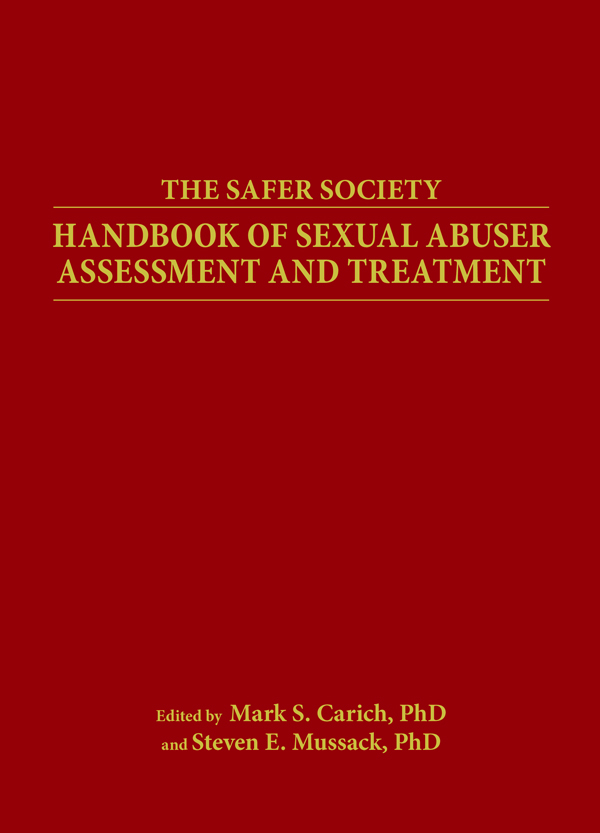
This is a PDF version of Chapter 13 of The Safer Society Handbook of Sexual Abuser Assessment and Treatment.
People with low cognitive functioning are overrepresented in the criminal justice system. About 2 percent of the US population has mild intellectual disabilities, yet research places individuals with intellectual disabilities at 4 to 10 percent of prison populations. Chapter 13 reviews evidence-based assessment and treatment strategies for working with men with intellectual disabilities who have offended sexually, with practical guidance for adapting clinical work to how these clients actually learn.
Looking Past the Full-Scale IQ
 Author Gerry D. Blasingame cautions that a single full-scale IQ score can hide more than it reveals. The chapter walks through the four indices of the WAIS-IV (verbal comprehension, working memory, perceptual organization, and processing speed) and the specific impairments associated with low scores on each. When index scores differ significantly from one another, the full-scale score no longer represents the person’s overall abilities, and clinicians should focus on the separate indices to identify the individual’s unique strengths and needs.
Clinical Adaptations That Work
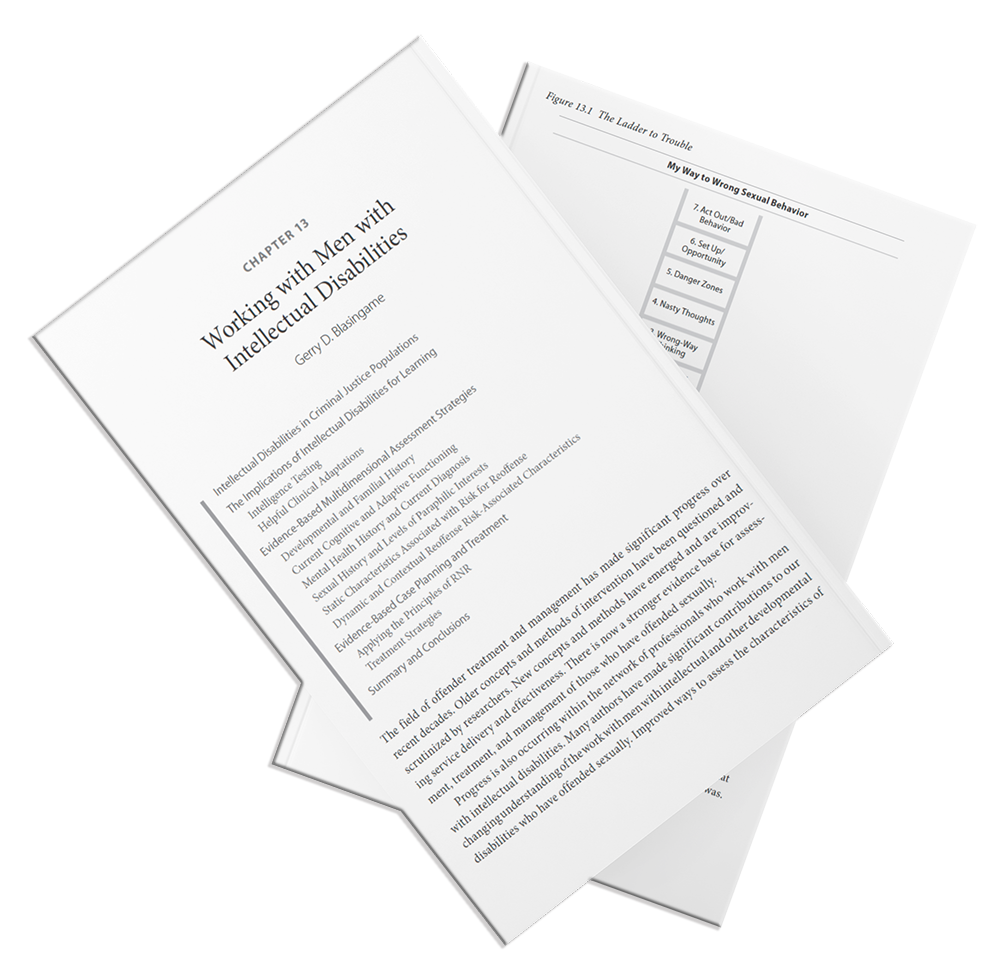
Limited vocabulary, concrete thinking, impaired executive functioning, social immaturity, and emotional dysregulation each call for specific adjustments. The chapter offers practical adaptations: matching written materials to a fifth- or sixth-grade reading level, asking clients to rephrase concepts in their own words, reducing distractions while new information is being learned, and using role plays and visual prompts. Two concrete treatment schemas are described in detail. In the Old Me–New Me model, the New Me learns the skills needed to manage the ever-present Old Me. The Ladder to Trouble presents a seven-step, linear version of the offense chain that clients memorize and then personalize with their own thoughts, feelings, and situations.
Classifying Risk for Reoffense
For static risk, the chapter compares the RRASOR and the Static-99R, including modified coding rules that allow informal records to document offense behaviors when formal charges were never filed. Current findings support the Static-99R as the preferred actuarial tool when sufficient documentation exists. For dynamic and contextual risk, two tools are described: the TIPS-ID, an expert rating form sensitive to changes within a six-month period, and the ARMIDILO-S, which is unusual in scoring contextual characteristics outside the individual’s control, such as staff turnover, consistency, and degree of monitoring. Recent research suggests the ARMIDILO-S outperforms the Static-99 in classifying sexual reoffense risk.
Applying Risk, Need, and Responsivity
Case planning is organized around the risk, need, and responsivity (RNR) principles, integrated with self-determination and positive behavioral support. The chapter notes that some criminogenic needs operate differently in this population: a history of sexual abuse (but not physical abuse) differentiates men with intellectual disabilities who offended sexually from those who offended violently, and supervised residential placements can themselves expose clients to destabilizing peers. Responsivity extends to staff members, whose training, attitudes, and relationship styles directly affect outcomes. The most effective staff model prosocial skills, use effective reinforcement, and are warm, genuine, respectful, and committed to helping the client.
Treatment That Matches How Clients Learn
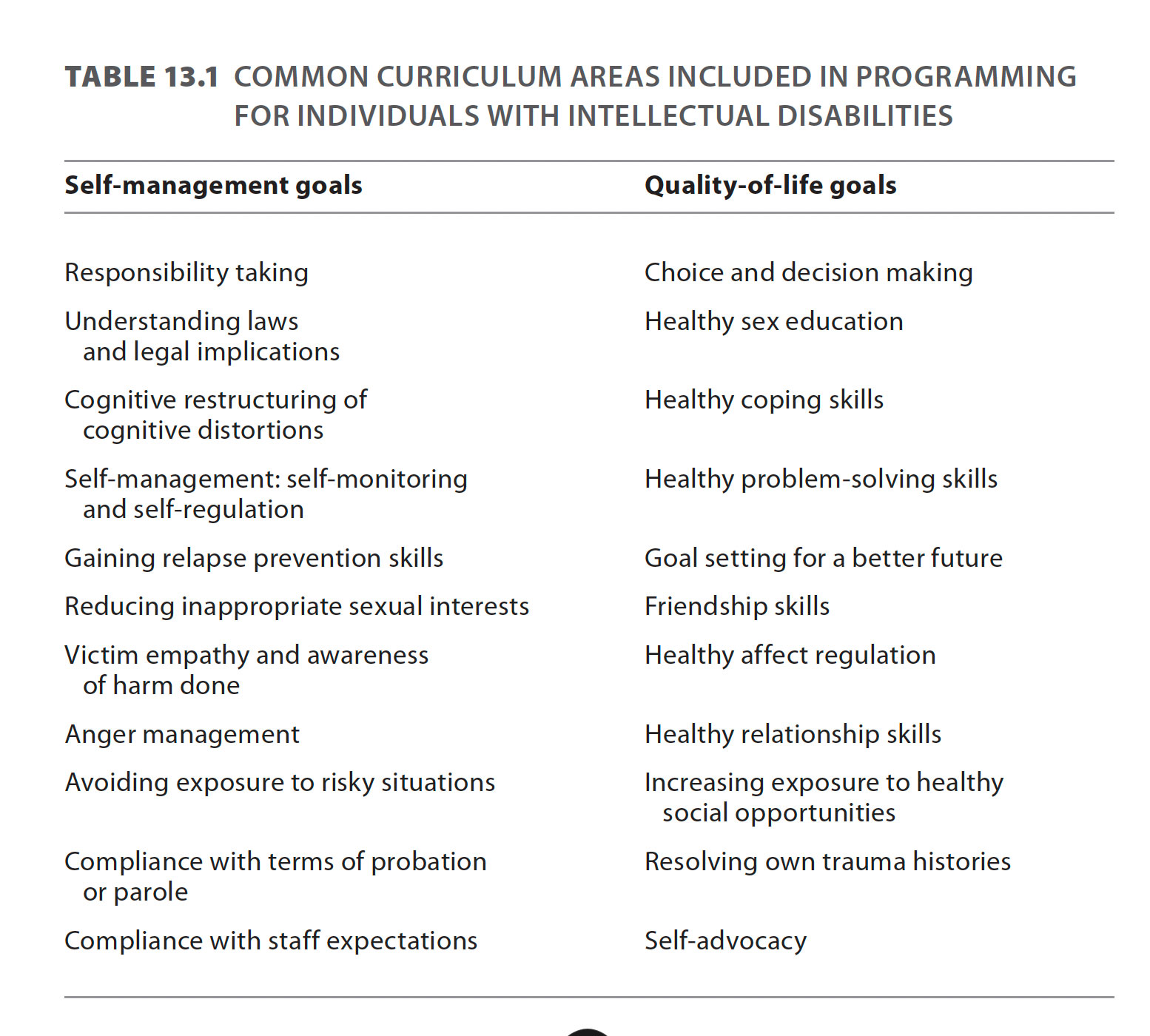 Cognitive-behavioral therapy remains the most appropriate approach, addressing both cognitive deficits and cognitive distortions. The chapter applies memory research to treatment: explicit teaching paired with role plays, pictures, repetition, and the client’s own words promotes the deeper processing that turns session content into lasting behavior change. Linked self-management tools (danger zones, “Leave It!”, and the pre-scripted Smart Plan) extend learning beyond the office when direct care staff and family members learn the same vocabulary. Individual counseling, group therapy, and group psychoeducation each have a place, and interventions are delivered within a multidisciplinary risk management circle adapted from the containment model.
Two Goals Throughout
The primary goals of therapeutic intervention with these clients are twofold: no more victims, and a better quality of life for the individual. For clinicians, case managers, and program staff who serve men with intellectual disabilities, this chapter translates a growing research base into specific, usable adjustments to everyday practice.
The author covers the following topics:
- Intellectual Disabilities in Criminal Justice Populations
- The Implications of Intellectual Disabilities for Learning
- Intelligence Testing
- Helpful Clinical Adaptations
- The Implications of Intellectual Disabilities for Learning
- Evidence-Based Multidimensional Assessment Strategies
- Developmental and Familial History
- Current Cognitive and Adaptive Functioning
- Mental Health History and Current Diagnosis
- Sexual History and Levels of Paraphilic Interests
- Static Characteristics Associated with Risk for Reoffense
- Dynamic and Contextual Reoffense Risk-Associated Characteristics
- Evidence-Based Multidimensional Assessment Strategies
- Evidence-Based Case Planning and Treatment
- Applying the Principles of RNR
- Treatment Strategies
- Evidence-Based Case Planning and Treatment
- Summary and Conclusions
After purchasing this product, you will have three days to download it. After that, you will need to contact Safer Society Press to receive your copy.
32 pages, plus bonus material
PDF Format
Order#: WP162-13
Related Publications
-
Earn CEUs
Safer Society Handbook of Sexual Abuser Assessment and Treatment
Bulk discount as low as $35.00Successfully Added to your Shopping CartAdding to Cart... -
Footprints - 2nd Edition
Bulk discount as low as $24.50Successfully Added to your Shopping CartAdding to Cart...