Home / Shop / PDF Downloads / PDFs for Adult Clients
Trauma-Informed Care with Sexual Offenders (PDF Download)
$8.00
A one-time price of $8.00 will be added to your order.
Categories: Handbook PDFs, Professional Books
Manufacturer: Safer Society Press


- Description
- Specifications
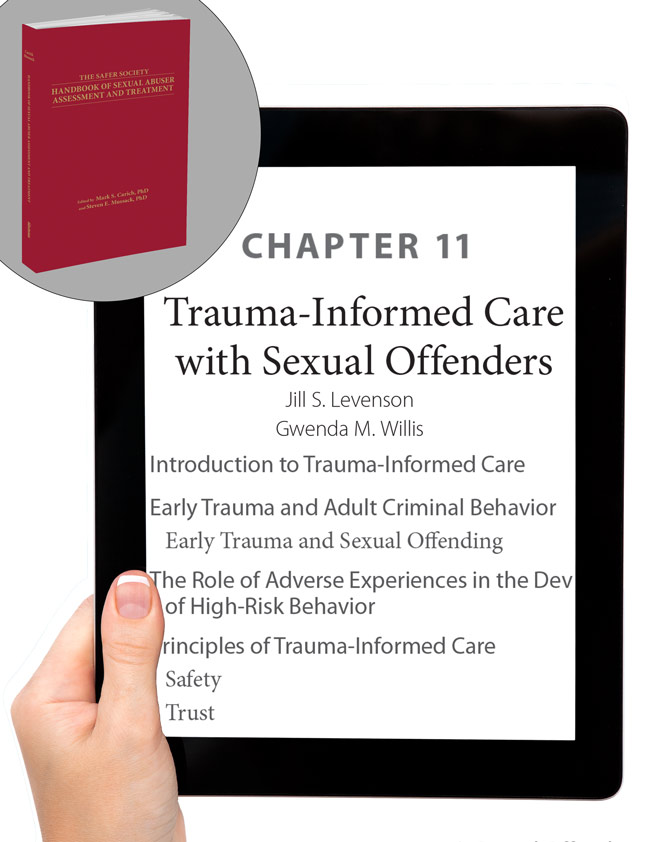
CHAPTER 11 - Trauma-Informed Care with Sexual Offenders
by Jill S. Levenson & Gwenda M. Willis
This is a PDF version of Chapter 11 of The Safer Society Handbook of Sexual Abuser Assessment and Treatment.
Many people who have committed sexual offenses arrive in treatment carrying histories of childhood trauma. For clinicians, understanding how early adversity shapes behavior, and how it can interfere with a client’s ability to learn and apply new skills, is central to effective intervention. Chapter 11 introduces trauma-informed care (TIC) as a framework for delivering interventions for individuals with sexual offending behavior within a larger model of cognitive-behavioral therapy, helping clients recognize the patterns that began as survival strategies and replace them with healthier, non-victimizing ways of meeting their needs.
What Trauma-Informed Care Is
 Trauma is defined as an experienced or witnessed event that threatens a person’s physical or psychological integrity, to which the response may be fear, helplessness, or horror. TIC is a model of service delivery that incorporates evidence about the prevalence and impact of early trauma on behavior across the lifespan. It occurs in a safe, client-centered environment where providers view and respond to maladaptive behavior in the context of traumatic experiences, using practices that are compassionate, promote respect, and encourage self-determination.
The chapter draws a clear distinction between TIC and trauma resolution therapy. Trauma resolution helps clients discuss painful memories and reduce the anxiety they cause. TIC, by contrast, is not content-oriented: it creates a treatment setting built on safety, trust, choice, collaboration, and empowerment, emphasizing strengths over pathology and skill building over symptom reduction. Above all, TIC ensures that the dynamics of abusive relationships are not unwittingly replicated in the helping relationship.
The Link Between Early Trauma and Later Behavior
Chapter 11 reviews research showing that criminal populations, including individuals who have committed sexual offenses, are more likely to have histories of early trauma than samples drawn from the general population. The chapter presents data from the Centers for Disease Control’s Adverse Childhood Experiences (ACE) study of 17,337 adults, which documented a high prevalence of abuse, neglect, and household dysfunction, and notes that adverse experiences tend to co-occur: one adverse event significantly raises the odds of others.
The authors trace how cumulative childhood adversity can lead to social, emotional, and cognitive impairment and the adoption of health-risk behaviors as coping strategies. Many high-risk behaviors are understood not as “crazy” or “antisocial” but as maladaptive attempts to relieve distress or protect against perceived threats. When sex is used to meet emotional needs, the chapter describes this as sexualized coping. Importantly, the authors stress that individuals vary in their responses to trauma and some show marked resilience, so practitioners should assess for early trauma and understand its impact through individualized case conceptualization.
The Five Core Principles
Chapter 11 organizes trauma-informed care around five interwoven principles that are applied throughout intake, assessment, and treatment:
- Safety: Both physical surroundings and relationships should feel secure. Safe relationships are consistent, predictable, and non-shaming.
- Trust: Earned over time by reducing ambiguity so clients know what to expect, and by not pressuring early disclosure before they are ready.
- Choice: Maximizing clients’ control over the pace and course of their own recovery, helping transform them from overwhelmed victims into people who direct their own decisions.
- Collaboration: A genuine partnership in which treatment goals are agreed upon together, with constant attention to the power imbalance inherent in the therapeutic relationship.
- Empowerment: A strengths-based stance that reframes symptoms as adaptation. Rather than asking “What’s wrong with you?” the clinician learns to ask “What happened to you?”
Applying TIC in Sexual Abuser Treatment
The chapter argues that people who have perpetrated interpersonal violence are among those most in need of trauma-informed services. Programs have historically relied on confrontational strategies, yet such approaches can re-create traumatic experiences in the clinical setting and reinforce the very coping patterns treatment seeks to change. For some clients, a therapy session may be one of the first times they have encountered healthy boundaries and respectful interaction, creating an opportunity for a corrective emotional experience.
Motivational interviewing, which combines cognitive-behavioral techniques with a humanistic, client-centered approach, is presented as well suited to resistant populations. The authors also address “negative process”: the anger, judgment, or withdrawal therapists may feel toward resistant clients, which can quietly drive treatment failure. Because most clients enter non-voluntarily and with denial, sexual abuser therapists are encouraged to examine how their own beliefs and reactions affect their engagement skills.
Caring for the Clinician
A closing section addresses the therapist’s own wellbeing. Because early adverse experiences are common in the general population, many clinicians carry their own histories, and repeated exposure to clients’ trauma can produce vicarious trauma, also called secondary trauma or compassion fatigue. The authors describe predictable phases therapists may move through and identify protective strategies, including positive self-care, supervision and consultation, organizational support, and continuing education, all undertaken in a nonjudgmental atmosphere that allows open processing of these reactions.
A Framework That Complements Existing Models
Trauma-informed care is not a replacement for established practice. The authors show how it can be integrated into relapse prevention, cognitive-behavioral therapy, the Good Lives Model, and risk-need-responsivity models, delivering services in a way that recognizes the prevalence and impact of early trauma without sacrificing a focus on risk reduction and criminogenic needs. When clinicians respond to traumatized clients with compassion, validation, and respect, corrective emotional experiences allow new skills to be learned and reinforced. For anyone treating this population, Chapter 11 offers a practical, humane framework for building the kind of therapeutic relationship that research consistently links to better outcomes.
The author addresses the following topics:
- Introduction to Trauma-Informed Care
- Early Trauma and Adult Criminal Behavior
- Early Trauma and Sexual Offending
- Early Trauma and Adult Criminal Behavior
- The Role of Adverse Experiences in the Development of High-Risk Behavior
- Principles of Trauma-Informed Care
- Safety
- Trust
- Choice
- Collaboration
- Empowerment
- Principles of Trauma-Informed Care
- Incorporating TIC Principles with Sexual Offenders
- Implementing TIC Principles in Practice
- The Role of TIC in Promoting Emotional Regulation
- The Role of TIC in Promoting Client Change
- The Role of TIC in the Prevention of Recidivism
- Implementing TIC Principles in Practice
- Trauma and the Sexual Offender Therapist
- Summary and Conclusions
26 pages, plus bonus material
PDF Format
Order#: WP162-11
Related Publications
-
Earn CEUs
Safer Society Handbook of Sexual Abuser Assessment and Treatment
Bulk discount as low as $35.00Successfully Added to your Shopping CartAdding to Cart...