Home / Shop / PDF Downloads / PDFs for Adult Clients
The Role of Cognitive Factors (PDF Download)



- Description
- Specifications
The Role of Cognitive Factors in Sexual Offending
by William D. Murphy and I. Jacqueline Page
This is a PDF version of Chapter 7 of The Safer Society Handbook of Sexual Abuser Assessment and Treatment.
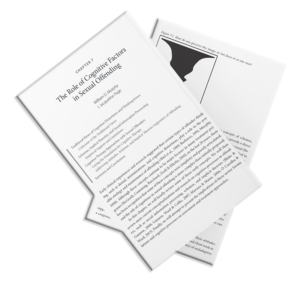 How clinicians understand the thinking of individuals who have committed sexual offenses has changed considerably over the past two decades. Earlier models centered on cognitive distortions, denial, and thinking errors, and these ideas shaped treatment programs for years. More recent research suggests that some of these concepts were simplistic and may have led programs to focus on the wrong cognitive processes. Chapter 7 traces the field's movement from surface-level self-statements toward deeper cognitive structures (schemas, implicit theories, and social information processing) and offers practical guidance for translating these ideas into treatment.
Reconsidering the Traditional View of Cognitive Distortions
The chapter traces the origins of the term cognitive distortions in this field, beginning with the work of Abel and colleagues, who described them as the justifications, perceptions, and judgments individuals use to rationalize their behavior. Murphy (1990) extended this work, framing cognitive distortions as self-statements that allow a person to deny, minimize, justify, and rationalize their behavior. Alongside these models, feminist theory contributed a focus on broader attitudes such as rape myth acceptance and hostility toward women, while Yochelson and Samenow's work on “thinking errors” shaped early treatment manuals.
Recent reviews have raised significant questions about these formulations. Self-report measures such as the Abel-Becker Cognition Scale and the MOLEST and RAPE Scales tend to separate individuals who have committed sexual offenses from those who have not, but the differences often reflect that respondents disagree less with the items rather than positively endorsing them. The term cognitive distortions has expanded so broadly that it now covers attitudes, belief systems, denial, post-offense minimizations, and excuses, making its meaning unclear.
Drawing on work by Maruna and Mann, Murphy and Page argue that some of what clinicians have labeled as distortions may simply reflect normal human responses. People generally try to explain behavior that conflicts with their values, and post-offense minimizations may signal guilt, shame, or attempts to maintain self-esteem rather than ongoing risk. Research on desistance suggests that those who can separate past behavior from their core self are more likely to stop offending, a finding with significant implications for how treatment frames responsibility.
Schemas, Implicit Theories, and Social Information Processing
A central contribution of this chapter is its discussion of cognitive structures that may underlie offending behavior. Schemas are the memory structures that guide attention, shape perception, and provide shortcuts for interpreting social situations. Implicit theories function similarly, acting like personal “scientific theories” people develop through life experience to explain and predict the actions of others.
The chapter summarizes research identifying possible implicit theories among individuals who have offended against children: children as sexual beings, entitlement, nature of harm, dangerous world, and uncontrollability. For those who have offended against adults, identified implicit theories include entitlement, dangerous world, women as dangerous, women as sex objects, and male sex drive as uncontrollable. Related schemas identified through qualitative analysis include grievance, self as victim, control, and disrespect for certain women.
Social information processing offers another way of understanding cognition in this population. Research with both community and clinical samples has shown that men who have engaged in sexually coercive behavior may have difficulty reading social cues from women, sometimes misinterpreting friendly behavior as sexual interest or interpreting hostile refusals as merely assertive. Hostile masculinity and adversarial sexual beliefs have consistently been linked to sexual violence in college and community samples.
What the Research Supports
The chapter is candid about the limits of current evidence. A meta-analysis by Helmus and colleagues (2013), based on 46 studies and 13,782 individuals, found a small but statistically significant relationship between offense-supportive attitudes and recidivism. Among the many measures examined, only three consistently predicted reoffending: the Abel-Becker Cognition Scale, the STABLE-2000 child molester attitudes scale, and item 18 of the SVR-20 (“attitudes that support, condone sexual offenses”). Attitudes were stronger predictors for individuals who had offended against children than for those who had offended against adults.
Murphy and Page note that while many programs spend substantial treatment time on cognitive distortions, offense responsibility, and denial, the empirical support for these as primary treatment targets is modest. Research on schemas, implicit theories, and indirect measurement techniques such as the Implicit Association Test is promising, but the methodology is still developing and direct evidence linking these deeper structures to reoffending remains limited.
Identifying and Modifying Attitudes and Schemas
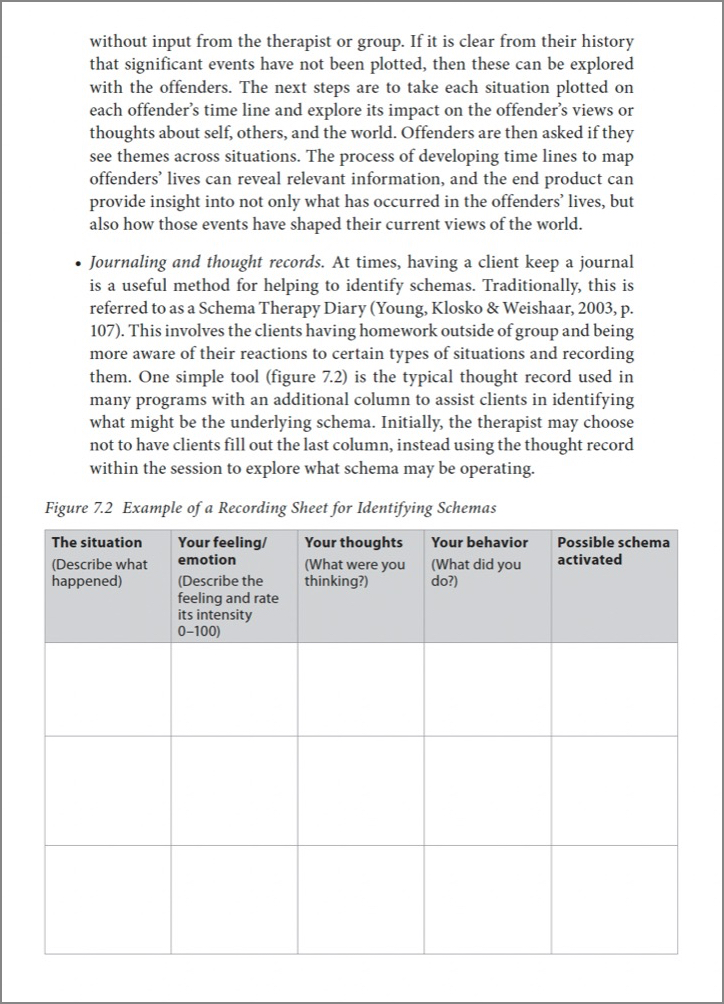 Once clients are ready, the chapter describes practical techniques for surfacing and working with cognitive content:
- Life maps that plot positive and negative life experiences along a timeline, helping clients recognize patterns that have shaped their views of self, others, and the world.
- Thought records that link situations, feelings, thoughts, behaviors, and possible underlying schemas, used both as in-session tools and as homework.
- Visual metaphors such as the iceberg image, which illustrates that surface self-statements rest on deeper cognitive structures, and the “rose-colored glasses” exercise developed by Shingler and Mann, which uses different colored lenses to demonstrate how schemas shape perception.
- Visual illusions that show how the same image can be perceived in different ways, opening a discussion about how people can see the world differently and how difficult it can be to shift one's perspective.
A Thoughtful Approach to a Complex Topic
Chapter 7 offers a careful synthesis of how thinking about cognition in this population has evolved. Murphy and Page present current conceptualizations honestly, including the limitations of the empirical base, while equipping treatment providers with concrete techniques drawn from cognitive therapy, schema therapy, and the Motivational Interviewing tradition. For clinicians who want to move beyond formulaic approaches to cognitive distortions and engage more meaningfully with the cognitive processes that may contribute to offending, this chapter provides both the theoretical context and the practical tools needed to do so.
In this PDF the author covers the following topics:
- Traditional Views of Cognitive Distortions and Thinking Errors
- Criticisms of the Traditional Views
- Traditional Views of Cognitive Distortions and Thinking Errors
- Schemas, Implicit Theories, and Social Information Processing
- Empirical Support and Limitations
- Schemas, Implicit Theories, and Social Information Processing
- Cognitive Therapy Approaches with Sexual Offenders
- Laying the Foundation for Cognitive Therapy
- Addressing Attitudes, Schemas, and Implicit Theories Supportive of Offending
- Cognitive Therapy Approaches with Sexual Offenders
- Summary and Conclusions
After purchasing this product, you will have three days to download it. After that, you will need to contact Safer Society Press to receive your copy.
Related Publications
-
Earn CEUs
Safer Society Handbook of Sexual Abuser Assessment and Treatment
Bulk discount as low as $35.00Successfully Added to your Shopping CartAdding to Cart...