Home / Shop / PDF Downloads / PDFs for Adult Clients
Self-Esteem, Empathy, and Relationship Skills Training (PDF Download)


- Description
- Specifications
Self-Esteem, Empathy, and Relationship Skills Training
by Liam E. Marshall & William L. Marshal
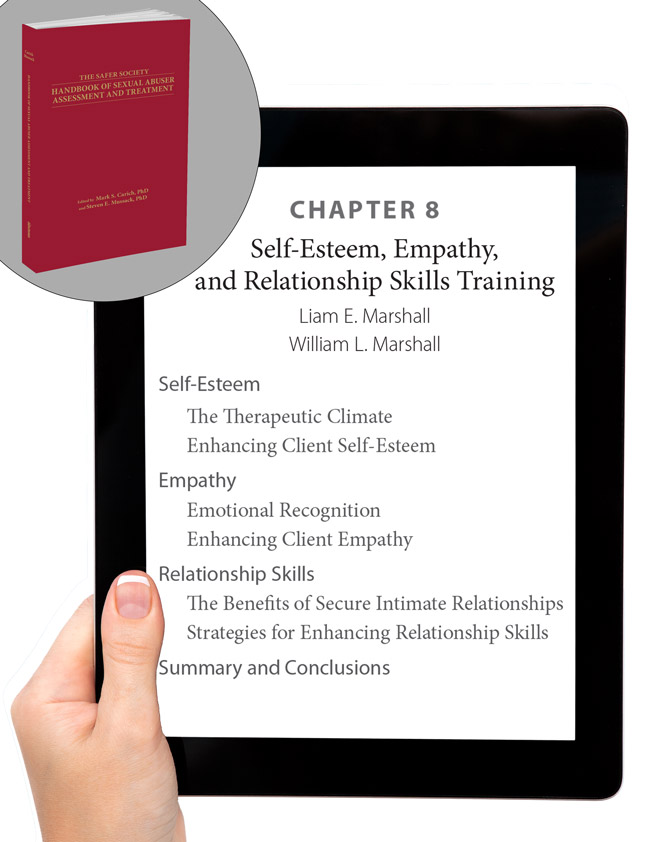
This is a PDF version of Chapter 8 of The Safer Society Handbook of Sexual Abuser Assessment and Treatment.
For professionals working with adults who have committed sexual offenses, the question of what to target in treatment matters as much as the techniques used. Chapter 8 addresses three interconnected areas (self-esteem, empathy, and relationship skills) and offers practical procedures drawn from decades of the authors' research and clinical work. The argument throughout is straightforward: while self-esteem and empathy deficits are not themselves direct predictors of sexual recidivism, they are the building blocks of the relationship capacity whose absence is among the strongest predictors of reoffending.
An Honest Look at the Evidence
 The chapter opens by addressing a tension in the research. Meta-analyses have not shown low self-esteem or inadequate empathy to be criminogenic factors directly tied to sexual recidivism. Yet chronic problems in relationships strongly predict sexual reoffending, and both self-confidence and empathic skills are foundational components of effective relationship functioning.
Establishing the Therapeutic Climate
The procedures described in this chapter depend on a particular kind of therapeutic environment. Therapists are encouraged to display empathy, warmth, respect, and support, and to model and reward prosocial attitudes and behavior. Clients should be discouraged from describing themselves with labels such as “sex offender,” “rapist,” “child molester,” or “exhibitionist,” and from adopting derogatory descriptions found in the tabloid press.
Motivational Interviewing serves as a framework for self-esteem work, and Ward's Good Lives Model is identified as a useful structure for helping clients close the gap between their capacities and their realized potential. The authors note that many sexual offender clients do not differ from other adult males in intelligence but often have markedly lower educational attainment and jobs below their inherent capacity, a discrepancy that must be addressed if gains in self-worth are to be sustained.
A Working Model of Empathy
The chapter presents empathy as a four-stage process:
- Recognizing another person's emotional state
- Taking the other person's perspective
- Having an affective response to that emotional state
- Attempting to ameliorate the other person's distress
An important distinction emerges from the research: victim-specific empathy alone does not predict reoffending, but generalized lack of emotional concern for others does. Treatment work therefore needs to extend beyond empathy for the offender's own victims to empathic concern for others more broadly.
Strategies for Empathy Enhancement
The chapter describes a group-based exercise that draws on naturally occurring distress in the room. When one group member expresses upset about a past experience or current event, each other client is asked first to identify the distressed member's emotions, then to identify the emotional responses they themselves experienced while observing the distressed member. Discussion follows at each step.
Adult Attachment as the Foundation for Relationship Work
 Drawing on Bartholomew and Horowitz's four-category model, the chapter helps clinicians work with clients to identify their typical attachment style:
- Secure. People who find it easy to become emotionally close to others and are comfortable depending on others and being depended on.
- Preoccupied. People desperate for others to like them, who believe others are reluctant to become as close as they would like, and who worry that partners do not value them.
- Fearful. People who want closeness but do not trust others enough, fear being hurt, and avoid depending on others.
- Dismissive. People comfortable never having a close emotional relationship, with a strong need for independence and self-sufficiency.
- Suspicious. Jealousy is described as destructive, particularly when it remains unspoken, and is often driven by lack of self-worth or by the suspicious person's own infidelity.
Summary
Mutual satisfaction in relationships, including sexual satisfaction, is highly correlated with life satisfaction, and increasing life satisfaction is a plausible route to reducing the propensity to reoffend. Chapter 8 offers clinicians an integrated framework for the layered work of building self-esteem, developing empathy, and supporting the relationship skills that may help clients establish the stable connections whose absence has so consistently predicted reoffending.
The author covers the following topics:
- Self-Esteem
- The Therapeutic Climate
- Enhancing Client Self-Esteem
- Self-Esteem
- Empathy
- Emotional Recognition
- Enhancing Client Empathy
- Empathy
- Relationship Skills
- The Benefits of Secure Intimate Relationships
- Strategies for Enhancing Relationship Skills
- Relationship Skills
- Summary and Conclusions
After purchasing this product, you will have three days to download it. After that, you will need to contact Safer Society Press to receive your copy.
Related Publications
-
Earn CEUs
Safer Society Handbook of Sexual Abuser Assessment and Treatment
Bulk discount as low as $35.00Successfully Added to your Shopping CartAdding to Cart...