Home / Shop / PDF Downloads / PDFs for Adult Clients
Internet Pornography and Sexual Offending (PDF Download)
$8.00
A one-time price of $8.00 will be added to your order.
Categories: Handbook PDFs, Professional Books
Manufacturer: Safer Society Press


- Description
- Specifications
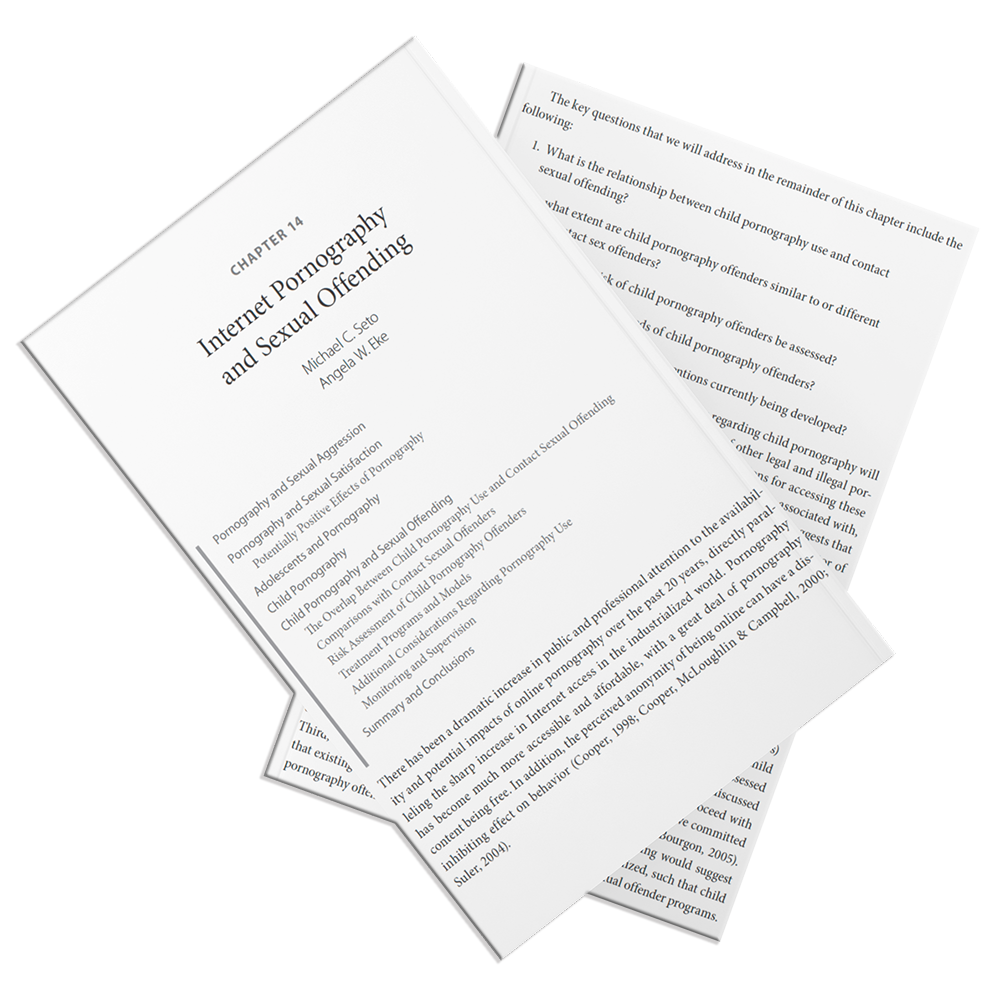
CHAPTER 14 - Internet Pornography and Sexual Offending
by Michael C. Seto & Angela W. Eke
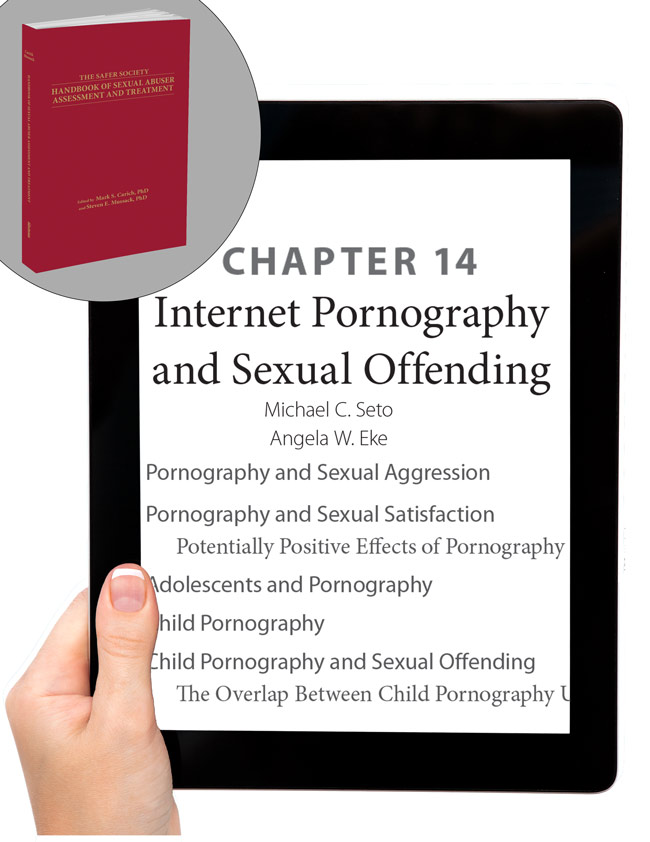
This is a PDF version of Chapter 14 of The Safer Society Handbook of Sexual Abuser Assessment and Treatment.
 Pornography has become far more accessible and affordable over the past 20 years, and the perceived anonymity of being online can have a disinhibiting effect on behavior. Chapter 14 examines what the research actually shows about pornography and sexual offending, with particular attention to child pornography offenses: who commits them, how they overlap with contact offending, and what assessment and treatment should look like.
Pornography and Sexual Aggression
Authors Michael C. Seto and Angela W. Eke sort through a polarized debate. Individual-level correlational, longitudinal, and experimental studies suggest that pornography exposure can have a negative effect, particularly for individuals already at risk because of antisocial attitudes, a strong drive for casual sex, and a willingness to use coercive tactics. A natural experiment in Norway found that approximately 3 percent of sexual crimes could be attributed to the introduction of high-speed Internet access: not a large effect, but not consistent with claims that pornography reduces sexual crime.
Adolescents and Pornography
Most male youths (93 percent) and over half of female youths (62 percent) have been exposed to online pornography by their mid-teens. The authors also correct the record on sexting: early media reports inflated its prevalence, and more specific surveys suggest a rate of 1 to 4 percent. What prolonged exposure does to adolescents passing through a fluid stage of development is simply unknown. The authors describe today’s easy access to explicit and paraphilic content as a large, unregulated experiment on the impact of pornography on future adults.
Risk Assessment
Recidivism research on this population is recent but informative. Across nine samples followed for up to six years, 2 percent of child pornography offenders were apprehended for a new contact sexual offense and 5 percent for a new sexual offense of any kind. In one study of 541 adult males followed just over four years, a quarter failed a conditional release in some way; about half of those failures involved being with children unsupervised, contacting children online, or accessing child pornography again. The chapter’s risk factor table covers pedophilic or hebephilic interests, relative interest in content depicting boys, younger age at first and index offense, prior criminal history, conditional release failure, prior contact offending, prior treatment, and low education. The authors recommend rank-ordering clients with established static measures such as the Static-99R or Risk Matrix 2000, then assessing dynamic risk factors to identify treatment and supervision targets.
Treatment Programs and Supervision
 Four treatment options are reviewed: the prison-based Sex Offender Treatment Program originally housed at FCI Butner; the UK’s Internet Sex Offender Treatment Program (i-SOTP), delivered through probation in six modules that begin with motivation to change; the cybersex unhooked model, built on addiction and 12-step principles; and Croga.org, an online self-help resource with materials for clinicians. The authors are candid that none of these options has undergone rigorous outcome evaluation. The chapter closes with guidance on when mainstream pornography use should be restricted (a decision based on the role pornography played in the person’s offending) and on the uses and limits of remote monitoring software, which is no substitute for face-to-face supervision.
The authors cover the following topics the authors cover the following topics:
- Pornography and Sexual Aggression
- Pornography and Sexual Satisfaction
- Potentially Positive Effects of Pornography
- Pornography and Sexual Satisfaction
- Adolescents and Pornography
- Child Pornography
- Child Pornography and Sexual Offending
- The Overlap Between Child Pornography Use and Contact Sexual Offending
- Comparisons with Contact Sexual Offenders
- Risk Assessment of Child Pornography Offenders
- Treatment Programs and Models
- Additional Considerations Regarding Pornography Use
- Monitoring and Supervision
- Child Pornography and Sexual Offending
- Summary and Conclusions
After purchasing this product, you will have three days to download it. After that, you will need to contact Safer Society Press to receive your copy.
26 pages, plus bonus material
PDF Format
Order#: WP162-14
Related Publications
-
Earn CEUs
Safer Society Handbook of Sexual Abuser Assessment and Treatment
Bulk discount as low as $35.00Successfully Added to your Shopping CartAdding to Cart... -
Adult Relapse Prevention Workbook
Bulk discount as low as $22.40Successfully Added to your Shopping CartAdding to Cart...