Home / Shop / PDF Downloads / PDFs for Adult Clients
The Good Lives Model (PDF Download)
$8.00
A one-time price of $8.00 will be added to your order.
Categories: Handbook PDFs, Professional Books
Manufacturer: Safer Society Press


- Description
- Specifications
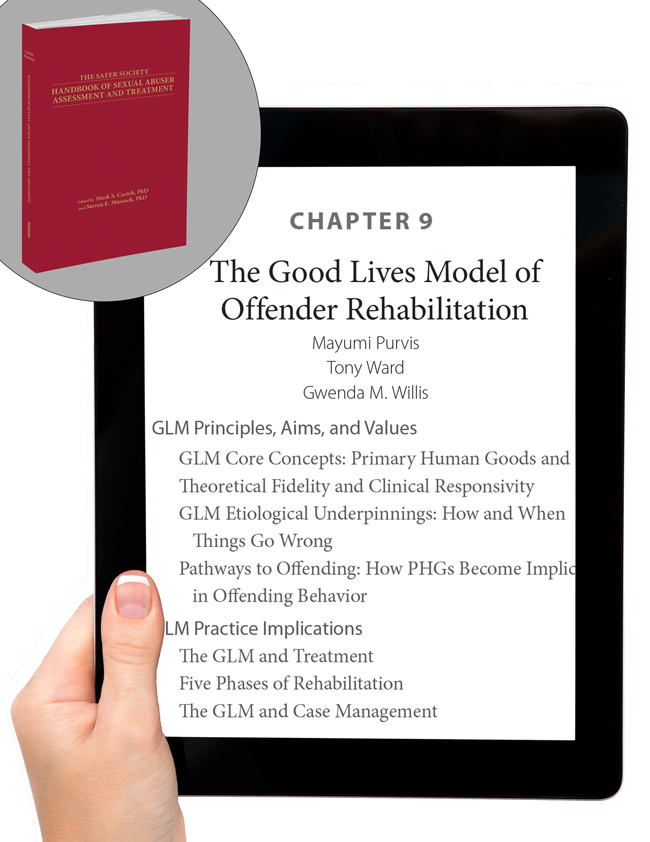
CHAPTER 9 - The Good Lives Model of Offender Rehabilitation
by Mayumi Purvis, Tony Ward & Gwenda M. Willis
This is a PDF version of Chapter 9 of The Safer Society Handbook of Sexual Abuser Assessment and Treatment.
Work with people who have committed sexual offenses ranks among the most difficult roles a therapist can take on. For decades, the field has focused primarily on managing the risk these clients present. While risk management has produced positive results within the treatment context, those results are nevertheless modest, and many programs have moved toward an orientation that complements risk management with a broader focus on healthy human functioning. The Good Lives Model of offender rehabilitation (GLM) offers such an approach, grounded in human rights, strengths, and the recognition that meaningful behavior change involves more than risk reduction alone.
 Chapter 9 presents a contemporary summary of the GLM as developed by Tony Ward and colleagues over more than a decade of theoretical refinement. The authors are direct about what the GLM is and is not. It is not an etiological model of sexual offending, not a treatment program, and not an account of the offense process. It is a model of healthy human functioning that serves as a rehabilitation framework, designed to equip and empower clients to live happy, healthy, and socially responsible lives so that the risk they present to the community is reduced for the long-term.
Primary Human Goods: The Foundation of the Model
At the heart of the GLM are 11 Primary Human Goods (PHGs): actions, states of affairs, experiences, and states of mind that are intrinsically beneficial to people and sought for their own sake. According to the model, all human actions, including criminal and antisocial behavior, are directly or indirectly linked to the pursuit of these goods. Some of these goods are knowledge, excellence in play, excellence in work, inner peace, creativity, and states of happiness and pleasure.
The chapter draws an important distinction between PHGs themselves and the means by which they are pursued. People who offend are typically seeking goods that are entirely legitimate, such as intimacy, autonomy, or a sense of accomplishment. The problem lies not in what they seek but in how they go about securing it. As the authors put it, what the offender is seeking is acceptable; the way he is going about it is not.
How Things Go Wrong: Flaws in Ways of Living
The chapter identifies four types of problems that can develop in a person’s lifestyle or life plan:
- Scope: Failing to strive for or secure each of the PHGs, which can produce physiological dysfunction, psychological distress, or social maladjustment.
- Capacity: Internal weaknesses (skills, attitudes, beliefs, mental health) or external obstacles (environmental factors, social supports, opportunities) that prevent the person from securing goods in healthy ways.
- Means: Engaging in behaviors or strategies that undermine rather than support the achievement of goods.
- Coherence and Conflict: “Horizontal conflict” occurs when goods are pursued in ways that work against each other (for example seeking control through behavior that destroys intimacy). “Vertical conflict” occurs when a person’s daily life fails to reflect the goods they most value.
Within the GLM, criminogenic needs are conceptualized as the internal or external obstacles that make it difficult for individuals to secure PHGs in personally meaningful and socially acceptable ways.
 Five Phases of GLM Rehabilitation

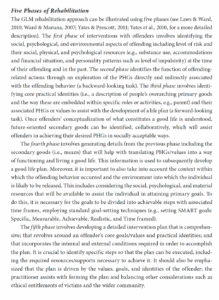
- Identify the social, psychological, and environmental aspects of offending, including risk level and the client’s resources at the time of offending.
- Explore the function of offending-related actions through the PHGs directly and indirectly associated with the offense (a backward-looking task).
- Identify the client’s core practical identities and associated values to support development of a life plan (a forward-looking task).
- Generate the secondary goods (means) that will translate values into a way of functioning, taking into account the context of release and using techniques such as SMART goals.
- Develop a detailed intervention plan organized around the client’s core goals, practical identities, and the internal and external conditions needed to accomplish them.
The GLM and Case Management
One of the chapter’s more distinctive contributions is its argument that case managers (often called offender supervisors) should function as active agents of change rather than as compliance monitors alone. The authors observe that case management has traditionally been treated as separate from treatment, with the two roles operating in silos and sharing limited information. The GLM offers a shared framework that allows therapists and case managers to coordinate their work around a common understanding of the client.
A Framework for Humanistic, Effective Practice
Chapter 9 closes with the argument that decades of punitive responses to offending have produced limited positive effects, and that working with clients’ strengths and obstacles together offers the best path forward. The GLM helps clients recognize that a socially responsible, personally meaningful life is a real possibility, not a long-gone potentiality. For clinicians, administrators, and case managers seeking a rehabilitation framework that respects clients as human beings while keeping the harm they have caused firmly in view, this chapter lays out the theory, the practice commitments, and the practical structure needed to put the Good Lives Model to work.
The author covers the following topics:
- GLM Principles, Aims, and Values
- GLM Core Concepts: Primary Human Goods and Means
- Theoretical Fidelity and Clinical Responsivity
- GLM Etiological Underpinnings: How and When Things Go Wrong
- Pathways to Offending: How PHGs Become Implicated in Offending Behavior
- GLM Principles, Aims, and Values
- GLM Practice Implications
- The GLM and Treatment
- Five Phases of Rehabilitation
- The GLM and Case Management
- GLM Practice Implications
- Empirical Support for the GLM
- Summary and Conclusions
After purchasing this product, you will have three days to download it. After that, you will need to contact Safer Society Press to receive your copy.
26 pages, plus bonus material
PDF Format
Order#: WP162-09
Related Publications
-
Earn CEUs
Safer Society Handbook of Sexual Abuser Assessment and Treatment
Bulk discount as low as $35.00Successfully Added to your Shopping CartAdding to Cart... -
Earn CEUs
Applying the Good Lives and Self-Regulation Models to Sex Offender Treatment
Bulk discount as low as $28.70Successfully Added to your Shopping CartAdding to Cart... -
Earn CEUs
Applying the Good Lives Model to the Case Management of Sexual Offenders
Bulk discount as low as $27.30OUT OF STOCKSuccessfully Added to your Shopping CartAdding to Cart...