Home / Shop / PDF Downloads / PDFs for Adult Clients
Family Therapy with Adult Sexual Offenders (PDF Download)
$8.00
A one-time price of $8.00 will be added to your order.
Categories: Handbook PDFs, Professional Books
Manufacturer: Safer Society Press


- Description
- Specifications
CHAPTER 12 - Family Therapy with Adult Sexual Offenders
by Becky Palmer
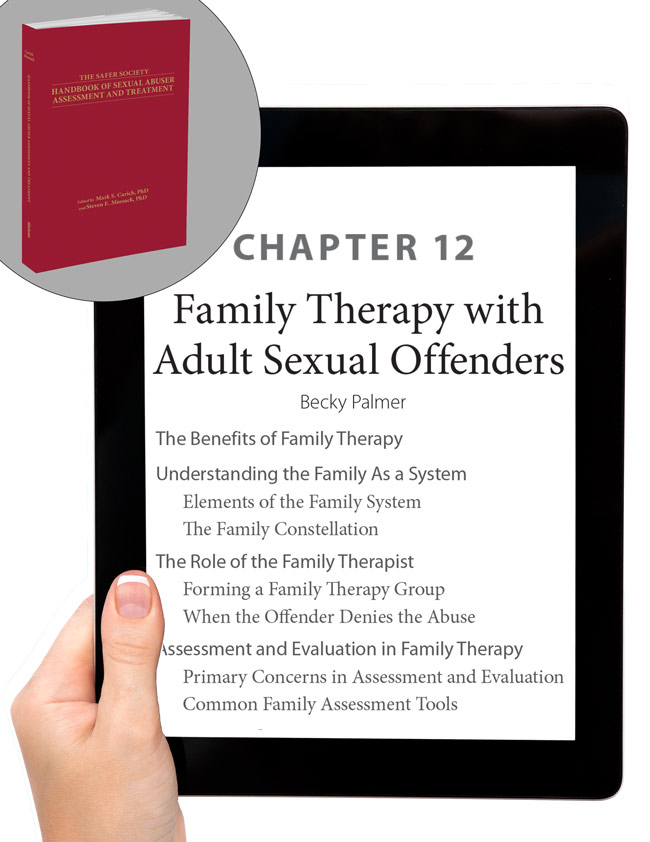
This is a PDF version of Chapter 12 of The Safer Society Handbook of Sexual Abuser Assessment and Treatment.
Most trained family therapists have little experience working with individuals who have committed sexual offenses, and many therapists who treat these clients have no background in family therapy. Chapter 12 of this Handbook works to close both gaps, making the case that family therapy belongs near the beginning of the treatment process rather than at the end, where it usually lands. When family therapy begins late, family members often feel that their needs are secondary, and the family misses the chance to understand the treatment process and learn how their support can help.
What Family Therapy Is (and Is Not)
 Author Becky Palmer draws a clear line between family-informed therapy (sitting with a family to review a safety plan or the terms of probation) and true family therapy: meeting with a family to uncover the dynamics and factors causing the dysfunctional patterns that prompted a family member to be sexually abusive. The chapter addresses both intra-familial abuse (incest) and extra-familial abuse, and explains that for all families affected by sexual abuse, family therapy serves to support the client in treatment, give the family a forum for deciding under what circumstances members will spend time together, increase awareness of family dynamics that support or undermine an offense-free life, and empower every member to speak up when the behavior of others feels unsafe.
Understanding the Family as a System
Families are systems of interconnected and interdependent individuals, none of whom can be understood in isolation. The chapter explains the three main elements a family therapist seeks to identify: family roles (who is the boss, who is the scapegoat, who is the “responsible one”), family rules (the often unspoken expectations about anger, affection, decision making, and boundaries), and homeostasis (the process that keeps a family system in its accustomed balance, even when that balance is dysfunctional). Palmer also widens the traditional definition of family to a “family constellation” that may include support figures, parental figures, employers, or even neighbors.
Assessment and the Treatment Plan
The chapter identifies eight areas of concern to evaluate in every family:
- conflicting parenting styles
- isolation
- internal and external stressors
- intergenerational sexual or physical abuse
- unhealthy communication styles
- emotional deficiency
- power differentials
- rigidity
Two common assessment tools, the genogram and the family eco-map, give the therapist a picture of the family’s beliefs, fractures, connections to the outside world, and resiliencies. Treatment planning is collaborative, gathering input from every family member and from the other professionals involved, and produces a written plan with long-term goals, short-term objectives, and interventions that can adjust as new information emerges.
Safety Planning, Resolution, and Reintegration
 A complete sample visitation safety plan for the chapter’s running case study, the Allen Smith family, covers supervision, privacy and boundary guidelines, appropriate touch and affection, and other rules that readers can adapt to their own cases. Rather than assuming reunification is the goal, the chapter follows the family resolution framework (California Coalition on Sexual Offending, 2002), which places outcomes on a continuum from no contact ever again to unrestricted life with spouse and children. Circles of support and accountability (COSAs) are presented as an added layer of community support, and a model reintegration plan appears in Appendix B of the Handbook.
Why It Matters
Healthy intimate relationships are a protective factor that decreases the likelihood of reoffense (Hanson & Morton-Bourgon, 2005), and family relationships, particularly marriage, along with employment, have consistently been linked to desistance from crime. Since the majority of adults who have committed sexual offenses will not remain incarcerated for a lifetime, Palmer argues, building family therapy into treatment programs is both sensible and farsighted. It is almost certain that each client will have at least one family member willing to engage.
The author covers the following topics:
- The Benefits of Family Therapy
- Understanding the Family As a System
- Elements of the Family System
- The Family Constellation
- Understanding the Family As a System
- The Role of the Family Therapist
- Forming a Family Therapy Group
- When the Offender Denies the Abuse
- The Role of the Family Therapist
- Assessment and Evaluation in Family Therapy
- Primary Concerns in Assessment and Evaluation
- Common Family Assessment Tools
- Assessment and Evaluation in Family Therapy
- Conducting Family Therapy
- Communicating That Change Is Possible
- Developing the Family Treatment Plan
- Working with Families of Sexual Offenders
- The Visitation Safety Plan
- Conducting Family Therapy
- Resolution and Reintegration
- Summary and Conclusions
After purchasing this product, you will have three days to download it. After that, you will need to contact Safer Society Press to receive your copy.
28 pages, plus bonus material
PDF Format
Order#: WP162-12
Related Publications
-
Earn CEUs
Safer Society Handbook of Sexual Abuser Assessment and Treatment
Bulk discount as low as $35.00Successfully Added to your Shopping CartAdding to Cart...