
• Our Safe Haven: Helping Clients with Paraphilias and Paraphilic Disorders

    Join us for a series of professional dialogues designed to address these pressing issues. Moderated by Nikole Nassen and David Prescott, these discussions provide a supportive space for professionals to share insights, develop strategies, and strengthen their ability to navigate the complexities of working with clients with paraphilias and paraphilic disorders. Each session will begin with a focused exploration of a specific topic, evolving naturally into an engaging, attendee-driven conversation shaped by shared experiences and professional insights.

    $8.00
  • Advances in the Structured Assessment of Protective Factors Against Sexual Offending (SAPROF-SO): Current Research and Practice Considerations

    Explore the latest research and practice developments in the SAPROF-SO, a specialized measure of protective factors relevant to sexual offending. Building on foundational SAPROF-SO knowledge, this session examines how protective factors can inform risk assessment, treatment planning, and risk management. Drs. Willis, Thornton, and Kelley will highlight recent findings on the SAPROF-SO’s reliability, construct validity, and predictive value—including its contribution alongside commonly used static actuarial and dynamic sexual-offense risk measures. The session also introduces practical developments, including use of the SAPROF-SO Calculator, applications for identifying treatment goals, and the new SAPROF-SO Risk Management Framework, with special attention to adversarial settings.

    Please note: This session reviews updates to the SAPROF-SO and is not intended to train or certify participants in its administration, scoring, or implementation.

    $70.00
  • Screen to Session: Addressing Gaming and Anime Subcultures with Individuals Who Have Sexually Offended

    Dr. Tracy Alvord and her colleagues, Elizabeth Bigham, Michael “Christian” Alvord, and Markus Wiegel, developed this training to examine the risks associated with, and responses to, online gaming in the context of sexual harm. Presenters review current research on sexual offending in gaming-related environments, including grooming techniques, platform affordances, and patterns of exploitation. They also discuss law-enforcement strategies for identifying and investigating sexual exploitation in gaming-related environments, including ways to recognize individuals who target minors (often referred to as “bad players”) in these spaces.

    The training addresses clinical implications, including assessment considerations, treatment targets, and interventions for individuals who have committed sexual offenses and engage in gaming. Emphasis is placed on collaboration between treatment providers and community supervision officers to support effective risk management. Demonstrations of gaming platforms, sexually explicit video game—including anime- and hentai-related genres—and related social media environments are incorporated to strengthen participants’ understanding of these contexts.

    $105.00
  • Our Safe Haven: Rural Providers Working Across the Sexual Harm Continuum

    Living and working in rural areas pose unique challenges for providers working with individuals across the sexual harm continuum. For survivors and those who have caused harm, rural communities have fewer services, resources, and supports available. Both clients and providers alike can experience feelings of isolation. Clinicians, case managers, educators, and doctors also have to navigate unique challenges related to ethical boundaries, including dual relationships and confidentiality in small towns where everyone seems to know each other. Studies have shown that rural healthcare workers experience higher rates of burnout, in part due to the higher number of ethical dilemmas.

    Join us for a series of professional dialogues designed for rural providers who work with individuals across the sexual harm continuum. Moderated by Angelique Caley and David Prescott, these discussions provide a supportive space for rural providers to come together, share insights, offer creative ideas, and develop strategies to address the unique needs of their rural communities, their clients, and to maintain their own self-care.

    $8.00
  • Our Safe Haven: Rural Providers Working Across the Sexual Harm Continuum

    Living and working in rural areas pose unique challenges for providers working with individuals across the sexual harm continuum. For survivors and those who have caused harm, rural communities have fewer services, resources, and supports available. Both clients and providers alike can experience feelings of isolation. Clinicians, case managers, educators, and doctors also have to navigate unique challenges related to ethical boundaries, including dual relationships and confidentiality in small towns where everyone seems to know each other. Studies have shown that rural healthcare workers experience higher rates of burnout, in part due to the higher number of ethical dilemmas.

    Join us for a series of professional dialogues designed for rural providers who work with individuals across the sexual harm continuum. Moderated by Angelique Caley and David Prescott, these discussions provide a supportive space for rural providers to come together, share insights, offer creative ideas, and develop strategies to address the unique needs of their rural communities, their clients, and to maintain their own self-care.

    $8.00
  • Our Safe Haven: Helping Clients with Paraphilias and Paraphilic Disorders

    Join us for a series of professional dialogues designed to address these pressing issues. Moderated by Nikole Nassen and David Prescott, these discussions provide a supportive space for professionals to share insights, develop strategies, and strengthen their ability to navigate the complexities of working with clients with paraphilias and paraphilic disorders. Each session will begin with a focused exploration of a specific topic, evolving naturally into an engaging, attendee-driven conversation shaped by shared experiences and professional insights.

    $8.00
  • Our Safe Haven: Helping Clients with Paraphilias and Paraphilic Disorders

    Join us for a series of professional dialogues designed to address these pressing issues. Moderated by Nikole Nassen and David Prescott, these discussions provide a supportive space for professionals to share insights, develop strategies, and strengthen their ability to navigate the complexities of working with clients with paraphilias and paraphilic disorders. Each session will begin with a focused exploration of a specific topic, evolving naturally into an engaging, attendee-driven conversation shaped by shared experiences and professional insights.

    $8.00
  • Our Safe Haven: Rural Providers Working Across the Sexual Harm Continuum

    Living and working in rural areas pose unique challenges for providers working with individuals across the sexual harm continuum. For survivors and those who have caused harm, rural communities have fewer services, resources, and supports available. Both clients and providers alike can experience feelings of isolation. Clinicians, case managers, educators, and doctors also have to navigate unique challenges related to ethical boundaries, including dual relationships and confidentiality in small towns where everyone seems to know each other. Studies have shown that rural healthcare workers experience higher rates of burnout, in part due to the higher number of ethical dilemmas.

    Join us for a series of professional dialogues designed for rural providers who work with individuals across the sexual harm continuum. Moderated by Angelique Caley and David Prescott, these discussions provide a supportive space for rural providers to come together, share insights, offer creative ideas, and develop strategies to address the unique needs of their rural communities, their clients, and to maintain their own self-care.

    $8.00
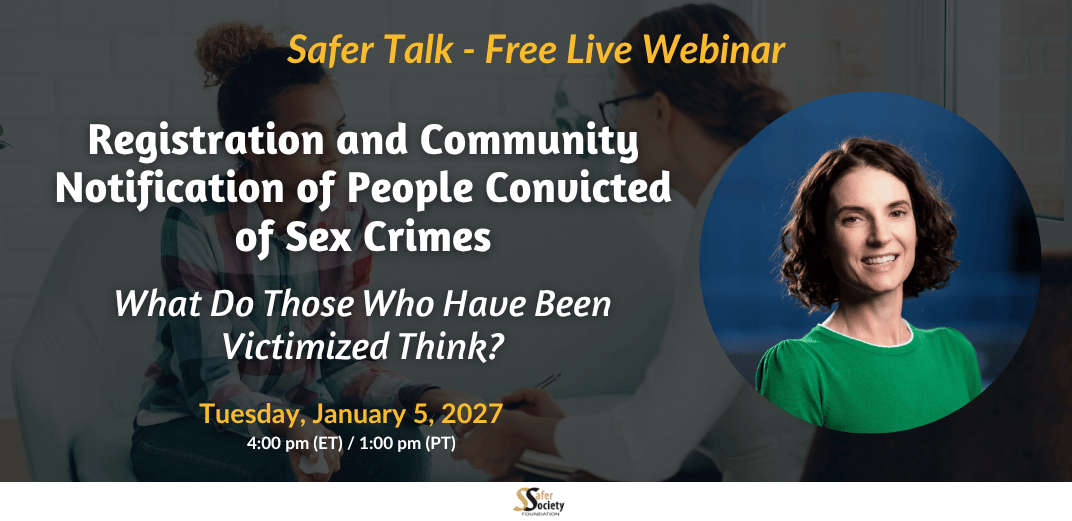
  • Registration and Community Notification of People Convicted of Sex Crimes: What Do Those Who Have Been Victimized Think?

    This webinar explores victim/survivor perspectives on Sex Offender Registration and Notification (SORN) policies. Drawing on recent Australian research, Dr. Kelly Richards examines the complex concerns and priorities raised by victim/survivors, including the risks of vigilantism, unnecessary fear, false reassurance, and the need for meaningful community safety. The webinar considers the implications of these findings for public policy and community responses to sexual abuse.

    Free
  • The Intersection of Brain Injury and Domestic Violence: Adapting Assessment and Treatment

    Russha Knauer—Director of Colorado’s lead state agency on traumatic brain injuries, MINDSOURCE Brain Injury Network—developed this training to address a critical gap in understanding, assessing, and working with adults who perpetrate domestic violence and have TBIs. During this training, Knauer highlights how brain injuries are often misinterpreted or overlooked, as their symptoms may appear similar to those of mental health conditions, substance use disorders, and other criminogenic needs.

    Knauer introduces practical, brain injury–informed strategies to enhance identification and adapt interventions, ultimately supporting healthier, less controlling interpersonal behaviors.

    $87.00