
Home / Shop / PDF Downloads / PDFs for Adult Clients
Facilitating Group-Centered Treatment Groups (PDF Download)
$8.00
A one-time price of $8.00 will be added to your order.
Categories: Handbook PDFs, Professional Books
Manufacturer: Safer Society Press


- Description
- Specifications
Facilitating Group-Centered Treatment Groups
by Steven P. Sawyer and Jerry L. Jennings
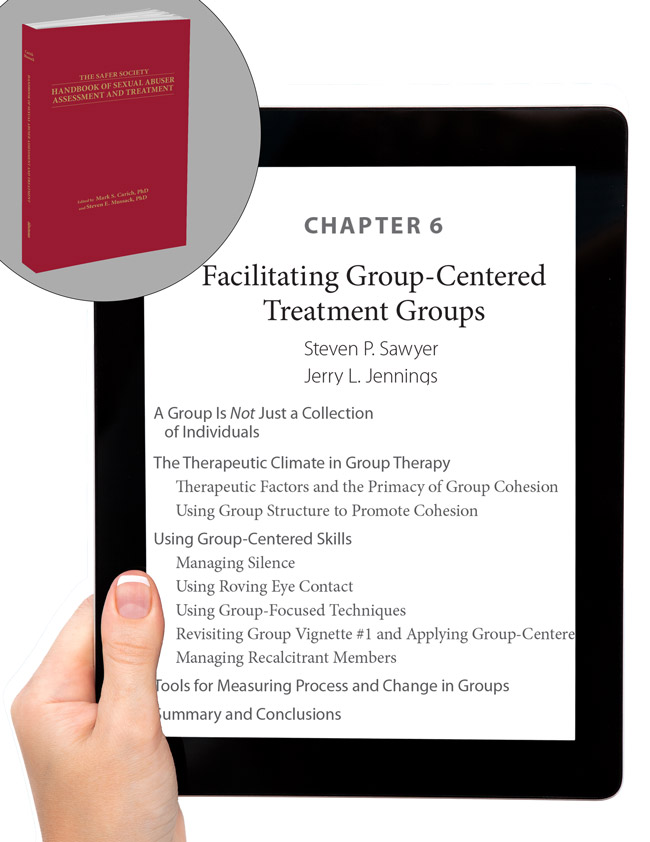
This is a PDF version of Chapter 6 of The Safer Society Handbook of Sexual Abuser Assessment and Treatment.
Group treatment is the predominant modality used in the specialized treatment of adults who have committed sexual offenses, yet it is too often conducted as an unnatural sequence of one-to-one therapy sessions performed publicly before a group of peers. Chapter 6 presents an alternative framework: group-centered therapy, in which the entire group, including the therapist, sits in a circle, and most of the conversation occurs among the members with minimal input from the therapist. Drawing on group therapy research and decades of clinical practice, the authors argue that group-centered interventions have greater therapeutic potential and impact, both for the individual and for all members of the group.
A Group Is Not Just a Collection of Individuals
The chapter opens with a striking observation about the gap between practice and research: a 15-year review of 60 issues of Sexual Abuse, the official journal of the Association for the Treatment of Sex Abusers, showed that only 7 of 375 articles (1.8 percent) focused on group therapy. The authors suggest this discrepancy reflects a continuing lack of understanding and appreciation of the unique therapeutic potential that group therapy offers in this specialized work. Group-based treatment is not simply a cost-efficient way to provide treatment to multiple clients at one time. It is a distinct mode of treatment that can have a powerful therapeutic impact on multiple treatment objectives.
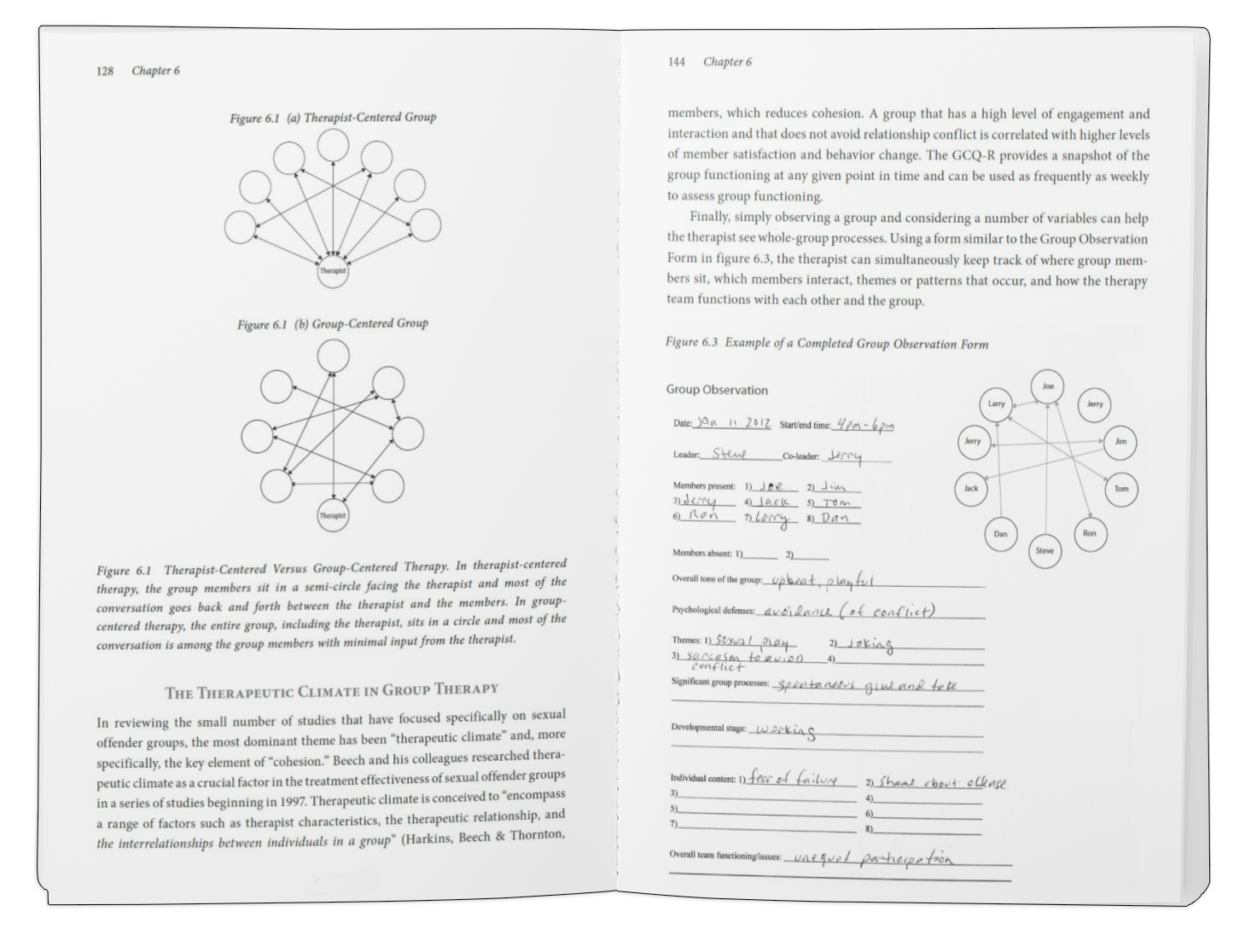 The authors illustrate the contrast between therapist-centered and group-centered groups. In therapist-centered therapy, members sit in a semi-circle facing the therapist, and most of the conversation moves back and forth between the therapist and individual members. In group-centered therapy, the seating is a full circle that includes the therapist, and most of the conversation flows among the members themselves.
The Importance of Group Cohesion
Chapter 6 reviews the body of research focused specifically on groups for individuals who have committed sexual offenses, where therapeutic climate, and particularly cohesion, has emerged as the dominant theme. Beech and Fordham (1997) found that group therapy with strong cohesion showed superior outcomes on measures of cognitive distortion, denial, and admission of offense behaviors. Beech and Hamilton-Giachritsis (2005) found that group involvement, commitment to and concern for one another, and the encouragement of emotional expressiveness within the group were significantly related to positive treatment outcomes for individuals who had committed sexual offenses against children.
Drawing on Yalom’s landmark theory of therapeutic factors, the authors describe cohesiveness as the primary therapeutic factor from which all others flow. A cohesive group is one in which all members feel a sense of belonging, acceptance, and validation. Another therapeutic factor, instillation of hope, holds particular significance in this field, as members in earlier stages of treatment can draw inspiration from peers who have begun to overcome the problems they themselves are still struggling with.
Five Principles of Effective Group Therapy
The chapter outlines five empirically validated principles drawn from Burlingame and colleagues (2002):
- Facilitating cohesion. Promoting member-to-member interactions that build connection, empathy, and shared investment in the group’s success.
- Pre-group preparation. Educating members about how group therapy works and screening for traits conducive to group work, such as motivation and capacity for empathy.
- Use of group structure. Maintaining clear, predictable boundaries such as starting and ending times, commitment to participation, and confidentiality.
- Timing of verbal interactions. Well-timed interventions that support positive group interaction and affirm positive actions while discouraging unhealthy conflict.
- Maintaining the emotional climate. Positive and supportive relationships grounded in the constructive expression of emotions.
Group-Centered Skills in Action
Chapter 6 describes specific skills that distinguish group-centered facilitation from traditional approaches:
- Managing silence: rather than always breaking silence with a comment, the therapist learns to read the context. Silence after a poignant disclosure may signal absorption of meaning. Silence at the start of a session may signal anxiety. Group-centered interventions draw attention to the meaning of the silence in light of what is happening interpersonally in the group at that moment.
- Roving eye contact (REC): by continually attending to one group member after another, the therapist enhances the range and depth of behavioral data, while modeling and reinforcing prosocial interaction. REC reminds members that they are not alone, and through observational learning, group members begin to use roving eye contact themselves, which counteracts egocentric thinking and promotes empathy and listening skills.
- Group-focused techniques: mapping member interactions to reveal subgroups and patterns of influence, using equidistant circularity in seating to avoid creating positions of power, and changing the therapist’s seat to observe how the dynamics shift.
 Vignettes
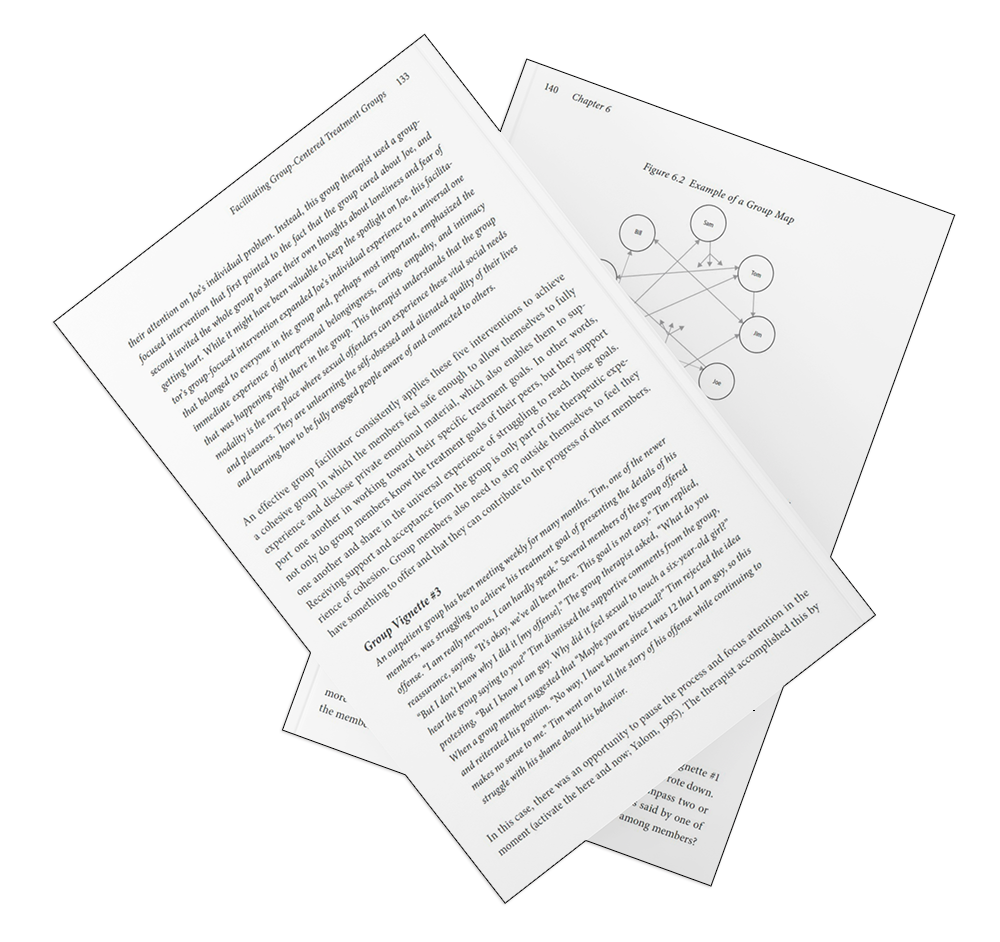
The chapter is rich with real-life vignettes that illustrate how a group-centered intervention reframes an individual problem as a shared concern. In one example, a member named Tim struggled to describe his offense and dismissed the supportive comments offered by the group. Rather than pursuing Tim’s individual anxiety, the therapist drew the group’s attention to the fact that Tim was missing the empathic support being offered to him. The intervention affirmed that other members had experienced similar struggles, hitting upon the universal social need for belonging and acceptance. Tim was then able to “really hear” the group’s earlier advice and went on to describe his offense in a way that allowed everyone in the group to share the experience of support and acceptance.
Tools for Measuring Group Process and Change
The chapter introduces validated instruments that allow therapists to move beyond subjective impressions of how their groups are functioning:
- Group Climate Scale (GCS): contains three measures of relationship (cohesion, leader support, expressiveness), four measures of personal growth (independence, task orientation, self-discovery, anger and aggression), and three measures of system change dimensions (order and organization, leader control, and innovation).
- Group Climate Questionnaire–Revised (GCQ-R): a 12-item measure that assesses three interwoven dimensions of group interaction: engaged, conflict, and avoiding.
- Group Observation Form: allows the therapist to track where members sit, which members interact, themes that occur during the session, and how the therapy team functions with each other and the group.
As a treatment population, adult men who have committed sexual offenses are often characterized by social disconnection, alienation, and self-centered thinking, with many lacking empathy or awareness of how other people think and feel. The authors argue that group therapy is the only modality that can create a living, realistic social laboratory where these clients can learn to relate and experience social bonding. Group-focused therapy can break through self-obsessed thinking and open clients to the genuine experience of connectedness. Chapter 6 gives clinicians both the theoretical grounding and the specific facilitation skills needed to harness this distinct therapeutic power for the benefit of clients and communities.
The author covers the following topics:
- A Group Is Not Just a Collection of Individuals
- The Therapeutic Climate in Group Therapy
- Therapeutic Factors and the Primacy of Group Cohesion
- Using Group Structure to Promote Cohesion
- The Therapeutic Climate in Group Therapy
- Using Group-Centered Skills
- Managing Silence
- Using Roving Eye Contact
- Using Group-Focused Techniques
- Revisiting Group Vignette #1 and Applying Group-Centered Skills
- Managing Recalcitrant Members
- Using Group-Centered Skills
- Tools for Measuring Process and Change in Groups
- Summary and Conclusions
After purchasing this product, you will have three days in which to download it. After that time, if you have not downloaded it yet, you will need to contact Safer Society Press.
23 pages, plus bonus material
PDF Format
Order#: WP162-06
Related Publications
-
Earn CEUs
Safer Society Handbook of Sexual Abuser Assessment and Treatment
Bulk discount as low as $35.00Successfully Added to your Shopping CartAdding to Cart...