Home / Shop / PDF Downloads / PDFs for Adult Clients
Working with Women Who Sexually Offend (PDF Download)
$8.00
A one-time price of $8.00 will be added to your order.
Categories: Handbook PDFs, Professional Books
Manufacturer: Safer Society Press


- Description
- Specifications
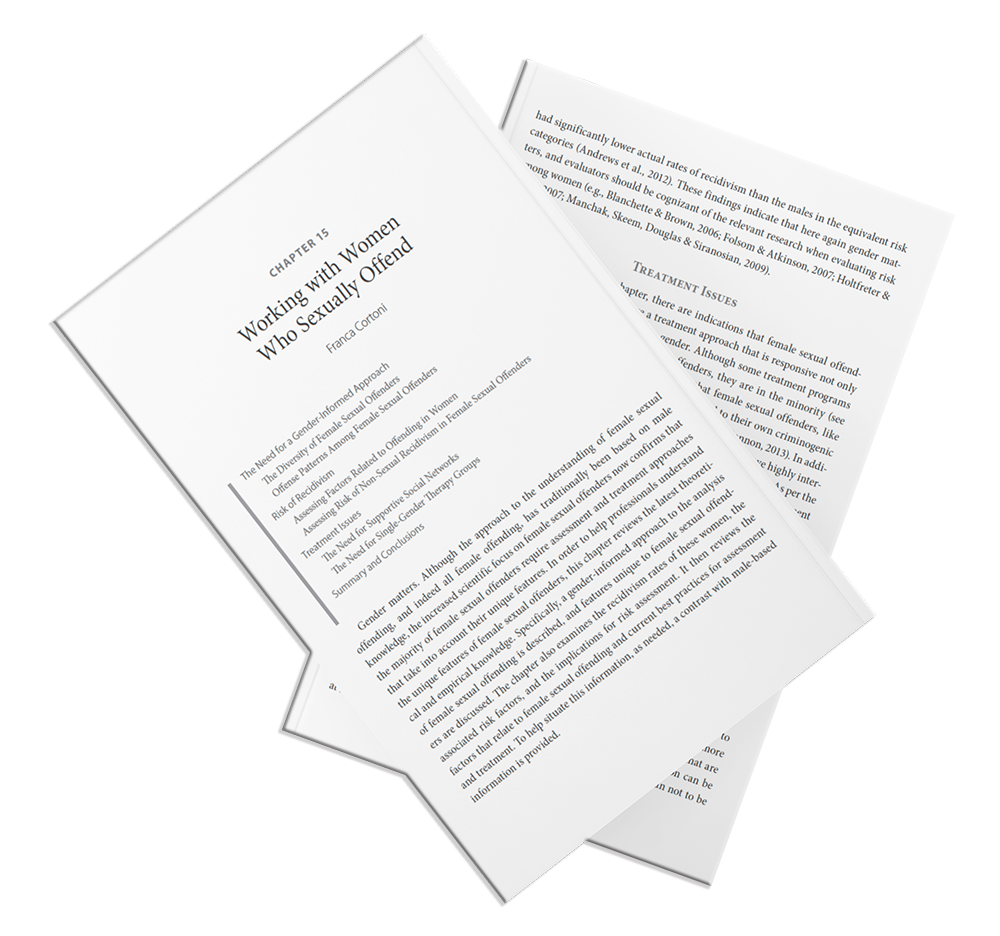
CHAPTER 15 - Working with Women Who Sexually Offend
by Franca Cortoni
This is a PDF version of Chapter 15 of The Safer Society Handbook of Sexual Abuser Assessment and Treatment.
Gender matters. The understanding of sexual offending by women has traditionally been built on male-based knowledge, but the growing body of research confirms that most women who have sexually offended require assessment and treatment approaches that account for their unique features. Chapter 15 reviews the latest theoretical and empirical knowledge, contrasting it with male-based information where that helps situate the findings.
Why a Gender-Informed Approach
 Women commit the same range of sexual offenses as men, so it is tempting to assume the same factors drive the behavior. Research on women in the criminal justice system shows otherwise: female criminality is best understood through a combination of gender-neutral factors (antisocial attitudes, criminal associates, substance abuse) and gender-specific factors (parental stress, lack of family support, victimization histories, relationship dysfunction). For women, trauma, mental health, and substance abuse problems are highly interrelated and cannot be treated as separate entities.
The Diversity of Women Who Sexually Offend
The chapter reviews the typologies developed since the 1980s, from the so-called teacher-lover, who frames her abuse of an adolescent as an act of kindness and love, to women who offend in the company of others. In one study comparing solo and co-offending women, 71 percent of the co-offending women had male co-offenders. Author Franca Cortoni cautions against assuming that women with co-offenders are always coerced: some offend willingly, and some initiate the behavior. The chapter also challenges two stereotypes that distort practice. At one extreme, the harm done by women is minimized, even though victims suffer the same range of traumatic effects as victims of men. At the other, women who offend are viewed as “unnatural,” as if the identical behavior were somehow more natural for a man.
Three Pathways to Offending
Moving past typologies, the descriptive model of the offense process for female sexual offenders (DMFSO) identifies three pathways.
- In the directed-avoidant pathway, women offend out of extreme fear of a male co-offender or a desire for intimacy with him, after actively trying to avoid the offending.
- In the implicit-disorganized pathway, women offend suddenly and impulsively, with little advance planning, to fulfill immediate needs.
- In the explicit-approach pathway, women plan their offenses with specific goals in mind: sexual gratification, intimacy, revenge and humiliation, or financial reward.
The model was developed and validated on a small sample (58 women in total) and requires further investigation, but it gives evaluators an empirical, gender-informed basis for identifying offense patterns and treatment targets.
Treatment Issues
Treatment should address five broad areas of difficulty: cognitive processes, emotional processes, intimacy and relationship issues, sexual dynamics, and psychosocial functioning, along with the interrelationships among them and a self-management plan with goals for a healthier life. Because women tend to form their self-identity and sense of self-worth through their relationships, treatment should follow a relational model that supplies the positive relationship experiences these clients have typically lacked. The chapter also makes the case for single-gender therapy groups: research shows women benefit more from them when dealing with intensely personal issues, and mixed-gender groups can be countertherapeutic for the men as well, who become preoccupied with establishing dominance rather than supporting one another.
A Maturing Knowledge Base
Women constitute only a small proportion of those who commit sexual offenses, but the effects of their offending on victims are just as serious. Until validated tools exist, evaluators must rely on professional judgment structured by the available empirical evidence. Treatment providers, in turn, need to understand the gendered contexts in which familiar problems (offense-supportive cognitions, relationship deficits, emotional regulation and coping deficits, problematic sexual regulation) show up in women’s lives, and build that knowledge into their services.
The author covers the following topicsThe author covers the following topics:
- The Need for a Gender-Informed Approach
- The Diversity of Female Sexual Offenders
- Offense Patterns Among Female Sexual Offenders
- Risk of Recidivism
- Assessing Factors Related to Offending in Women
- Assessing Risk of Non-Sexual Recidivism in Female Sexual Offenders
- Risk of Recidivism
- Treatment Issues
- The Need for Supportive Social Networks
- The Need for Single-Gender Therapy Groups
- Treatment Issues
- Summary and Conclusions
After purchasing this product, you will have three days to download it. After that, you will need to contact Safer Society Press to receive your copy.
20 pages, plus bonus material
PDF Format
Order#: WP162-15
Related Publications
-
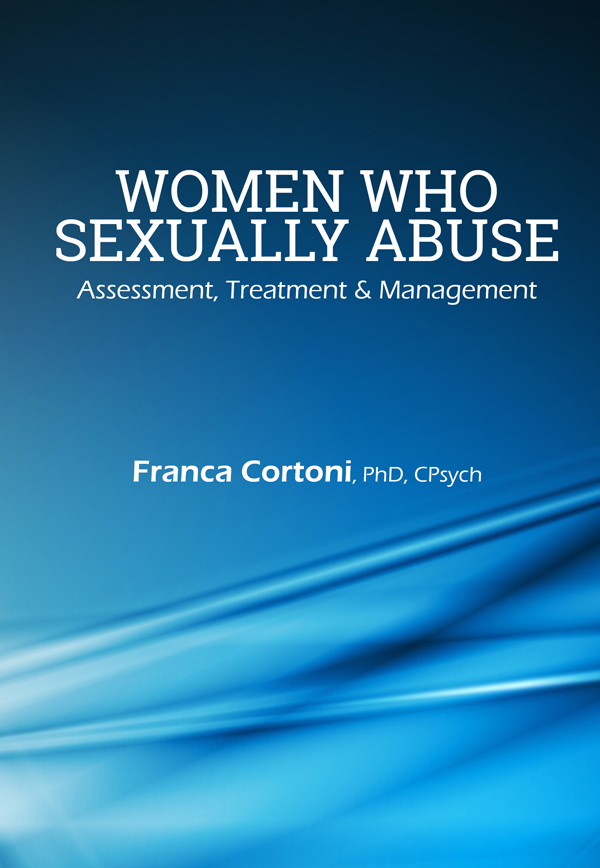
Women Who Sexually Abuse
Bulk discount as low as $30.10OUT OF STOCK until early January, 2026Successfully Added to your Shopping CartAdding to Cart... -
Earn CEUs
Group Therapy with Sexual Abusers
Bulk discount as low as $30.10Successfully Added to your Shopping CartAdding to Cart...