
Program Development and Management (PDF Download)


Home / Shop / PDF Downloads / PDFs for Adult Clients

Program Development and Management (PDF Download)

$8.00
Program Development and Management (PDF Download)

Home / Shop / PDF Downloads / PDFs for Adult Clients

Program Development and Management (PDF Download)

$8.00
Model Number: WP162-03
Chapter 3 PDF from The Safer Society Handbook of Sexual Abuser Assessment and Treatment.
Maximum quantity exceeded
Minimum purchase amount of 0 is required
Maximum purchase amount of 0 is allowed
Your Price: $8.00
8.000
A one-time price of $8.00 will be added to your order.
Manufacturer: Safer Society Press
Facebook
X
Email
LinkedIn
  • Description
  • Specifications
Program Development and Managemen
By Robert J. McGrath, Georgia F. Cumming, and Melanie Williams

This is a 24-page PDF of chapter 3 of the Safer Society Handbook of Sexual Abuser Assessment and Treatment.

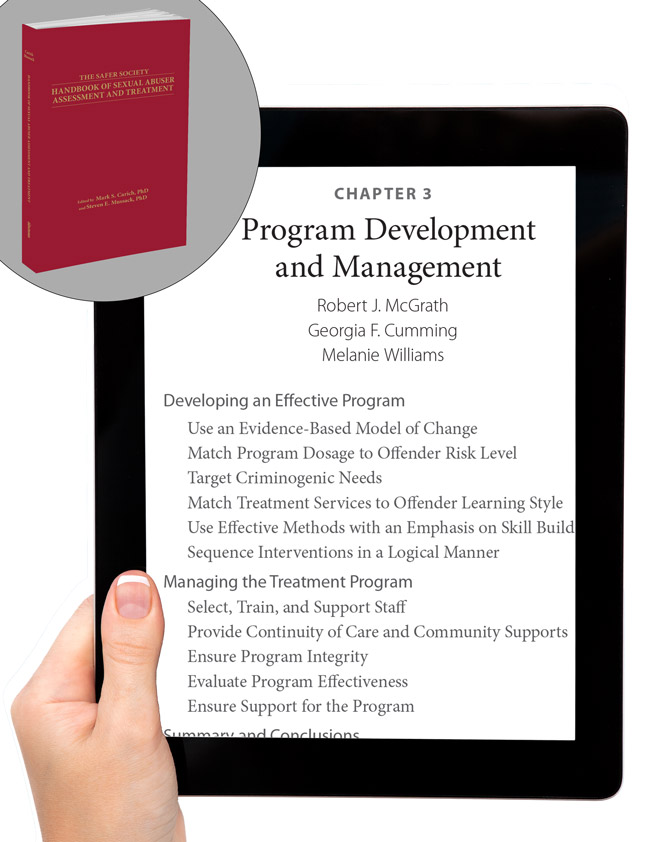
Book chapter page titled "Program Development and Management" by Robert J. McGrath, Georgia F. Cumming, and Melanie Williams, showing text about effective correctional treatment programs and evidence-based interventionsTreatment programs for individuals who have sexually offended vary widely in their effectiveness. While some reduce reoffending, others have no measurable impact, and a few may even increase recidivism. Chapter 3 provides clinicians, administrators, and jurisdictions with a roadmap for designing and managing programs that work, drawing from more than three decades of research on what distinguishes effective correctional treatment from ineffective approaches.

Building Programs That Reduce Reoffending

Research consistently shows that treatment-oriented correctional interventions reduce recidivism rates by approximately 10 percentage points on average, with particularly well-designed programs achieving reductions of 25 percentage points or more. Chapter 3 translates this research into actionable guidance for creating programs for individuals who have committed sexual offenses that are grounded in evidence-based principles.

The chapter begins by examining models of change, with particular attention to the cognitive-behavioral approach—the most empirically supported method for treating adult males who have committed sexual offenses. The authors discuss how this model blends cognitive therapy (changing patterns of thinking) with behavior therapy (learning new behaviors through modeling and conditioning). Two newer frameworks—the self-regulation model and the Good Lives Model—are also explored as approaches that address perceived limitations of earlier relapse prevention models.

The Risk-Need-Responsivity Framework

At the core of effective programming is the Risk-Need-Responsivity (RNR) model, which answers three fundamental questions:

  1. Who should receive the most intensive services? The risk principle directs the greatest treatment dosage to moderate- and high-risk individuals at high risk of reoffending. The chapter provides practical guidance on using structured, empirically based risk assessment instruments and includes specific recommendations for treatment dosage by risk level—from session frequency to program length to total treatment hours.
  2. What should treatment target? The need principle focuses services on criminogenic needs—the changeable risk factors that, when addressed, reduce the likelihood that a person will reoffend. The authors provide detailed tables identifying supported criminogenic needs (such as deviant sexual interests, sexual preoccupation, and offense-supportive attitudes) versus factors that lack empirical support as treatment targets.
  3. How should services be delivered? The responsivity principle calls for tailoring treatment to individual learning styles and characteristics. This includes addressing factors like intelligence, mental health needs, motivation, and cultural considerations. The chapter tackles practical responsivity issues such as working with individuals who deny their offenses and determining appropriate treatment modalities.
Practical Program Design

Chapter 3 offers guidance on treatment methods and structure. The authors emphasize skill building over simple information delivery, outlining a seven-step process for teaching new skills that includes modeling, practice, feedback, and real-world application. They discuss the advantages and limitations of group versus individual treatment, optimal group size, and considerations for co-facilitation.

The chapter addresses how to sequence interventions logically, typically through phased treatment models that progress from engagement and assessment through skill building to transition planning. Practical considerations such as closed versus open groups, manualized versus flexible approaches, and spacing of sessions are all examined.

Managing for Success

Effective program design must be matched with strong management. The authors detail how staff selection, training, and supervision directly impact outcomes. Research shows that therapist interpersonal skills and therapeutic style—including warmth, empathy, and directiveness—account for up to 30 percent of treatment benefit. Programs should select staff for these qualities and provide ongoing support to maintain effectiveness.

The chapter addresses continuity of care, stressing that progress made in institutional settings must be reinforced through follow-up services in the community. This includes collaboration between treatment providers and supervision officers, assistance with employment and housing, and consideration of approaches like circles of support for high-risk individuals with few community ties.

Program integrity—ensuring services are delivered as designed—requires operational and treatment manuals, staff supervision, and adherence monitoring. The authors note that about one-fifth of North American programs for individuals who have committed sexual offenses use external reviewers for quality improvement evaluations.

Evaluation and Sustainability

Programs must evaluate their effectiveness, though this presents unique challenges given the relatively low base rates of sexual reoffending. The chapter discusses the requirements for demonstrating treatment effects, including the need for adequate sample sizes, follow-up periods of at least five years, and appropriate comparison groups.

Finally, the authors address the reality that programs require broad support to succeed. This includes not just treatment staff but also non-treatment personnel, management, the public, and other stakeholders. The chapter acknowledges the particular challenges of maintaining support for programming for individuals who have committed sexual offenses and notes that recent benefit-cost analyses show that the monetary value of these programs to society exceeds their costs.

A Foundation for Effective Practice

Chapter 3 synthesizes decades of research into practical principles that clinicians and administrators can apply in real-world settings. While recognizing that unanswered questions remain, the authors demonstrate that we have sufficient knowledge to design and deliver programs that meaningfully reduce sexual reoffending. For anyone responsible for developing, managing, or improving treatment programs for individuals who have committed sexual offenses, this chapter provides the foundation needed to align practice with evidence and achieve better outcomes for clients and communities.

The following topics are covered:

    • Developing an Effective Program
        • Use an Evidence-Based Model of Change
        • Match Program Dosage to Offender Risk Level
        • Target Criminogenic Needs
        • Match Treatment Services to Offender Learning Style
        • Use Effective Methods with an Emphasis on Skill Building
        • Sequence Interventions in a Logical Manner
    • Managing the Treatment Program
        • Select, Train, and Support Staff
        • Provide Continuity of Care and Community Supports
        • Ensure Program Integrity
        • Evaluate Program Effectiveness
        • Ensure Support for the Program
    • Summary and Conclusions

After purchasing this product, you will have three days in which to download it. After that time, if you have not downloaded it yet, you will need to contact Safer Society Press.

24 pages, plus bonus material PDF Format Order#: WP162-03

Store Account Login

Please enter your Email Address
Please enter your Password

Product Search

Program Development and Management


Home / Shop / PDF Downloads / PDFs for Adult Clients

Program Development and Management (PDF Download)

$8.00
Program Development and Management (PDF Download)

Home / Shop / PDF Downloads / PDFs for Adult Clients

Program Development and Management (PDF Download)

$8.00
Model Number: WP162-03
Chapter 3 PDF from The Safer Society Handbook of Sexual Abuser Assessment and Treatment.
Maximum quantity exceeded
Minimum purchase amount of 0 is required
Maximum purchase amount of 0 is allowed
Your Price: $8.00
8.000
A one-time price of $8.00 will be added to your order.
Manufacturer: Safer Society Press
Facebook
X
Email
LinkedIn
  • Description
  • Specifications
Program Development and Managemen
By Robert J. McGrath, Georgia F. Cumming, and Melanie Williams

This is a 24-page PDF of chapter 3 of the Safer Society Handbook of Sexual Abuser Assessment and Treatment.

Book chapter page titled "Program Development and Management" by Robert J. McGrath, Georgia F. Cumming, and Melanie Williams, showing text about effective correctional treatment programs and evidence-based interventionsTreatment programs for individuals who have sexually offended vary widely in their effectiveness. While some reduce reoffending, others have no measurable impact, and a few may even increase recidivism. Chapter 3 provides clinicians, administrators, and jurisdictions with a roadmap for designing and managing programs that work, drawing from more than three decades of research on what distinguishes effective correctional treatment from ineffective approaches.

Building Programs That Reduce Reoffending

Research consistently shows that treatment-oriented correctional interventions reduce recidivism rates by approximately 10 percentage points on average, with particularly well-designed programs achieving reductions of 25 percentage points or more. Chapter 3 translates this research into actionable guidance for creating programs for individuals who have committed sexual offenses that are grounded in evidence-based principles.

The chapter begins by examining models of change, with particular attention to the cognitive-behavioral approach—the most empirically supported method for treating adult males who have committed sexual offenses. The authors discuss how this model blends cognitive therapy (changing patterns of thinking) with behavior therapy (learning new behaviors through modeling and conditioning). Two newer frameworks—the self-regulation model and the Good Lives Model—are also explored as approaches that address perceived limitations of earlier relapse prevention models.

The Risk-Need-Responsivity Framework

At the core of effective programming is the Risk-Need-Responsivity (RNR) model, which answers three fundamental questions:

  1. Who should receive the most intensive services? The risk principle directs the greatest treatment dosage to moderate- and high-risk individuals at high risk of reoffending. The chapter provides practical guidance on using structured, empirically based risk assessment instruments and includes specific recommendations for treatment dosage by risk level—from session frequency to program length to total treatment hours.
  2. What should treatment target? The need principle focuses services on criminogenic needs—the changeable risk factors that, when addressed, reduce the likelihood that a person will reoffend. The authors provide detailed tables identifying supported criminogenic needs (such as deviant sexual interests, sexual preoccupation, and offense-supportive attitudes) versus factors that lack empirical support as treatment targets.
  3. How should services be delivered? The responsivity principle calls for tailoring treatment to individual learning styles and characteristics. This includes addressing factors like intelligence, mental health needs, motivation, and cultural considerations. The chapter tackles practical responsivity issues such as working with individuals who deny their offenses and determining appropriate treatment modalities.
Practical Program Design

Chapter 3 offers guidance on treatment methods and structure. The authors emphasize skill building over simple information delivery, outlining a seven-step process for teaching new skills that includes modeling, practice, feedback, and real-world application. They discuss the advantages and limitations of group versus individual treatment, optimal group size, and considerations for co-facilitation.

The chapter addresses how to sequence interventions logically, typically through phased treatment models that progress from engagement and assessment through skill building to transition planning. Practical considerations such as closed versus open groups, manualized versus flexible approaches, and spacing of sessions are all examined.

Managing for Success

Effective program design must be matched with strong management. The authors detail how staff selection, training, and supervision directly impact outcomes. Research shows that therapist interpersonal skills and therapeutic style—including warmth, empathy, and directiveness—account for up to 30 percent of treatment benefit. Programs should select staff for these qualities and provide ongoing support to maintain effectiveness.

The chapter addresses continuity of care, stressing that progress made in institutional settings must be reinforced through follow-up services in the community. This includes collaboration between treatment providers and supervision officers, assistance with employment and housing, and consideration of approaches like circles of support for high-risk individuals with few community ties.

Program integrity—ensuring services are delivered as designed—requires operational and treatment manuals, staff supervision, and adherence monitoring. The authors note that about one-fifth of North American programs for individuals who have committed sexual offenses use external reviewers for quality improvement evaluations.

Evaluation and Sustainability

Programs must evaluate their effectiveness, though this presents unique challenges given the relatively low base rates of sexual reoffending. The chapter discusses the requirements for demonstrating treatment effects, including the need for adequate sample sizes, follow-up periods of at least five years, and appropriate comparison groups.

Finally, the authors address the reality that programs require broad support to succeed. This includes not just treatment staff but also non-treatment personnel, management, the public, and other stakeholders. The chapter acknowledges the particular challenges of maintaining support for programming for individuals who have committed sexual offenses and notes that recent benefit-cost analyses show that the monetary value of these programs to society exceeds their costs.

A Foundation for Effective Practice

Chapter 3 synthesizes decades of research into practical principles that clinicians and administrators can apply in real-world settings. While recognizing that unanswered questions remain, the authors demonstrate that we have sufficient knowledge to design and deliver programs that meaningfully reduce sexual reoffending. For anyone responsible for developing, managing, or improving treatment programs for individuals who have committed sexual offenses, this chapter provides the foundation needed to align practice with evidence and achieve better outcomes for clients and communities.

The following topics are covered:

    • Developing an Effective Program
        • Use an Evidence-Based Model of Change
        • Match Program Dosage to Offender Risk Level
        • Target Criminogenic Needs
        • Match Treatment Services to Offender Learning Style
        • Use Effective Methods with an Emphasis on Skill Building
        • Sequence Interventions in a Logical Manner
    • Managing the Treatment Program
        • Select, Train, and Support Staff
        • Provide Continuity of Care and Community Supports
        • Ensure Program Integrity
        • Evaluate Program Effectiveness
        • Ensure Support for the Program
    • Summary and Conclusions

After purchasing this product, you will have three days in which to download it. After that time, if you have not downloaded it yet, you will need to contact Safer Society Press.

24 pages, plus bonus material PDF Format Order#: WP162-03

Store Account Login

Please enter your Email Address
Please enter your Password

Product Search