Home / Shop / Online Trainings / Trainings
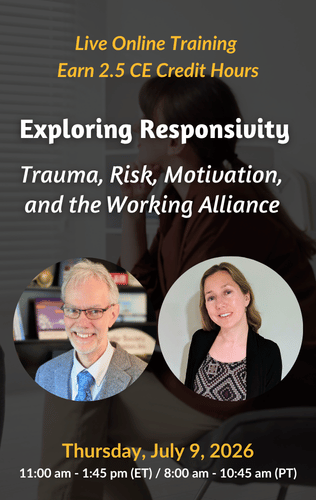
Live Online Training - Exploring Responsivity: Trauma, Risk, Motivation, and the Working Alliance
$87.00
A one-time price of $87.00 will be added to your order.
Categories: Live Online Training
Manufacturer: Safer Society Foundation


- Description
Date: July 9, 2026
Time: 11:00 am – 1:45 pm ET /
8:00 am – 11:45 am PT
Format: Live interactive training offered via Zoom
Presented by: David Prescott, LICSW, ATSA-F (See Bio) and Nikole Nassen, PhD (See Bio)
You must attend the entire live training and complete an evaluation to be eligible for CE credits. If you seek only psychology credits, the evaluation is optional, and you can remain anonymous.
Online Training Description:
The responsivity principle is broadly defined as matching treatment services to each client's individual characteristics. Of the three primary principles of effective correctional rehabilitation (risk, need, and responsivity), it can sometimes be the least clearly understood in practice. Recognizing this, Mr. Prescott and Dr. Nassen developed this training to help professionals in tailoring services for clients in treatment for sexual offending.

During this training, Mr. Prescott and Dr. Nassen explore the responsivity principle and its implications for treatment programs. They address recent developments in the field of understanding and treating adults and older adolescents who sexually abuse, including the broader Risk-Need-Responsivity (RNR) framework. The presenters then examine how childhood adversity can influence dynamic risk and overall functioning, which may create barriers to developing a lifestyle in which causing harm is unnecessary and undesirable. The training also reviews methods for improving responsivity and the working alliance, such as Feedback Informed Treatment, Motivational Interviewing, and related approaches
While the field has improved in understanding the ever-changing nature of risk and treatment need, there are continuing opportunities to enhance our abilities to provide treatment in a way that clients can respond to.
As a result of this training, participants will be able to:
1) Explain how adverse childhood experiences impact behavior and responsivity to treatment
2) Describe the relationship between trauma sequelae and dynamic risk
3) Use practical skills for understanding and improving treatment engagement
4)Describe how the responsivity principle applies at the institutional and program levels
Interactive Follow-Up Meeting
Attendees are invited to join an open discussion 15 minutes following the end of the training, where you can engage with fellow attendees by turning on your camera and microphone. This is an opportunity to share your experiences and contribute to a meaningful exchange of ideas. Time will be allocated to address questions or insights from the training. Please note that attendance is optional and will not affect your eligibility for a training certificate.
We can refund your training fee up to 24 hours prior to the start of the training.
To view all training details and review our list of frequently asked questions, please click here to visit the promotional page.
Related Publications
-
Earn CEUs
Group Therapy with Sexual Abusers
Bulk discount as low as $30.10Successfully Added to your Shopping CartAdding to Cart... -
Getting the Most from Group
Bulk discount as low as $9.10Successfully Added to your Shopping CartAdding to Cart... -
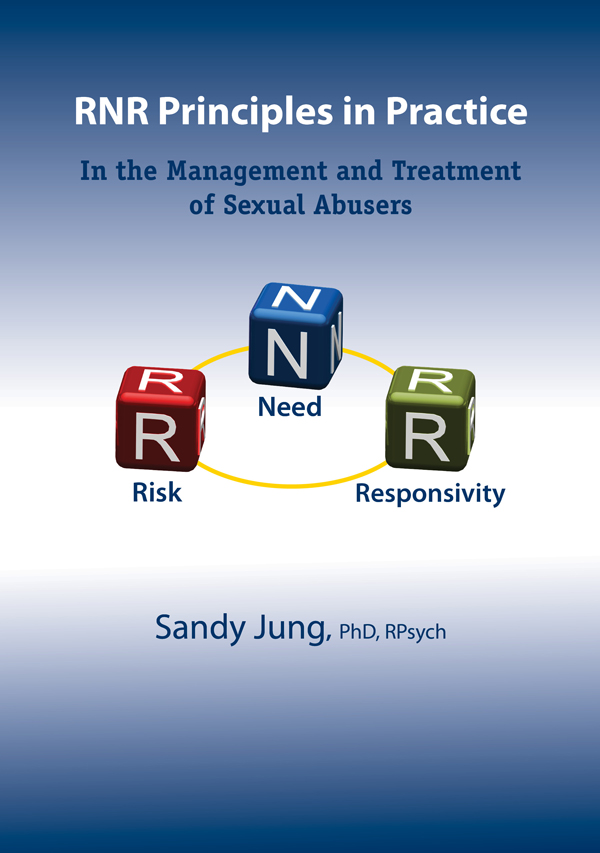
RNR Principles in Practice
Bulk discount as low as $23.10Successfully Added to your Shopping CartAdding to Cart...