Home / Shop / Online Trainings / Trainings
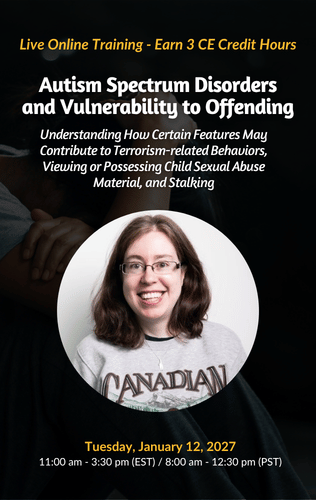
Live Online Training - Autism Spectrum Disorders and Vulnerability to Offending
$140.00
A one-time price of $140.00 will be added to your order.
Categories: Live Online Training
Manufacturer: Safer Society Foundation


- Description
- Product safety
Autism Spectrum Disorders and Vulnerability to Offending:
Understanding How Certain Features May Contribute to Terrorism-related Behaviors, Viewing or Possessing Child Sexual Abuse Material, and Stalking
Date: January 12, 2027
Time: 11:00 am – 3:30 pm EST / 8:00 am – 12:30 pm PST
Format: Live interactive training offered via Zoom
Presented by: Clare Allely, PhD (See Bio)
You must attend the entire live training and complete an evaluation to be eligible for CE credits. If you seek only psychology credits, the evaluation is optional, and you can remain anonymous.
This training will not be converted into an on-demand format, and the recording will not be available.
Online Training Description:
When individuals with autism spectrum disorder (ASD) engage in harmful or offending behaviors, it can be helpful to conceptualize risk factors as vulnerabilities that may increase the likelihood that harm will occur. Dr. Clare Allely, an internationally recognized expert on ASD and its links to harmful behaviors, developed this training to help professionals understand these vulnerabilities in relation to terrorism-related behaviors, viewing or possessing child sexual abuse material (CSAM), and stalking.

Using case examples to illustrate the complex relationship between autism and risk for harm, Dr. Allely:
- Provides an overview of ASD and key clinical considerations
- Explains how certain features of autism may contribute to vulnerabilities in individual cases, while distinguishing these vulnerabilities from generalized assumptions about the likelihood an individual with ASD will engage in harmful or offending behaviors.
- Describes the Terrorist Radicalization Assessment Protocol (TRAP-18) as a measure that may be useful to professionals*
Dr. Allely also examines the roles that autistic special interests, fantasy, obsessionality, the need for routine and predictability, social and communication difficulties, cognitive style, local coherence, systemizing, and sensory processing may contribute to vulnerabilities associated with harmful or offending behaviors.
*Please note that this is not a training on how to administer the TRAP-18. Rather, Dr. Allely discusses its potential use as a framework for understanding and managing risk for lone-actor acts of terrorism.
As a result of this training, participants will be able to:
1) Explain the distinction between ASD-related vulnerabilities that may contribute to specific harmful behaviors and assumptions about an autistic person’s likelihood of offending based on diagnosis alone
2) Identify a measure that can help to manage and prevent lone-actor terrorist acts
3) Describe how social and communication difficulties can increase risk for harmful behaviors
4) List key clinical considerations when working with a person with ASD who has caused harm
Interactive Follow-Up Meeting
Attendees are invited to join an open discussion 15 minutes following the end of the training, where you can engage with fellow attendees by turning on your camera and microphone. This is an opportunity to share your experiences and contribute to a meaningful exchange of ideas. Time will be allocated to address questions or insights from the training. Please note that attendance is optional and will not affect your eligibility for a training certificate.
We can refund your training fee up to 24 hours prior to the start of the training.
To view all training details and review our list of frequently asked questions, please click here to visit the promotional page.
Related Publications
-
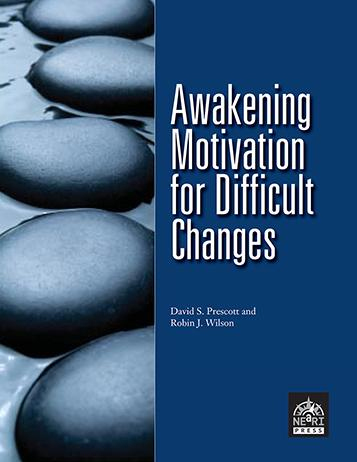
Awakening Motivation for Difficult Changes
Bulk discount as low as $14.70Successfully Added to your Shopping CartAdding to Cart... -
Passport to Independence
Bulk discount as low as $23.80Successfully Added to your Shopping CartAdding to Cart... -
Mastering the Art of Group Therapy: A Guide for Facilitators
Bulk discount as low as $28.00Successfully Added to your Shopping CartAdding to Cart... -
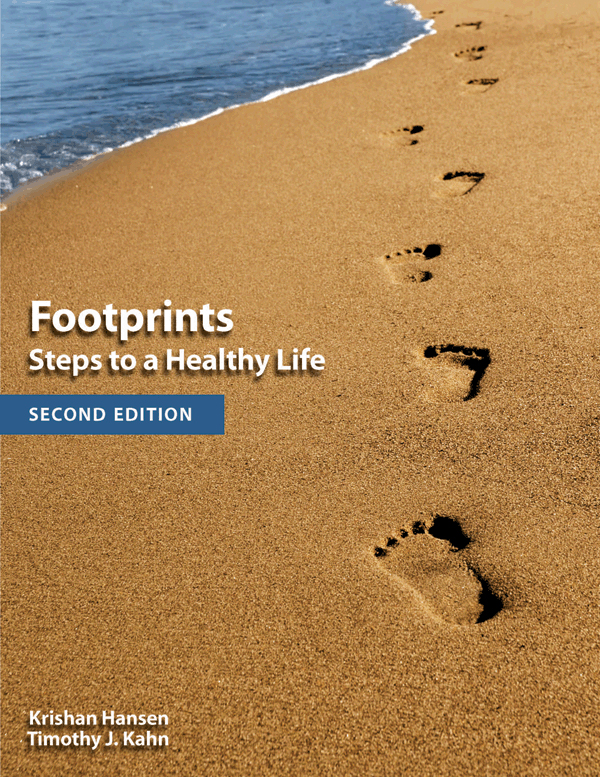
Footprints - 2nd Edition
Bulk discount as low as $24.50Successfully Added to your Shopping CartAdding to Cart...