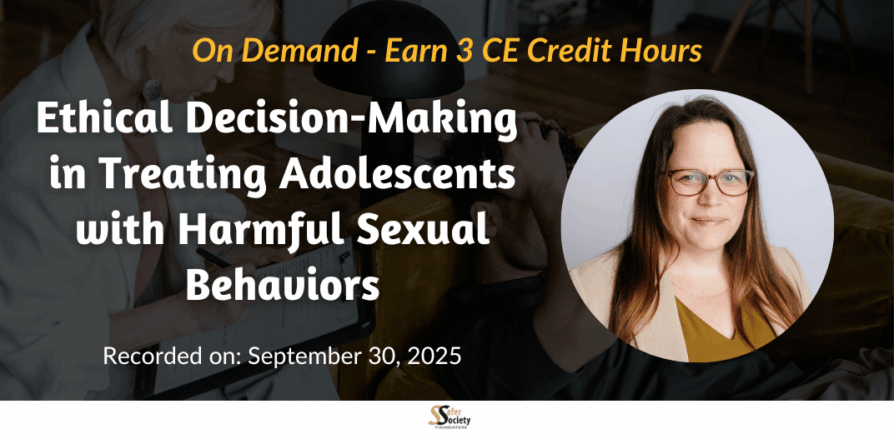
Ethical Decision-Making in Treating Adolescents with Harmful Sexual Behaviors

In this training, Ms. Pryor explores the ethical tensions that arise between treatment providers and the criminal justice system—each with their own goals and approaches. She discusses strategies for aligning therapeutic interventions with both legal requirements and ethical standards, and reviews relevant ethical codes to support effective and principled clinical decision-making.

Domestic Violence Awareness Month: Supporting Survivors Through Effective Intervention with Those Who Cause Harm

As October approaches and we prepare for this year’s annual Domestic Violence Awareness Month (DVAM), the theme “With Survivors, Always” calls on us to display unwavering solidarity with those who have experienced intimate partner violence (IPV). This commitment to safety, support, and solidarity is vital. A recent training on the CARE Method for treating those responsible for domestic violence suggests something else we need to bear in mind: We cannot fully support the victims of IPV without also effectively treating those who caused the harm. As CARE Method founder Nil Buckley emphasized throughout her training, “If we’re not doing treatment for offenders effectively, we’re not reducing recidivism, and we are not increasing victim safety.”

Helping Justice-Involved Clients Build Relationship Skills

Reentering society after incarceration is a complex process, particularly for justice-involved individuals with histories of sexual offending, intimate partner violence, or other behaviors that place them at risk of perpetrating harm. Professionals in the field play a crucial role in supporting these individuals as they work to rebuild trust, connection, and healthy relationships. Grounded in relational, trauma-informed, and accountability-centered frameworks, this training offers participants a compassionate approach to working with justice-involved clients and the crucial skills that help prevent further harmful behavior.

Through a blend of psychoeducation, interactive discussion, and hands-on skill-building, participants learn how to accompany clients in an exploration of boundary setting, consent, attachment dynamics, shame resilience, and the impact of social stigma on relational development. Special attention is given to navigating dating, disclosure, and emotional vulnerability in ways that prioritize both client safety and community responsibility.
Paths to Effective Care: Timothy Kahn’s Five Decades in Sexual Behavior Treatment

When Timothy Kahn, MSW, CSOTP, began working with youths who had engaged in sexually harmful behaviors in the 1970s, he was just 18 years old. Now, after nearly five decades in the field, his perspectives on what leads young people to commit sexual offenses—and how to help them—have evolved significantly.

After earning his Master of Social Work from Boston College in 1987, Kahn helped establish one of the first juvenile treatment programs for those involved in sexual offenses. Currently practicing in Bellevue, Washington, he conducts evaluations and treatment with children, adolescents, and adults with sexual behavior problems, serves as an expert consultant in professional sexual misconduct cases, and has authored multiple treatment workbooks, including the fifth edition of Pathways, for 14- to 18-year-olds and Pathways: Base Camp, for 11- to 14-year-olds.

Evidence-Based Safety Planning: A Practical Approach to Suicide Prevention

September is Suicide Prevention Month, when mental health professionals, advocates, and communities unite to share resources that save lives. This year, Substance Abuse and Mental Health Services (SAMHSA)’s Week 3 theme highlights collaborative safety planning as a tool that gives people “a sense of control and of hope” during a suicidal crisis. A recent training by Mark Margolis—Suicide Prevention Coordinator at Howard Center in Vermont—demonstrated exactly how this evidence-based approach works in practice.

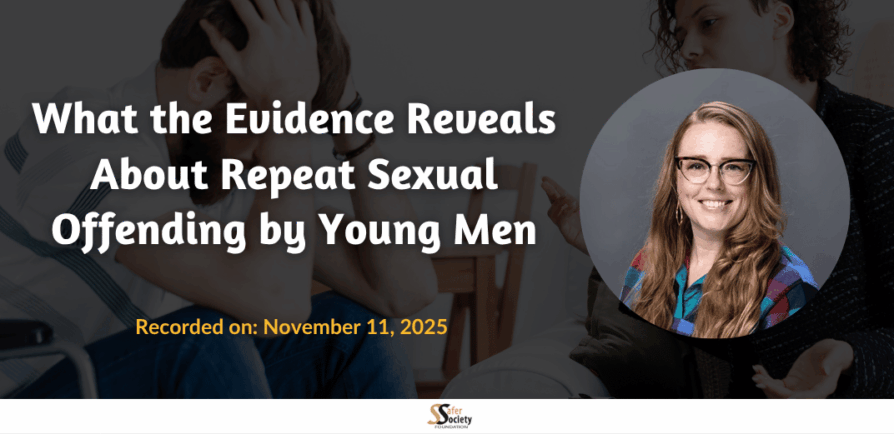
What the Evidence Reveals About Repeat Sexual Offending by Young Men

RaeAnn Anderson, PhD, a human sexuality researcher and educator at the Sexual Violence Prevention Laboratory of the University of Missouri–Kansas City, makes a strong case that both research and practice are not making the most of our existing findings and that the true implications of what we have learned are profound. During this webinar, Dr. Anderson explores what we know about repeated sexual harm perpetration by young men across multiple settings, drawing from a variety of fields to highlight both the evidence and its consequences.