
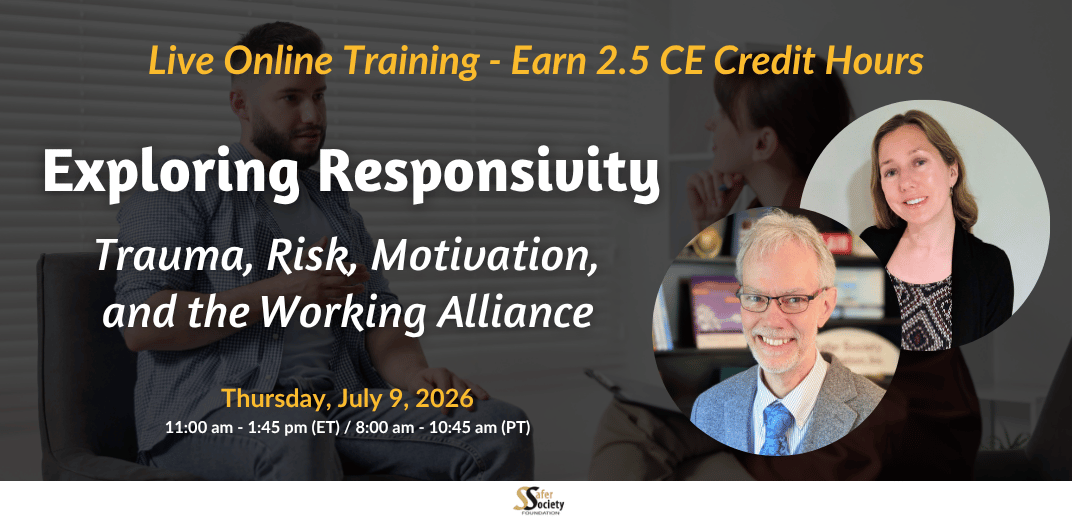
Exploring Responsivity: Trauma, Risk, Motivation, and the Working Alliance
The responsivity principle is broadly defined as matching treatment services to each client’s individual characteristics. Of the three primary principles of effective correctional rehabilitation (risk, need, and responsivity), it can sometimes be the least clearly understood in practice. Recognizing this, Mr. Prescott and Dr. Nassen developed this training to help professionals in tailoring services for clients in treatment for sexual offending.
During this training, Mr. Prescott and Dr. Nassen explore the responsivity principle and its implications for treatment programs. They address recent developments in the field of understanding and treating adults and older adolescents who sexually abuse, including the broader Risk-Need-Responsivity (RNR) framework. The presenters then examine how childhood adversity can influence dynamic risk and overall functioning, which may create barriers to developing a lifestyle in which causing harm is unnecessary and undesirable. The training also reviews methods for improving responsivity and the working alliance, such as Feedback Informed Treatment, Motivational Interviewing, and related approaches
While the field has improved in understanding the ever-changing nature of risk and treatment need, there are continuing opportunities to enhance our abilities to provide treatment in a way that clients can respond to.
Interactive Follow-Up Meeting
Attendees are invited to join an open discussion 15 minutes following the end of the training, where you can engage with fellow attendees by turning on your camera and microphone. This is an opportunity to share your experiences and contribute to a meaningful exchange of ideas. Time will be allocated to address questions or insights from the training. Please note that attendance is optional and will not affect your eligibility for a training certificate.
1) Explain how adverse childhood experiences impact behavior and responsivity to treatment
2) Describe the relationship between trauma sequelae and dynamic risk
3) Use practical skills for understanding and improving treatment engagement
4)Describe how the responsivity principle applies at the institutional and program levels
Audience
This training is for professionals working with adult and older adolescent clients who have committed sex crimes and who wish to better tailor their interventions to the needs of each client to prevent future sexual abuse. This includes social workers, psychologists, clinical counselors, therapists, and interested paraprofessionals.
Content Level
Disclosure
Cancellations
Continuing Education Approval
American Psychological Association (APA)
Safer Society Foundation, Inc. is approved by the American Psychological Association (APA) to sponsor continuing education for psychologists. Safer Society Foundation, Inc. maintains responsibility for this program and its content.
Association of Social Work Boards (ASWB)
Safer Society Foundation, Inc., provider #233, is approved to offer social work continuing education by the Association of Social Work Boards (ASWB) Approved Continuing Education (ACE) program. Regulatory boards are the final authority on courses accepted for continuing education credit. ACE provider approval period: 06/06/2025—06/06/2026. Social workers completing this course receive 2.5 clinical continuing education credits.
Who's Presenting
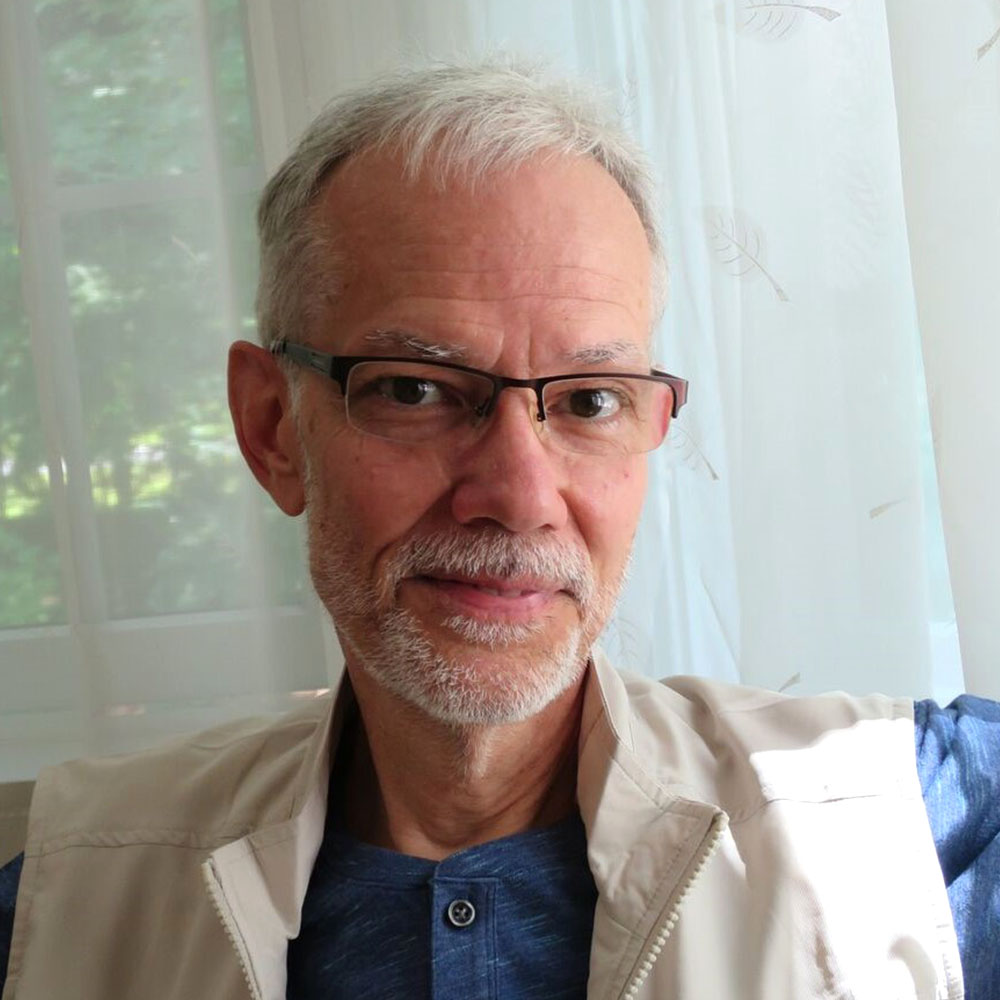
David Prescott, LICSW, ATSA-F
A mental health practitioner of 40 years, David Prescott is the Director of the Safer Society Continuing Education Center. He is the author and editor of 25 books in the areas of understanding and improving services to at-risk clients. He is best known for his work in the areas of understanding, assessing, and treating sexual violence and trauma. Mr. Prescott is the recipient of the 2014 Distinguished Contribution award from the Association for the Treatment and Prevention of Sexual Abuse (ATSA), the 2018 recipient of the National Adolescent Perpetration Network’s C. Henry Kempe Lifetime Achievement award, and the 2022 recipient of the Fay Honey Knopp Award from the New York State Alliance for the Prevention of Sexual Abuse and New York State ATSA. He also served as ATSA President in 2008-09. Mr. Prescott currently trains and lectures around the world. His published work has been translated into Japanese, Korean, German, French, Polish, and Southern Tutchone. He has served on the editorial boards of four scholarly journals.

Nikole Nassen, PhD
Nikole Nassen, Ph.D., is a clinical psychologist and the director of the Sex Offender Treatment Program at Naval Consolidated Brig Miramar. She has been involved in program development and implementation for Naval Corrections’ Violent Offender and Sex Offender Treatment Programs and has worked with individuals who have expressed non-traditional sexual interests in the context of these programs. Dr. Nassen is a Clinical Member of the Association for Treatment and Prevention of Sexual Abuse (ATSA) and is a member of ATSA’s Adult Community of Practice. She is also the Training Coordinator for the California Association for Treatment and Prevention of Sexual Abuse (CalATSA) and a Safer Society Collaborator. Dr. Nassen received her doctorate degree in Clinical Psychology from Alliant International University in 2008. She has assessed and treated individuals who have committed violent and sexual offenses, as well as individuals with mental health concerns, in community and in correctional settings. She has also completed clinical and forensic evaluations of adults and adolescents for the Delinquency and Dependency Courts in San Diego.