
• How to Effectively Use Dynamic Risk Assessment Tools: STABLE-2007 & ACUTE-2007 Training (Day 02)

    During this eight-hour training, Katie Gotch, LPC, CCSOT, ATSA-F, provides an overview of the development and research of the STABLE-2007 and ACUTE-2007 instruments. She explains how to score each of the measures’ items, as well as their appropriate interpretation and use within varying settings. This includes recent guidance on the use of these tools with individuals convicted of child sexual abuse material-related offenses (CSAM). To enhance learning, case studies are incorporated to provide hands-on practice and to address common scoring and administration errors.

    $280.00

  • Helping Clients Prepare for Change:
Exploring Ambivalence in Abuse Prevention

    Ambivalence is a universal human experience—we have all felt torn between two directions at different points in our lives. In clinical settings, practitioners often encounter clients who express a desire for change while remaining unsure about engaging in treatment. In this webinar, Motivational Interviewing trainer and domestic violence expert Lauren Garder explores how ambivalence manifests in clients whose actions have caused harm to others and how what may appear as resistance can, in fact, present valuable opportunities for meaningful clinical exploration. Participants will gain practical examples and strategies for skillfully eliciting, exploring, and resolving ambivalence to help clients move toward meaningful conversations about change.

    Free
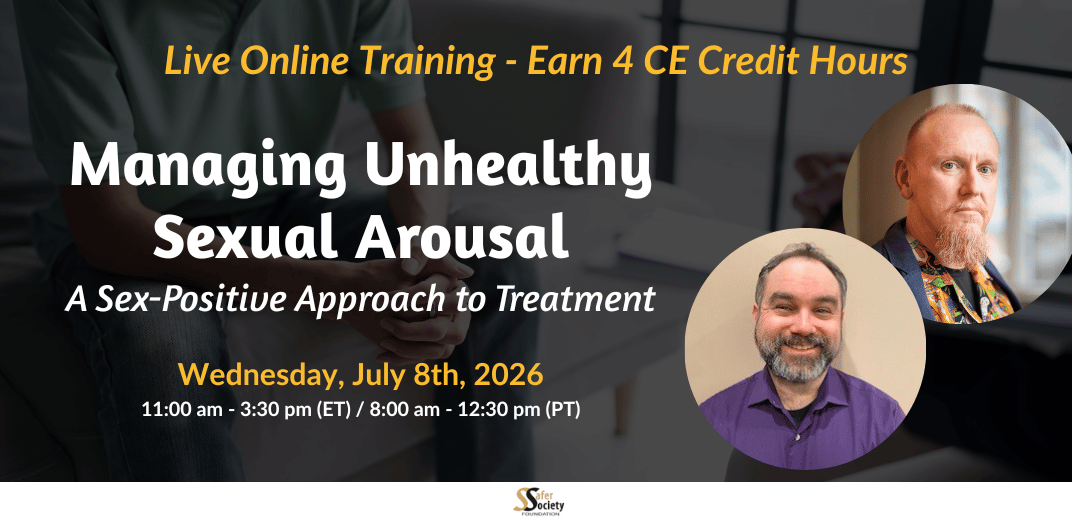
  • Managing Unhealthy Sexual Arousal: A Sex-Positive Approach to Treatment

    Dr. Jackson and Dr. Ballinger developed this training to support professionals in adopting sex-positive, non-judgmental approaches to help clients in managing unhealthy patterns of sexual arousal patterns. Many individuals who have sexually abused have had limited sex education and few opportunities to understand the role of sexuality in their lives. Against this backdrop, it is more constructive for clients to view healthy sexuality as a goal to pursue and achieve, rather than regarding sexual arousal as something to avoid for the rest of their lives.

    $140.00
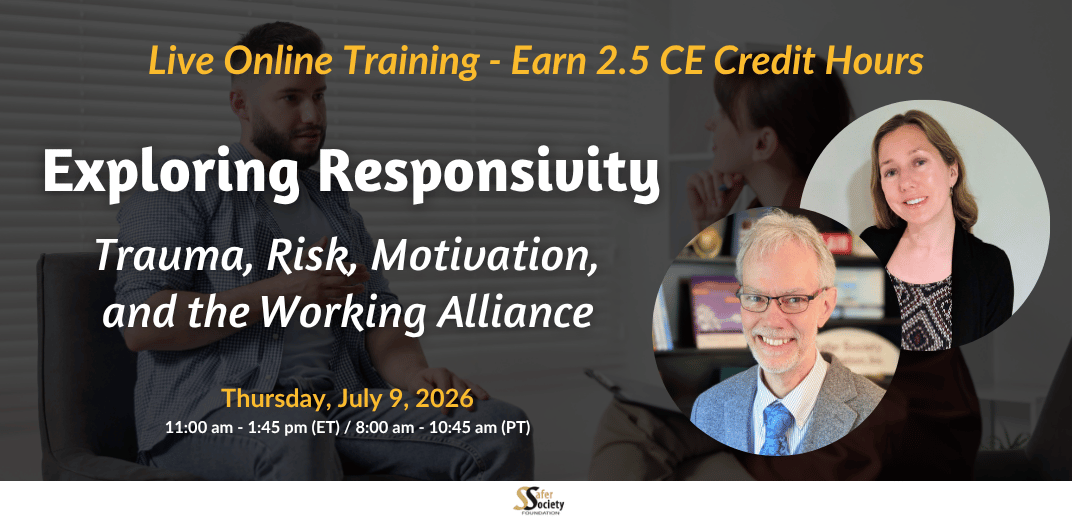
  • Exploring Responsivity: Trauma, Risk, Motivation, and the Working Alliance

    This training, presented by Mr. Prescott and Dr. Nassen, focuses on the responsivity principle—matching treatment services to each client’s unique characteristics. As one of the three key principles of effective correctional rehabilitation, responsivity is often the least clearly understood in practice. The presenters explore how this concept applies to treatment programs for adults and older adolescents who commit sexual offenses, within the broader Risk-Need-Responsivity (RNR) framework. They discuss how childhood adversity can shape dynamic risk and functioning, and review evidence-informed methods for improving responsivity and the therapeutic alliance, including Feedback Informed Treatment and Motivational Interviewing.

    $87
  • What Have We Learned from Research on Assessing Sexual Interests?

    This webinar examines efforts to prevent further sexual offending by exploring sexual interests and arousal patterns, including psycho-physiological measures and viewing time, while raising key questions about reliability, validity, standardization, interpretation, and levels of intrusiveness. Mervyn Davies, co-founder of the LOOK Assessment, reflects on decades of work in understanding and assessing human sexuality, reviewing past assessment efforts with people convicted of sexual crimes, the importance of structured measures, the limits of current knowledge, methodological challenges in developing reliable tools, and the role of assessment in preventing violence, including sexual assault.

    Free
  • Trauma-Informed Care for Survivors of Domestic Violence

    Trauma-specific treatments for experiences such as domestic violence are often conflated with trauma-informed care, though they are distinct. Trauma-informed care is not a specific service, treatment model, or protocol; rather, it is an overarching approach to understanding and supporting others. Lauren Garder developed this training to help professionals understand how trauma and adversity shape how we think, communicate, and engage with survivors.

    $105.
  • The Effectiveness of Motivational Approaches with Domestic Violence and Justice-Involved Individuals

    Teresa Pinto e Silva, a forensic psychologist and PhD researcher at the University of Minho, presents her research on Motivational Interviewing (MI) in justice settings, highlighting its effectiveness in improving engagement, motivation for change, and behavioral outcomes among justice-involved individuals, particularly those in early stages of change. She discusses key findings from her work, practical applications for professionals working with domestic violence populations, and the role of therapist genuineness and the therapeutic relationship in supporting lasting change.

    Free
  • Our Safe Haven: Advancing Allyship and Support Services for People with Marginalized Sexual Orientation and/or Gender Identity (MOGI)

    ndividuals with marginalized sexual orientations and/or sexual identities (MOGI) encounter numerous interrelated challenges, including stigma, discrimination, and violence in social, educational, and professional environments; heightened risk of mental health issues due to social isolation and abuse; barriers to accessing vital health and support services; and rejection from families or communities, often resulting in homelessness and further marginalization. These challenges are compounded by cultural misunderstandings, intersecting forms of exclusion, and gaps in societal and institutional support. Addressing them requires a collective effort to advance inclusion, equity, and community acceptance for people of all MOGI, ensuring their dignity and rights are respected and upheld.

    In response to these realities, we invite those supporting MOGI-diverse individuals and members of their communities to join us for this series of professional dialogues moderated by Jimmy Widdifield, Jr., and David Prescott. Created to foster meaningful and respectful conversations, these sessions provide a space for professionals to openly explore the challenges faced by individuals with diverse MOGIE. Through shared experiences, expert insights, and practical guidance, attendees will gain strategies to strengthen advocacy, promote inclusive practices, and build effective allyship—helping to foster environments where all people can live authentically and thrive.

    $8.00
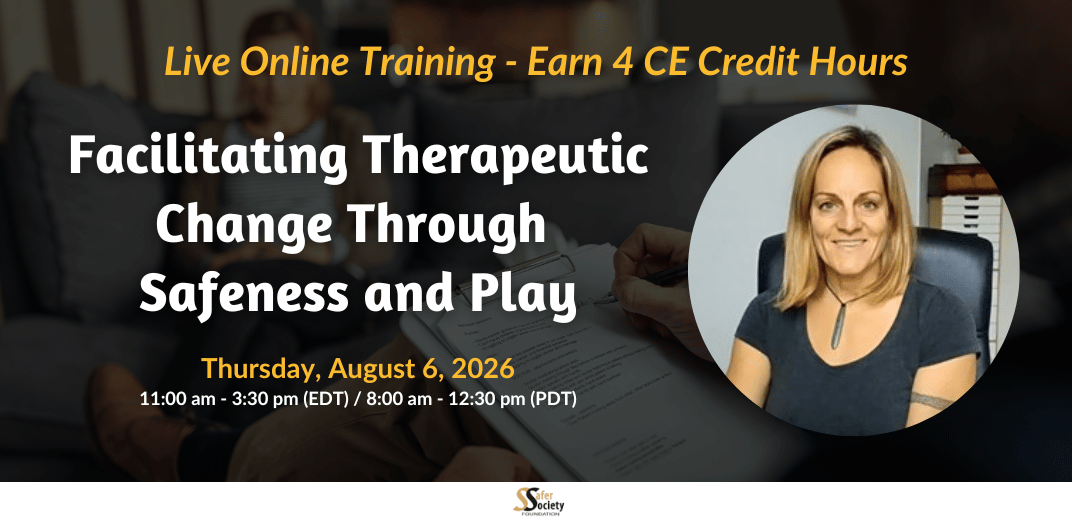
  • Facilitating Therapeutic Change Through Safeness and Play

    In this training, Dr. Kate Lucre—an expert in treating relational trauma and attachment issues—explores the relationship between safeness and play, and why both are central to meaningful therapeutic work across client populations. Her approach is grounded in compassion-focused therapy and related modalities.

    Drawing on the work of Donald Winnicott, particularly his contributions to developmental psychology and early parent–infant relationships, Dr. Lucre conceptualizes therapy as a shared “play space”: a relational field in which insight, experimentation, and integration can emerge. When safeness is absent, however, therapy can quickly constrict, leaving clients entrenched in rigidity, over-intellectualization, or emotional withdrawal. Moreover, both safeness and play may themselves feel threatening, particularly in the context of complexity and vulnerability.

    $140.00
  • Our Safe Haven: Advancing Allyship and Support Services for People with Marginalized Sexual Orientation and/or Gender Identity (MOGI)

    ndividuals with marginalized sexual orientations and/or sexual identities (MOGI) encounter numerous interrelated challenges, including stigma, discrimination, and violence in social, educational, and professional environments; heightened risk of mental health issues due to social isolation and abuse; barriers to accessing vital health and support services; and rejection from families or communities, often resulting in homelessness and further marginalization. These challenges are compounded by cultural misunderstandings, intersecting forms of exclusion, and gaps in societal and institutional support. Addressing them requires a collective effort to advance inclusion, equity, and community acceptance for people of all MOGI, ensuring their dignity and rights are respected and upheld.

    In response to these realities, we invite those supporting MOGI-diverse individuals and members of their communities to join us for this series of professional dialogues moderated by Jimmy Widdifield, Jr., and David Prescott. Created to foster meaningful and respectful conversations, these sessions provide a space for professionals to openly explore the challenges faced by individuals with diverse MOGIE. Through shared experiences, expert insights, and practical guidance, attendees will gain strategies to strengthen advocacy, promote inclusive practices, and build effective allyship—helping to foster environments where all people can live authentically and thrive.

    $8.00
  • Our Safe Haven: Advancing Allyship and Support Services for People with Marginalized Sexual Orientation and/or Gender Identity (MOGI)

    ndividuals with marginalized sexual orientations and/or sexual identities (MOGI) encounter numerous interrelated challenges, including stigma, discrimination, and violence in social, educational, and professional environments; heightened risk of mental health issues due to social isolation and abuse; barriers to accessing vital health and support services; and rejection from families or communities, often resulting in homelessness and further marginalization. These challenges are compounded by cultural misunderstandings, intersecting forms of exclusion, and gaps in societal and institutional support. Addressing them requires a collective effort to advance inclusion, equity, and community acceptance for people of all MOGI, ensuring their dignity and rights are respected and upheld.

    In response to these realities, we invite those supporting MOGI-diverse individuals and members of their communities to join us for this series of professional dialogues moderated by Jimmy Widdifield, Jr., and David Prescott. Created to foster meaningful and respectful conversations, these sessions provide a space for professionals to openly explore the challenges faced by individuals with diverse MOGIE. Through shared experiences, expert insights, and practical guidance, attendees will gain strategies to strengthen advocacy, promote inclusive practices, and build effective allyship—helping to foster environments where all people can live authentically and thrive.

    $8.00