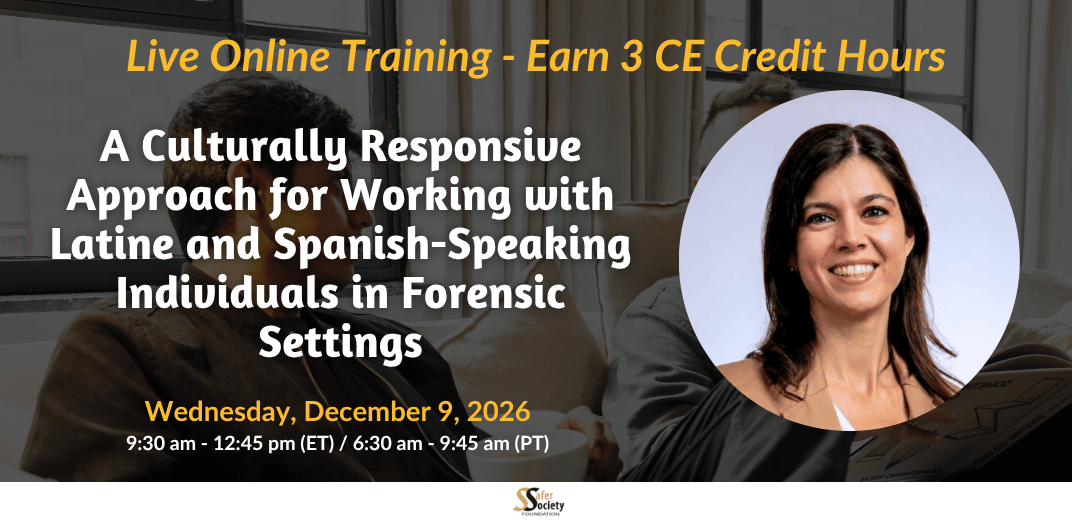
• A Culturally Responsive Approach for Working with Latine and Spanish-Speaking Individuals in Forensic Settings

    How can forensic practitioners conduct culturally responsive evaluations when the research offers limited guidance for working with Latine and Spanish-speaking individuals? In this training, Dr. Aparcero-Suero bridges the gap between research and practice. Participants will examine how sociocultural factors shape behavior, communication, and symptom expression—and how these differences can be misinterpreted in legal and mental health settings. The training offers practical guidance on working with interpreters, selecting and interpreting assessment instruments, and mitigating bias without stereotyping. It also considers sex offender risk assessment, treatment responsivity, and the research still needed to advance culturally responsive care.
    $105.00
  • Exploring the Role of Fanfiction in the Treatment of Adolescents and Emerging Adults Who Have Sexually Abused

    In this training, Ms. Hilliard reviews how fanfiction may relate to sexual scripts, understanding of consent, and impulsivity. She explains how professionals can pair cultural literacy about fan communities with evidence-informed practice. The training equips attendees to distinguish normative creative engagement from maladaptive or risk-laden patterns, tailor interventions, and engage clients in developmentally and ethically sound ways.

    $50.00
  • The Lethality Assessment Protocol: What It Is, How It Works, and Why It’s Important

    The Lethality Assessment Protocol (LAP) helps prevent intimate partner homicides and serious injuries by connecting victims to life-saving, community-based services. In this training, Sandie Campanella, a former police detective and District Attorney investigator, helps professionals understand and apply the LAP, particularly during periods of separation when the risk of lethal violence is greatest. Participants will learn how the LAP informs investigations, court decisions, and treatment; connects individuals at high risk to advocates for immediate resources and safety planning; and supports accountability for individuals who have caused harm.

    $105.00
  • Structured Assessment of Protective Factors Against Sexual Offending (SAPROF-SO) Version 1 Training

    The SAPROF-SO is a tool for assessing protective factors for individuals with a history of sexual offending, integrating with strengths-based therapeutic approaches. This tool comprises 14 items across three key subscales: Resilience, Adaptive Sexuality, and Prosocial Connection & Reward, with an optional fourth subscale, Professional Risk Management. Renowned for its strong reliability and predictive validity for reduced sexual recidivism (e.g., Nolan et al., 2023; Willis et al., 2020), the SAPROF-SO is instrumental in guiding therapy planning and risk management strategies (Kelley et al., 2022). This workshop, presented by Gwenda Willis, David Thornton, and Sharon Kelley, offers a training opportunity for clinicians interested in learning how to score and interpret the SAPROF-SO.

    $228.00
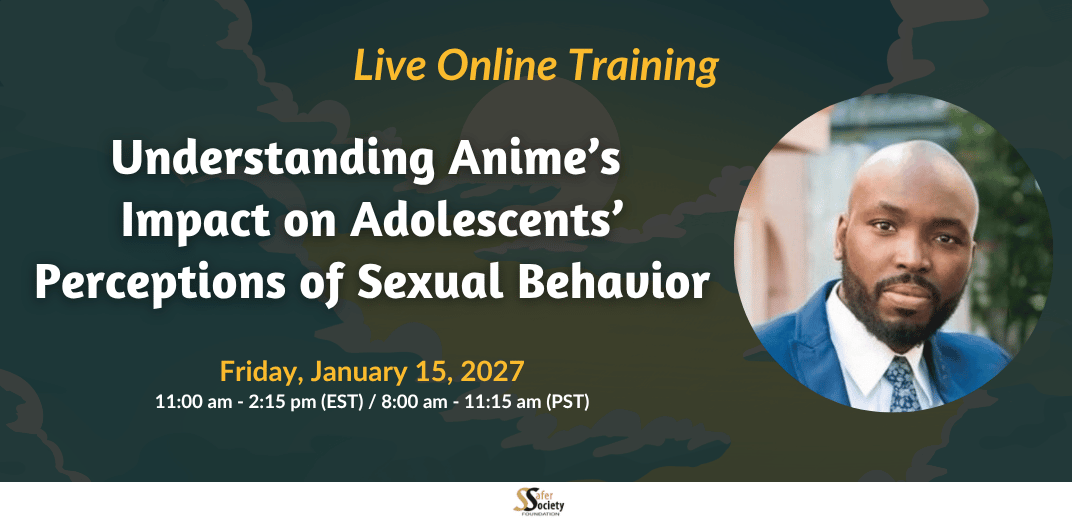
  • Understanding Anime’s Impact on Adolescents’ Perceptions of Sexual Behavior

    Developed by Jermaine Wall, a clinician with expertise in anime who treats adolescents who have sexually abused others, this training explores anime’s cultural influence and its relevance to clinical practice. It focuses on adolescents who have engaged in sexually abusive behavior while offering insights for parents, educators, and mental health professionals who work with youth.

    $72.00
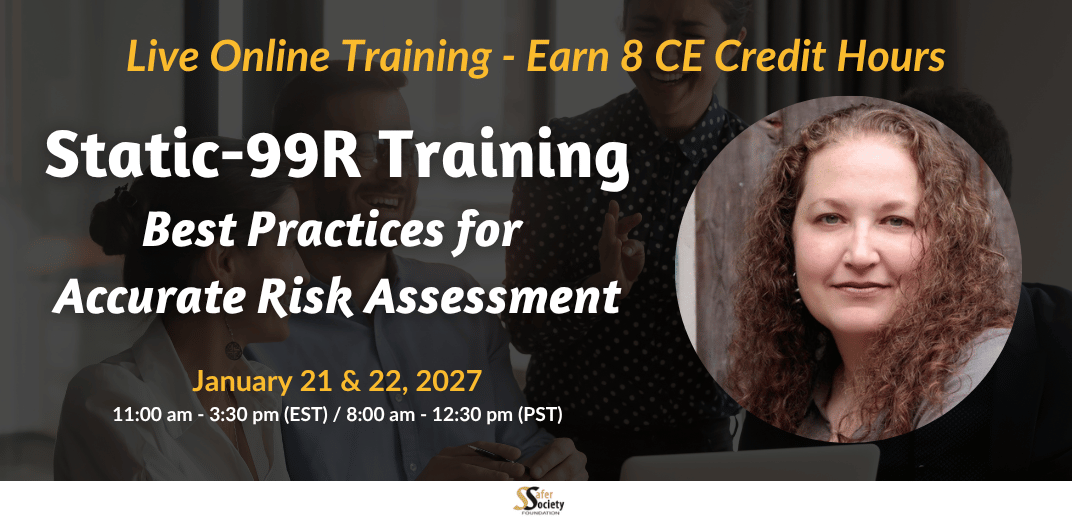
  • Static-99R Training: Best Practices for Accurate Risk Assessment (Day 01)

    In this training, Certified Trainer Katie Gotch provides a thorough overview of the Static-99R, including its development, scoring system, and application in various settings. Participants learn how to score each of the ten items, with scores ranging from -3 to 12, and understand how these scores categorize individuals into five distinct risk levels: very low, below average, average, above average, and well above average risk.

    The training also covers the predictive validity of the Static-99R and its appropriate use in forensic settings. Case studies are utilized to enhance understanding and facilitate skill development throughout the training.

    $280.00
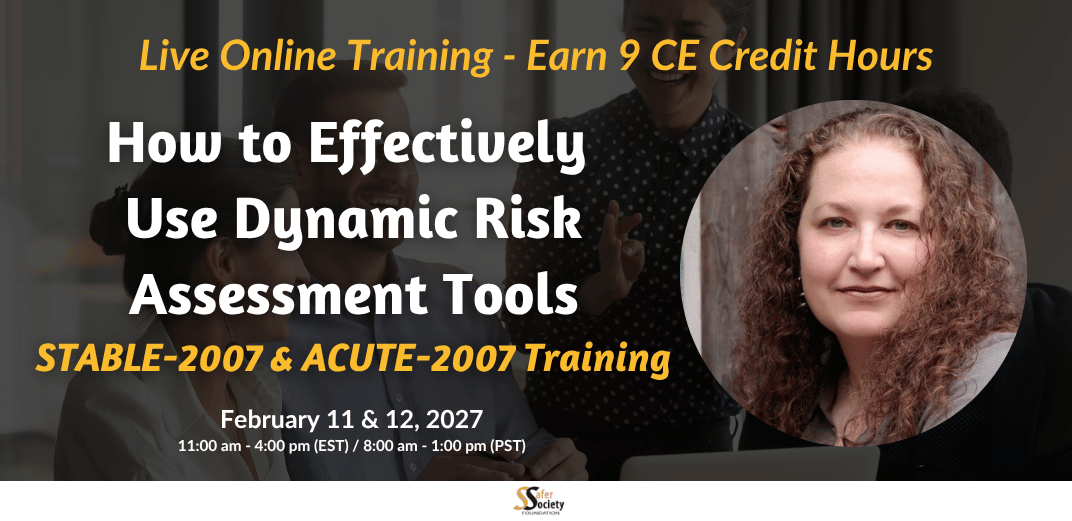
  • How to Effectively Use Dynamic Risk Assessment Tools: STABLE-2007 & ACUTE-2007 Training (Day 01)

    During this nine-hour training, Katie Gotch, LPC, CCSOT, ATSA-F, provides an overview of the development and research of the STABLE-2007 and ACUTE-2007 instruments. She explains how to score each of the measures’ items, as well as their appropriate interpretation and use within varying settings. This includes recent guidance on the use of these tools with individuals convicted of child sexual abuse material-related offenses (CSAM). To enhance learning, case studies are incorporated to provide hands-on practice and to address common scoring and administration errors.

    $315.00
  • How to Effectively Use Dynamic Risk Assessment Tools: STABLE-2007 & ACUTE-2007 Training (Day 02)

    During this nine-hour training, Katie Gotch, LPC, CCSOT, ATSA-F, provides an overview of the development and research of the STABLE-2007 and ACUTE-2007 instruments. She explains how to score each of the measures’ items, as well as their appropriate interpretation and use within varying settings. This includes recent guidance on the use of these tools with individuals convicted of child sexual abuse material-related offenses (CSAM). To enhance learning, case studies are incorporated to provide hands-on practice and to address common scoring and administration errors.

    $315.00