During this training, Dr. Michael Miner, Emeritus Professor of Family Medicine and Community Health at the University of Minnesota, addresses the criteria and processes of diagnosing paraphilias and paraphilic disorders as described in the DSM-5-TR. He covers historical and current definitions, clarifies the differences between paraphilias and disorders, focuses on pedophilia considerations, and guides attendees through diagnosing various paraphilias, such as sexual sadism and voyeurism, with insights on applying DSM-5-TR criteria effectively.
Online Training
Events
Calendar of Events
|
Monday
|
Tuesday
|
Wednesday
|
Thursday
|
Friday
|
Saturday
|
Sunday
|
|---|---|---|---|---|---|---|
|
0 events,
|
0 events,
|
0 events,
|
0 events,
|
0 events,
|
0 events,
|
0 events,
|
|
0 events,
|
1 event,
-
$90
|
0 events,
|
0 events,
|
0 events,
|
0 events,
|
0 events,
|
|
0 events,
|
0 events,
|
0 events,
|
0 events,
|
0 events,
|
0 events,
|
0 events,
|
|
0 events,
|
0 events,
|
1 event,
-
Clarification involves honesty about abusive behaviors, taking responsibility for them, and building a safer future. Professionals have long faced the challenge of helping families in the wake of sexual abuse. Practitioners must consider the complex needs of multiple people, including those who have harmed others and been harmed directly and indirectly within the family. Primary considerations include assisting families in building safety plans, ensuring the rights and welfare of those harmed are met, preventing re-traumatization, and having the sibling who has abused learn accountability.
$90
|
0 events,
|
1 event,
-
This training explores how stigma, social norms, moral panic, and sexual attraction act as barriers to those seeking help in preventing themselves from committing their first offense. Dr. Spooner provides a comprehensive understanding of minor-attracted people, as well as the inaccurate narratives about MAPs that result in strained relationships between providers and clients. Lastly, participants are encouraged to identify and reflect on their personal biases, explore effective approaches to meeting the needs of MAPs, and consider alternative approaches to current practices.
$75
|
0 events,
|
0 events,
|
|
0 events,
|
0 events,
|
0 events,
|
0 events,
|
1 event,
-
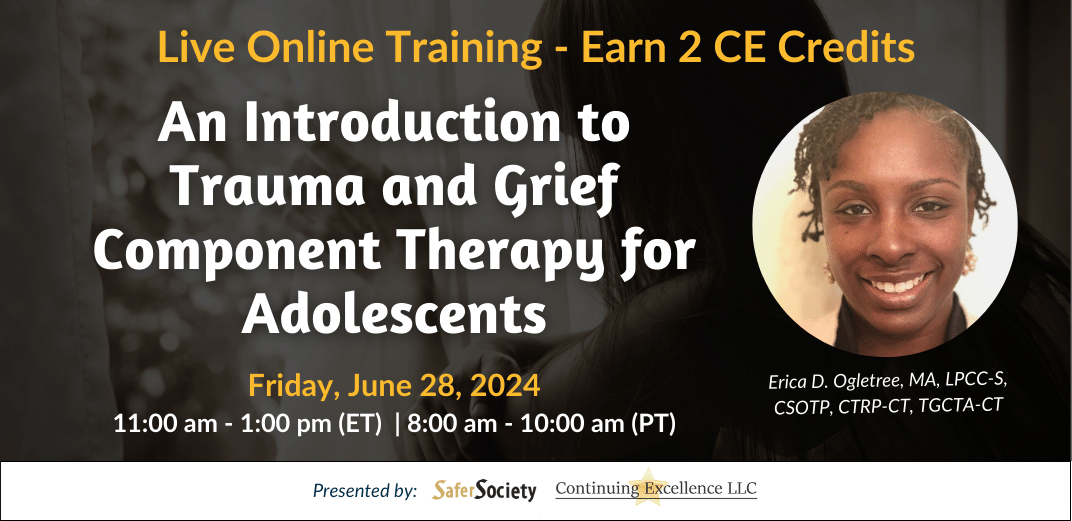
Trauma and Grief Component Therapy for Adolescents (TGCTA) is a four-module program designed to address trauma and grief in adolescents. It can be implemented in various settings, such as community mental health facilities, schools, clinics, and other service settings. This training covers the four modules of TGCTA, which address foundational knowledge and skills to enhance posttraumatic emotional, cognitive, and behavioral regulation, processing of trauma experiences, processing of grief/loss experiences, and the resumption of adaptive developmental progression and future orientation. Presenter Erica Ogletree highlights the features of TGCTA that support its initial implementation and long-term sustainability. This includes detailed instructions with suggested scripts for each session, which is especially useful when there is clinician turnover. Additionally, the grief component in TGCTA aligns fully with the Diagnostic and Statistical Manual of Mental Disorders (5th ed.; DSM-5; American Psychiatric Association , 2013), and it is the only contemporary adolescent treatment that does so. Resistant youths in some settings appear more willing to engage fully with the grief than with the trauma component, thus opening other doors to recovery.
$60
|
0 events,
|
0 events,
|