
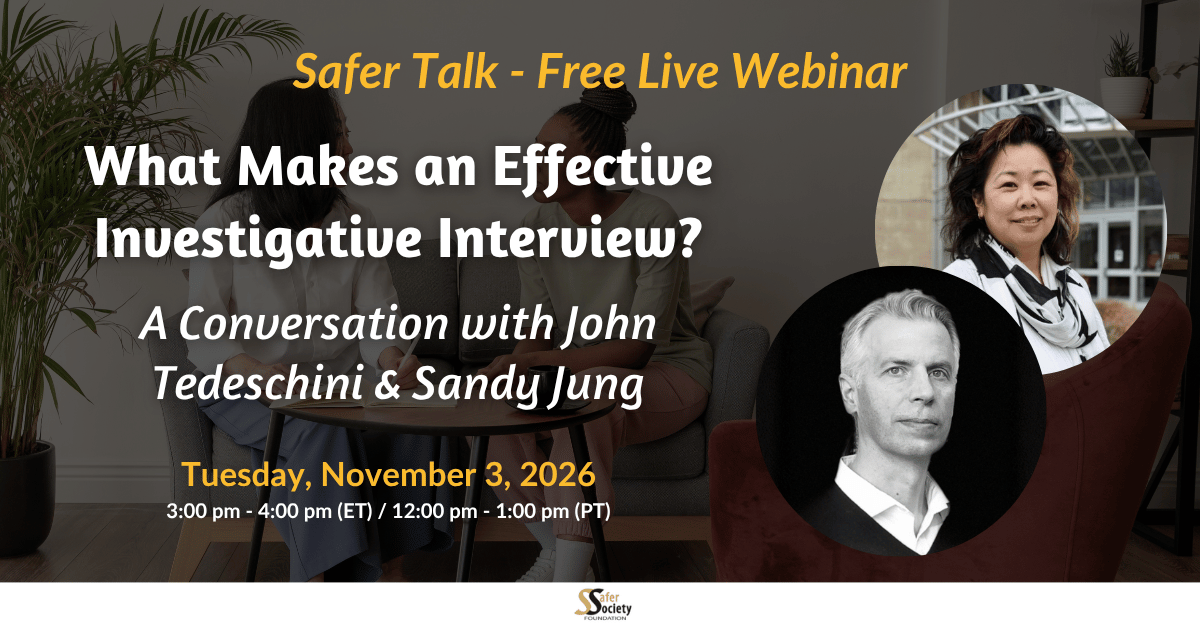
What Makes an Effective Investigative Interview? A Conversation with John Tedeschini & Sandy Jung
Please note: This webinar is not eligible for continuing education (CE) credit due to its informal, conversational format. Participants who attend the full live session will, however, receive a Certificate of Attendance. Also, the webinar recording will be made available for viewing through the On-Demand Webinar Library within 7-10 days following the live event.
This webinar is primarily for professionals whose work involves conducting interviews. This includes psychologists, counselors, social workers, educators, administrators in educational and correctional settings, as well as law enforcement and child welfare personnel.
Investigative interviewing plays a critical role in the work of professionals who prevent and respond to violence and other harmful behaviors. It is also increasingly relevant across a wide range of other settings, including post-secondary campuses and schools, corporate organizations, government departments, and other non-justice contexts such as military operations, health and safety inspections, and fire and rescue investigations. Strong interviewing skills help professionals gather high-quality information to support sound decision-making, particularly in situations where there is potential for interpersonal harm.
John Tedeschini and Sandy Jung, authors of Foundations of Investigative Interviewing: A Practitioner’s Guide, bring this important work to professionals seeking to strengthen their practical interviewing skills and techniques. Their evidence-based approach translates research into practical, accessible guidance to both those without formal interviewing training and experienced practitioners looking to refine their approach.
In this webinar conversation, Tedeschini and Jung offer a brief overview of topics from Foundations of Investigative Interviewing and discuss how they can inform thoughtful practice. Discussion points include:
- The role of planning and preparation in effective interviews
- Core interviewing skills and approaches
- Characteristics of productive questioning
- Several “golden rules” of interviewing that support accurate, ethical information gathering
- Key factors in conducting virtual interviews
Who's Presenting

John Tedeschini
John Tedeschini is a self-employed investigative interviewing trainer and consultant who combines extensive real-world interviewing experience with a commitment to delivering training grounded in psychological science. Throughout his 25-year police career with the Edmonton Police Service, John conducted thousands of interviews as both a patrol officer and a detective in the Major Crimes Section. His investigative assignments encompassed various roles, including the Homicide Section, Polygraph Unit, Internal Affairs, and the Interview Support Team—a specialized unit responsible for conducting, overseeing, and consulting on complex major crime interviews. John was also responsible for developing and delivering groundbreaking investigative interviewing training programs within the Edmonton Police Service and the province of Alberta. A recognized expert in the field of investigative interviewing, John has authored and co-authored articles published in academic journals and has been an invited speaker at national and international conferences hosted by judges, lawyers, and academic institutions.
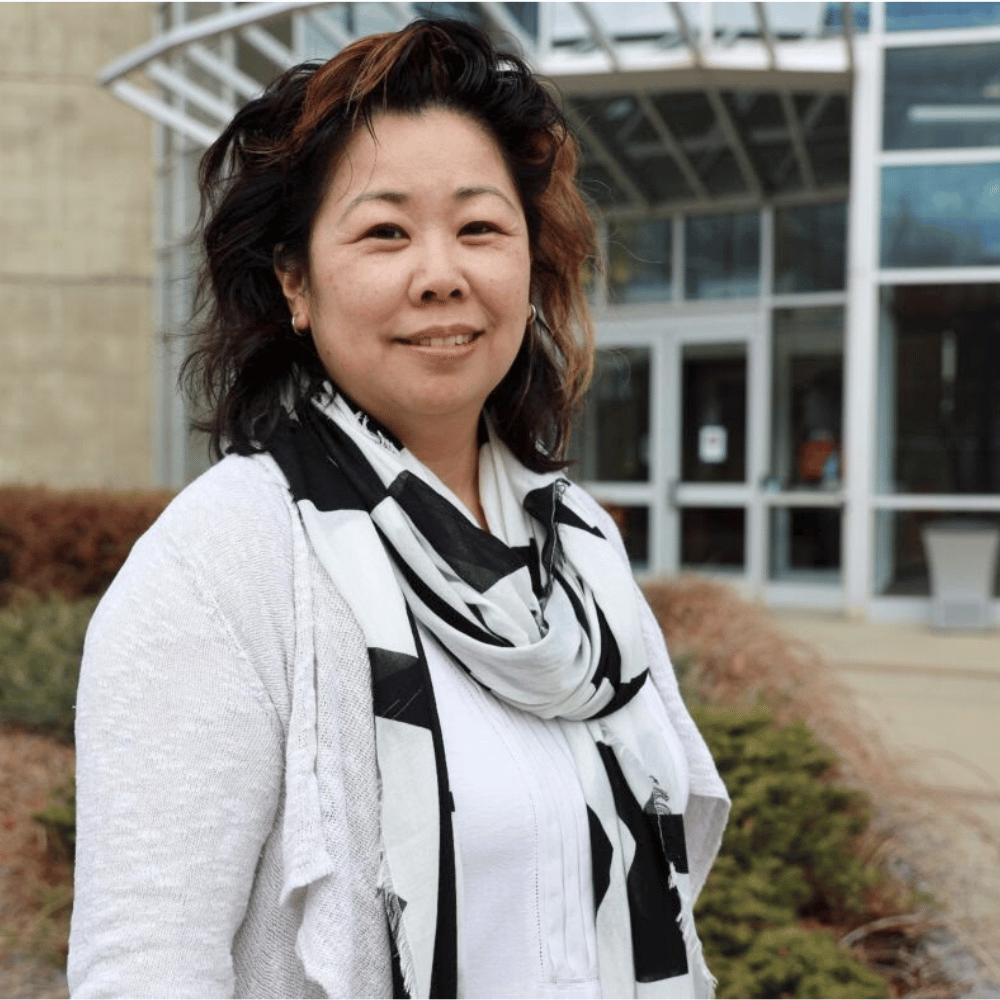
Sandy Jung, PhD, RPsych
Sandy Jung, Ph.D., is a full Professor in the Department of Psychology at MacEwan University in Edmonton, Canada. Prior to her current academic position, she was a forensic psychologist at a forensic mental health facility where she provided assessment, treatment, and risk management of violent and sexual offenders. Sandy maintains an active research program in her Psychology Crime Lab (PCL@M) that focuses on assessing risk for sexual, intimate partner, and gender-based violence. Her research is funded by both internal and major external grants. She has published extensively, often co-authoring peer-reviewed articles with her students, as well as collaborators in law enforcement, forensic mental health, and academia. She has been recognized for her teaching (Distinguished Teaching Award in 2017), research (Distinguished Research Award in 2018, CAFA Distinguished Academic Award in 2021, Board of Governors Research Chair in 2018, and Chancellor’s Research Chair in 2026), and both research and service (Association for the Treatment & Prevention of Sexual Abuse Fellow in 2016 and Canadian Psychological Association Fellow in 2021). She serves on editorial boards for several journals (Psychology of Violence, Sexual Offending: Theory, Research, and Prevention, and Canadian Psychology).