
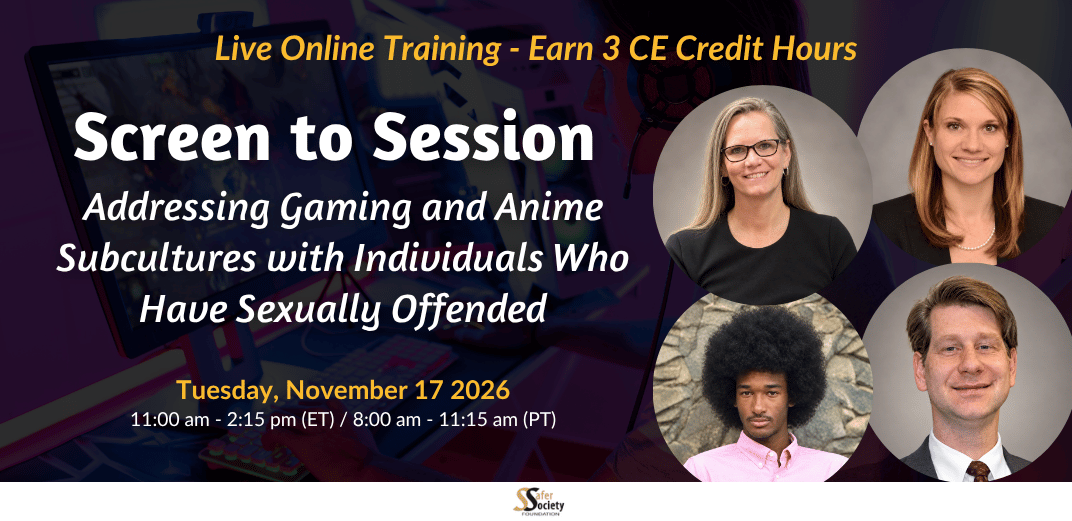
Screen to Session: Addressing Gaming and Anime Subcultures with Individuals Who Have Sexually Offended
This training will be converted into an on-demand format within two weeks following the live event. The on-demand version will be available for separate purchase, providing access to the training content for those who were unable to attend the live event or prefer a self-paced learning experience.
Gaming environments are shared spaces that span age groups. As of 2025, there were approximately 3.32 billion gamers worldwide. In the United States, nearly one-quarter of gamers are minors, and the average gamer is 36 years old. Modern video games are not only a form of entertainment but also a primary means of social interaction through in-game chat, streaming platforms, and gaming-focused social media. Although these environments can foster connection and community, they also present unique risks, including opportunities for sexual harassment, exploitation, and the grooming of minors.
Gaming platforms and affiliated online spaces (for example, Discord, Twitch, and TeamSpeak) facilitate interactions that can be difficult to monitor using traditional supervision methods. In addition, some games contain highly explicit sexual content, including depictions of sexual violence. Such content may present particular risks for individuals under supervision who are prohibited from accessing sexually explicit material but may attempt to circumvent restrictions through gaming environments.

Dr. Tracy Alvord and her colleagues, Elizabeth Bigham, Michael “Christian” Alvord, and Markus Wiegel, developed this training to examine the risks associated with, and responses to, online gaming in the context of sexual harm. Presenters review current research on sexual offending in gaming-related environments, including grooming techniques, platform affordances, and patterns of exploitation. They also discuss law-enforcement strategies for identifying and investigating sexual exploitation in gaming-related environments, including ways to recognize individuals who target minors (often referred to as “bad players”) in these spaces.
The training addresses clinical implications, including assessment considerations, treatment targets, and interventions for individuals who have committed sexual offenses and engage in gaming. Emphasis is placed on collaboration between treatment providers and community supervision officers to support effective risk management. Demonstrations of gaming platforms, sexually explicit video game—including anime- and hentai-related genres—and related social media environments are incorporated to strengthen participants’ understanding of these contexts.
This session equips clinicians, researchers, and supervision professionals with a more comprehensive understanding of gaming environments as both a potential risk factor and a treatment-relevant domain in the prevention of sexual harm.
Interactive Follow-Up Meeting
Attendees are invited to join an open discussion 15 minutes following the end of the training, where you can engage with fellow attendees by turning on your camera and microphone. This is an opportunity to share your experiences and contribute to a meaningful exchange of ideas. Time will be allocated to address questions or insights from the training. Please note that attendance is optional and will not affect your eligibility for a training certificate.
1) Describe unique aspects of video games and gaming/streaming communities that may increase the risk of sexual offending
2) Explain how grooming through video games and gaming-focused social media platforms is similar to, and differs from, general online grooming techniques
3) Identify how online sexual exploitation of children is detected on social media platforms (e.g., Discord) and describe investigative methods used to identify individuals who use gaming and social media environments to exploit vulnerable populations
Audience
This training is primarily for professionals working with adults who have sexually abused and who participate in gaming. This includes psychologists, social workers, counselors, probation and parole officers, victim advocates, and law enforcement personnel.
Content Level
Disclosure
Cancellations
Continuing Education Approval
American Psychological Association (APA)
Safer Society Foundation, Inc. is approved by the American Psychological Association (APA) to sponsor continuing education for psychologists. Safer Society Foundation, Inc. maintains responsibility for this program and its content.
Association of Social Work Boards (ASWB)
Safer Society Foundation, Inc., provider #233, is approved to offer social work continuing education by the Association of Social Work Boards (ASWB) Approved Continuing Education (ACE) program. Regulatory boards are the final authority on courses accepted for continuing education credit. ACE provider approval period: 6/6/2026-6/6/2029. Social workers completing this course receive 3 clinical continuing education credits.
Who's Presenting

Tracy Alvord, MS, LPC
Tracy Alvord, MS, LPC has specialized in the assessment and treatment, of those that commit sexual crimes, for over 30 years. She has been in private practice since 2003. She has been the Executive Director of the Sexual Offender Risk Review (SORRB) since 2010 and has contributed to various bills presented to the Georgia House and Senate.

Elizabeth Bigham
Elizabeth Bigham is a Special Agent with the Georgia Bureau of Investigation (GBI) and has been so employed since March of 2007. Agent Bigham was assigned to Child Exploitation and Computer Crimes Unit (CEACC) for just over 10 years, where she conducted proactive and reactive investigations involving crimes against children on the Internet. Those investigations included the possession/distribution/manufacturing of child sexual abuse material (commonly known as child pornography), solicitation of minors via the Internet, and the commercial sex trafficking of minors.

Michael “Christian” Alvord
Christian Alvord is a Senior at Kennesaw State University and will graduate with a Bachelor of Science degree in Psychology this summer. Throughout college he has competed in multiple ESport teams and serves as the Head Coordinator for the KSU Overwatch 2 Program. He is currently collaborating with experts to educate others about gaming platforms and vulnerable populations.

Markus Wiegel, PhD
Markus Wiegel, Ph.D. has worked with the Sex Offender Risk Review Board (SORRB) since February 2014, where he currently works as the Research and Legislative Analyst. Prior to SORRB, he worked in a private practice conducting assessments and treatment of sex offenders. Dr. Wiegel has contributed to research in the field of sex offenders, with an interest in objective measures of sexual interest and in women who sexually abuse.