
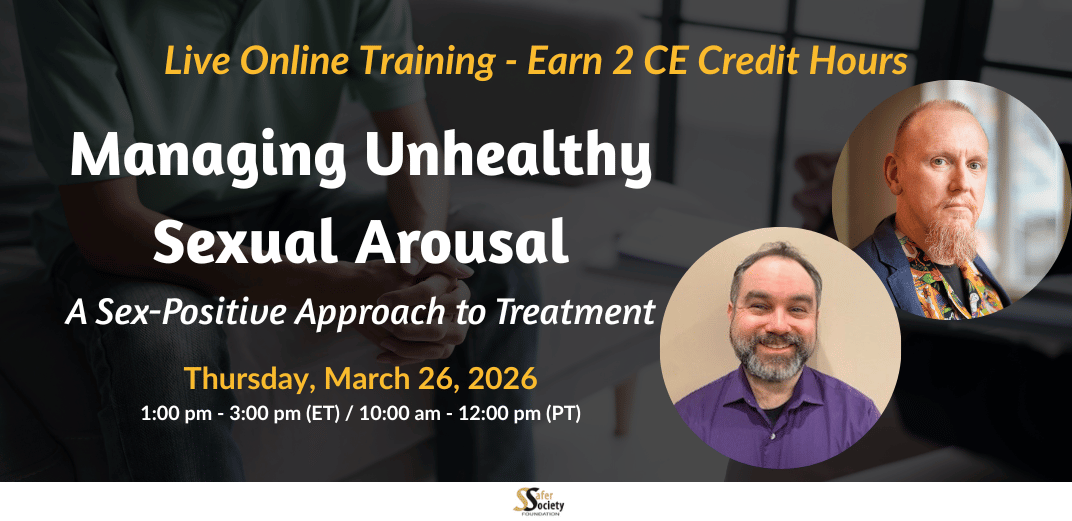
Managing Unhealthy Sexual Arousal: A Sex-Positive Approach to Treatment
The ability to manage one’s sexual arousal is a common and very important goal in the treatment of people who have sexually abused others. Studies find that programs addressing sexual arousal management produce better outcomes and reduced recidivism. However, methods for managing unhealthy arousal have often been implemented in ways that clients experience as intrusive, judgmental, and shaming.
 Dr. Jackson and Dr. Ballinger developed this training to support professionals in adopting sex-positive, non-judgmental approaches to help clients in managing unhealthy patterns of sexual arousal patterns. Many individuals who have sexually abused have had limited sex education and few opportunities to understand the role of sexuality in their lives. Against this backdrop, it is more constructive for clients to view healthy sexuality as a goal to pursue and achieve, rather than regarding sexual arousal as something to avoid for the rest of their lives.
In this training, Dr.’s Jackson and Ballinger offer specific arousal management techniques and explain how these strategies can be incorporated into treatment. Along the way, they also provide ideas for:
- Helping clients identify and discuss who they are attracted to and what they find enjoyable
- Identify how they might explore these interests without causing harm to others
- Addressing gaps in clients’ understanding of sexuality and sexual behaviors
- Supporting the development of realistic and arousing healthy sexual fantasies to strengthen positive arousal patterns
- Teaching skills for ethical decision-making regarding sex and sexual media consumption
- Integrating arousal management education into a strengths-based program
- Determining which clients are most likely to benefit from specific techniques
This training also emphasizes the importance of fostering clients’ internal motivation and strengthening the working alliance. The presenters offer suggestions for introducing interventions to help clients understand the importance of using appropriate techniques to manage their individual sexual behavior. Additionally, they provide guidance for adapting the material to accommodate participants’ learning abilities.
Interactive Follow-Up Meeting
Attendees are invited to join an open discussion 15 minutes following the end of the training, where you can engage with fellow attendees by turning on your camera and microphone. This is an opportunity to share your experiences and contribute to a meaningful exchange of ideas. Time will be allocated to address questions or insights from the training. Please note that attendance is optional and will not affect your eligibility for a training certificate.
1) Apply sex-positive techniques to treatment of adults who have committed sexual offenses
2) Explain arousal management practices to clients in treatment
3) Describe how to adapt the teaching of arousal management approaches for clients with special needs
Audience
This training is primarily for professionals who provide assessment, treatment, or supervision for adults who have sexually abused others. This includes psychologists, social workers, counselors, and other mental health clinicians. Probation, parole, and other justice-involved treatment staff, as well as program administrators and clinical supervisors, will also benefit from this training.
Content Level
Disclosure
Cancellations
Continuing Education Approval
American Psychological Association (APA)
Safer Society Foundation, Inc. is approved by the American Psychological Association (APA) to sponsor continuing education for psychologists. Safer Society Foundation, Inc. maintains responsibility for this program and its content.
Association of Social Work Boards (ASWB)
Safer Society Foundation, Inc., provider #233, is approved to offer social work continuing education by the Association of Social Work Boards (ASWB) Approved Continuing Education (ACE) program. Regulatory boards are the final authority on courses accepted for continuing education credit. ACE provider approval period: 06/06/2025—06/06/2026. Social workers completing this course receive 2 clinical continuing education credits.
Who's Presenting

Bud Ballinger, PhD, ATSA-F
Bud Ballinger is a clinical/forensic psychologist and the Director of Treatment Services for NYS Secure Treatment and Rehabilitation Center (New York’s civil confinement program). He has a passion for enhancing the quality and effectiveness of therapeutic work with people who have engaged in harmful sexual behavior and is a dynamic speaker who has engaged audiences across the United States. Since earning a Ph.D. in clinical psychology from Texas Tech University in 2000 he has worked in inpatient, outpatient, correctional, and civil confinement programs providing treatment, supervision, training, consultation, evaluation, and courtroom testimony. He developed New York’s treatment program for incarcerated people who are likely candidates for civil confinement. He is a past president of NYS ATSA, an ATSA Fellow, a member of the Board of Directors of ATSA, and a member of the ATSA workgroup for people with Intellectual Disabilities and Problematic Sexual Behavior.

Ted Jackson, LCSW, PhD
Ted Jackson is a licensed Social Worker in New York State who recently received his Ph.D. from the School of Social Welfare at SUNY Albany. He has experience in the field of Child Welfare and in the field of mental health and currently works for the New York State Office of Mental Health providing therapy to offenders, as well as conducting research and doing program development for sex offense-specific programs for those who are evaluated to be high-risk. His research interests include minor-attraction, sex offender treatment and mental health policy.