
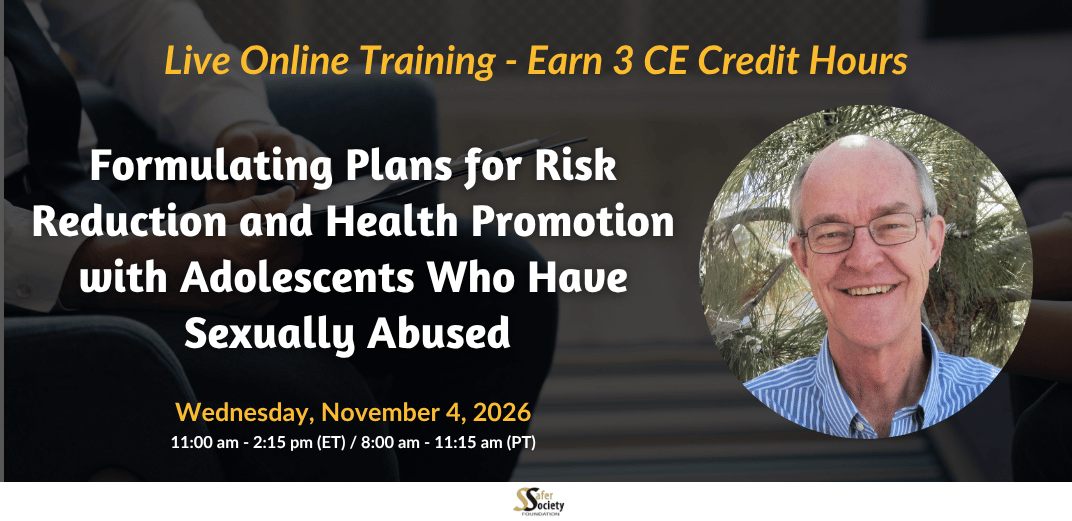
Formulating Plans for Risk Reduction and Health Promotion with Adolescents Who Have Sexually Abused
This training will be converted into an on-demand format within two weeks following the live event. The on-demand version will be available for separate purchase, providing access to the training content for those who were unable to attend the live event or prefer a self-paced learning experience.
The assessment, treatment, and supervision of adolescents who have sexually abused has evolved beyond simply preventing relapse to more holistic models that integrate both risk reduction and health promotion. An evidence-informed holistic conceptual framework for intervention includes:
- Considerations of core correctional principles (such as risk, need, and responsivity)
- An understanding of the developmental and ecological factors implicated in the abuse, as well as those that support change and growth
- Cognitive-behavioral, skills-based approaches
- A trauma-Informed understanding of the youth
- Strengths-based approaches for treatment and supervision
Tom Leversee developed this training to help professionals integrate these components into a structured guide for treatment and supervision planning. This training moves professional dialogue away from addressing treatment components in a fragmented manner and toward a holistic roadmap. It identifies the components of a plan for risk reduction and health promotion, as well as the rationale for each component. The training also includes a focus on strategies and methods for clinical practice and supervision. The training provides insights into:
- Fostering foundational elements of effective services, including the therapeutic relationship, promoting hope and optimism, identifying strengths, interests, and passions, and meeting basic human needs.
- Building the youth’s vision and goals for the future, as well as the motivation and confidence they need to achieve them
- Identifying obstacles to success, including fears, worries, and concerns
- Determining internal and external risk factors
- Considering cultural humility in assessment, treatment, and supervision
- Promoting healthy sexuality/gender identity
Mr. Leversee includes references to relevant research so that attendees can explore the literature further if they wish. He uses case examples throughout the presentation.
Interactive Follow-Up Meeting
Attendees are invited to join an open discussion 15 minutes following the end of the training, where you can engage with fellow attendees by turning on your camera and microphone. This is an opportunity to share your experiences and contribute to a meaningful exchange of ideas. Time will be allocated to address questions or insights from the training. Please note that attendance is optional and will not affect your eligibility for a training certificate.
1) Integrate strengths-based approaches into risk reduction and health promotion plans
2) Critique past approaches that focused exclusively on risk reduction
3) Describe the foundational elements of evidence-informed treatment with adolescents who have sexually abused
4) Create written plans for risk reduction and health promotion
5) Explain developmental and ecological factors that can underlie sexually abusive behaviors by adolescents
Audience
This training is designed for treatment providers, supervising officers, and other professionals and multidisciplinary team members who collaborate in treatment and supervision with adolescents who have sexually abused.
Content Level
Disclosure
Cancellations
Continuing Education Approval
American Psychological Association (APA)
Safer Society Foundation, Inc. is approved by the American Psychological Association (APA) to sponsor continuing education for psychologists. Safer Society Foundation, Inc. maintains responsibility for this program and its content.
Association of Social Work Boards (ASWB)
Safer Society Foundation, Inc., provider #233, is approved to offer social work continuing education by the Association of Social Work Boards (ASWB) Approved Continuing Education (ACE) program. Regulatory boards are the final authority on courses accepted for continuing education credit. ACE provider approval period: 6/6/2026-6/6/2029. Social workers completing this course receive 3 clinical continuing education credits.
Who's Presenting

Tom Leversee, LCSW
Tom Leversee, LCSW, worked for 34 years in direct care, clinical work, supervision and management, and administrative positions in the Colorado Division of Youth Corrections. He has extensive clinical experience with adolescents who have engaged in sexually abusive behavior and facilitated the Denver County Sexual Abuse Review Team. Tom currently has a private practice focused on consultation, training, and clinical services for adolescents. Tom has served on numerous occasions as an expert witness, with a recent focus on applying a neuroscience and psychosocial development framework to juvenile transfer hearings. Tom is also an adjunct professor at the University of Denver Graduate School of Social Work with courses focused on Delinquency and Youth Violence and Forensic Practice. Tom has numerous publications and has presented extensively nationally and internationally. He served on the state Sex Offender Management Board and on the Board for the Association for the Treatment and Prevention of Sexual Abuse.