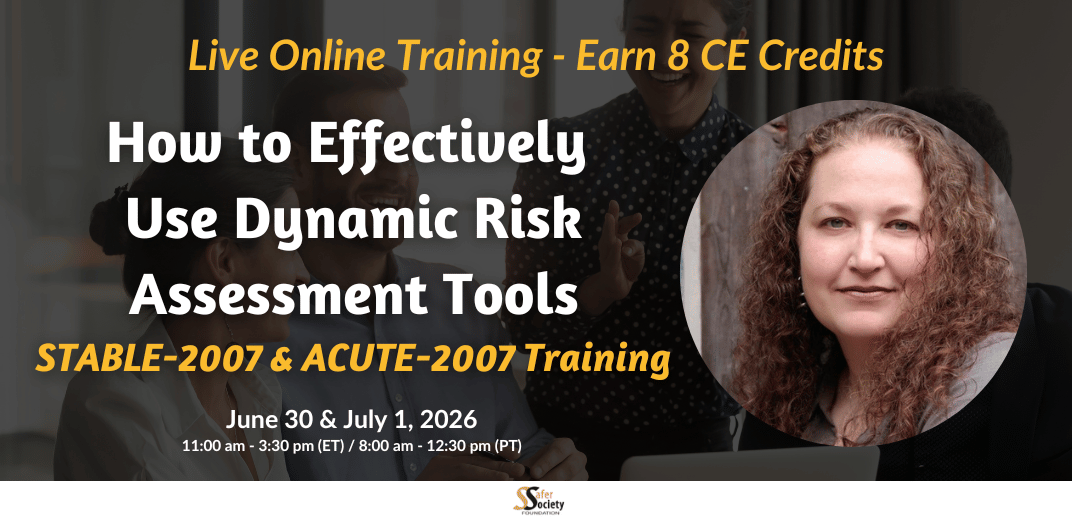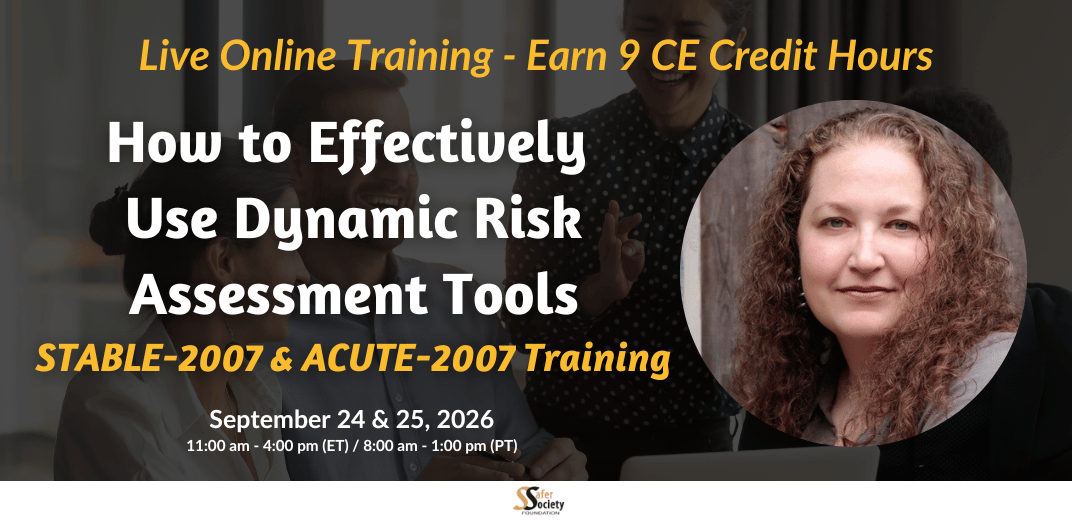
• Day 2: How to Effectively Use Dynamic Risk Assessment Tools: STABLE-2007 & ACUTE-2007 Training

    During this eight-hour training, Katie Gotch, LPC, CCSOT, ATSA-F, provides an overview of the development and research of the STABLE-2007 and ACUTE-2007 instruments. She explains how to score each of the measures’ items, as well as their appropriate interpretation and use within varying settings. This includes recent guidance on the use of these tools with individuals convicted of child sexual abuse material-related offenses (CSAM). To enhance learning, case studies are incorporated to provide hands-on practice and to address common scoring and administration errors.

    $265.00
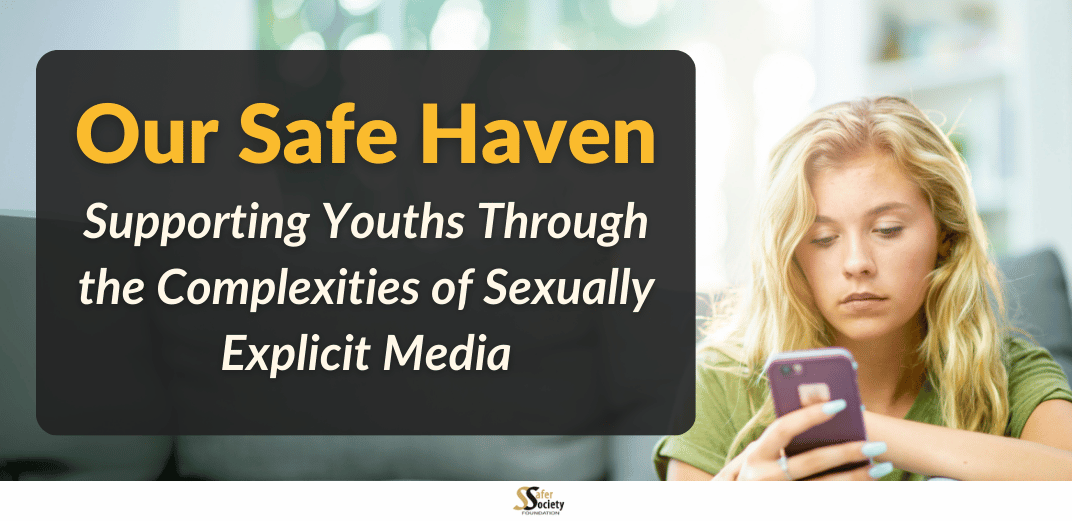
  • Our Safe Haven: Supporting Youths Through the Complexities of Sexually Explicit Media

    The rise of sexually explicit media (SEM) across digital platforms—spanning from traditional adult websites to social media and mainstream online spaces—has created significant challenges for parents, educators, and mental health professionals. Guiding youths through their media consumption in this rapidly evolving digital landscape requires innovative strategies and collaborative efforts.

    Join us for a series of professional dialogues designed to address these pressing issues. Moderated by Seth Wescott and David Prescott, these discussions provide a supportive space for professionals to share insights, develop strategies, and enhance their ability to navigate the complexities of SEM’s impact on youths. Each session will begin with a focused exploration of a specific topic, evolving naturally into an engaging, attendee-driven conversation shaped by shared experiences and professional insights.

    $8.00
  • Helping Justice-Involved Clients Build Relationship Skills

    Reentering society after incarceration is a complex process, particularly for justice-involved individuals with histories of sexual offending, intimate partner violence, or other behaviors that place them at risk of perpetrating harm. Professionals in the field play a crucial role in supporting these individuals as they work to rebuild trust, connection, and healthy relationships. Grounded in relational, trauma-informed, and accountability-centered frameworks, this training offers participants a compassionate approach to working with justice-involved clients and the crucial skills that help prevent further harmful behavior.

    Through a blend of psychoeducation, interactive discussion, and hands-on skill-building, participants learn how to accompany clients in an exploration of boundary setting, consent, attachment dynamics, shame resilience, and the impact of social stigma on relational development. Special attention is given to navigating dating, disclosure, and emotional vulnerability in ways that prioritize both client safety and community responsibility.

    $72.00
  • Our Safe Haven: Supporting Youths Through the Complexities of Sexually Explicit Media

    The rise of sexually explicit media (SEM) across digital platforms—spanning from traditional adult websites to social media and mainstream online spaces—has created significant challenges for parents, educators, and mental health professionals. Guiding youths through their media consumption in this rapidly evolving digital landscape requires innovative strategies and collaborative efforts.

    Join us for a series of professional dialogues designed to address these pressing issues. Moderated by Seth Wescott and David Prescott, these discussions provide a supportive space for professionals to share insights, develop strategies, and enhance their ability to navigate the complexities of SEM’s impact on youths. Each session will begin with a focused exploration of a specific topic, evolving naturally into an engaging, attendee-driven conversation shaped by shared experiences and professional insights.

    $8.00
  • Clinical Strategies for Changing Harmful Online Sexual Behavior

    People who view child sexual abuse material (CSAM) enter treatment with distinct clinical challenges, including intense shame, secrecy, and ambivalence about their actions. In this webinar, David Delmonico and Elizabeth Griffin introduce a structured, therapeutic approach to addressing these behaviors with clarity, compassion, and accountability. They further discuss its application in their newly released The Illegal Images Workbook.

    Free
  • Ethical Decision-Making in Treating Adolescents with Harmful Sexual Behaviors

    In this training, Ms. Pryor explores the ethical tensions that arise between treatment providers and the criminal justice system—each with their own goals and approaches. She discusses strategies for aligning therapeutic interventions with both legal requirements and ethical standards, and reviews relevant ethical codes to support effective and principled clinical decision-making.

    $105.00
  • Our Safe Haven: Advancing Allyship and Support Services for People with Marginalized Sexual Orientation and/or Gender Identity (MOGI)

    ndividuals with marginalized sexual orientations and/or sexual identities (MOGI) encounter numerous interrelated challenges, including stigma, discrimination, and violence in social, educational, and professional environments; heightened risk of mental health issues due to social isolation and abuse; barriers to accessing vital health and support services; and rejection from families or communities, often resulting in homelessness and further marginalization. These challenges are compounded by cultural misunderstandings, intersecting forms of exclusion, and gaps in societal and institutional support. Addressing them requires a collective effort to advance inclusion, equity, and community acceptance for people of all MOGI, ensuring their dignity and rights are respected and upheld.

    In response to these realities, we invite those supporting MOGI-diverse individuals and members of their communities to join us for this series of professional dialogues moderated by Jimmy Widdifield, Jr., and David Prescott. Created to foster meaningful and respectful conversations, these sessions provide a space for professionals to openly explore the challenges faced by individuals with diverse MOGIE. Through shared experiences, expert insights, and practical guidance, attendees will gain strategies to strengthen advocacy, promote inclusive practices, and build effective allyship—helping to foster environments where all people can live authentically and thrive.

    $8.00
  • Current Insights and Effective Approaches in Treating Adults Who Have Sexually Offended

    Staying current with best practices is essential for professionals working with adults involved in sexual offending. This free training provides an overview of advances in the field over the past half century, offering participants practical knowledge needed to prevent further offending and support clients in building lives where abuse is unnecessary and undesirable. The presenters—Katie Gotch, Seth Wescott, and David Prescott—draw on current research, practical experience, and the collective expertise of leaders in the field. Participants have the opportunity to reflect on evolving standards and consider how these changes can inform their daily practice.

    This training is suitable for both new professionals entering the field and experienced professionals interested in the latest developments and practices. Participants gain a clearer understanding of how to apply evidence-based strategies in their work and contribute to safer, healthier communities.

    Free
  • Our Safe Haven: Navigating Sexuality Beliefs When Working with Individuals Who Have Engaged in Nonconsensual Sexual Behaviors

    In this Our Safe Haven, we invite you to join Robin Cooper and David Prescott to explore how personal and professional beliefs about sexuality influence our work, client relationships, and the broader field. Each session begins with a focused review of how sexuality beliefs influence professional practice, evolving naturally into an engaging, attendee-driven conversation shaped by shared experiences and professional insights: Session 01: Let’s Talk Shame Around Sexuality and Sex - Examine the role shame plays in client experiences and professional practice. Discuss ways to address shame while fostering healthy, supportive narratives in treatment.

    $8.00
  • Dr. Karl Hanson on Advancing Sexual Abuse Assessment Practices

    In this webinar, Dr. Hanson invites us to rethink how we conceptualize risk and offers insights into the future of evidence-based assessment. He provides practical advice for early-career researchers and shares his vision for advancing approaches to the prevention of sexual abuse. Join us for this opportunity to engage with one of the field’s leading experts whose work continues to inform policy and practice in sexual abuse risk assessment and intervention.

    Free
  • Structured Assessment of Protective Factors Against Sexual Offending (SAPROF-SO) Version 1 Training – October 2025

    The SAPROF-SO is a tool for assessing protective factors for individuals with a history of sexual offending, integrating with strengths-based therapeutic approaches. This tool comprises 14 items across three key subscales: Resilience, Adaptive Sexuality, and Prosocial Connection & Reward, with an optional fourth subscale, Professional Risk Management.

    Renowned for its strong reliability and predictive validity for reduced sexual recidivism (e.g., Nolan et al., 2023; Willis et al., 2020), the SAPROF-SO is instrumental in guiding therapy planning and risk management strategies (Kelley et al., 2022). This workshop, presented by Gwenda Willis, David Thornton, and Sharon Kelley, offers a training opportunity for clinicians interested in learning how to score and interpret the SAPROF-SO.

    $228.00
  • Living with Children Evaluations: Assessing Whether Adults with Sexual-Offense Histories Can Safely Live with Children

    As with many areas of forensic psychology and the law, living with children (LWC) evaluations pose unique challenges. Whatever their personal viewpoints regarding policy and legislation, evaluators must conform their work product to meet the requirements of the legal systems in which they operate. In conducting these assessments, evaluators must balance best practices in sexual offense risk assessments and modern research on this population with answering the specific questions required by the legal system.

    Typically, a forensic evaluator comments on the risk of sexual re-offense by an individual who committed a sexual offense in broad, hypothetical contexts. In LWC evaluations, however, the evaluator must consider the examinee’s risk to a specific child. The specificity of the potential victim adds unique elements, such as potential vulnerabilities for victimization and the non-offending caregiver’s attributes and abilities.

    In this training, Dr. Zachary Yeoman examines numerous aspects of LWC evaluations. He provides an overview of the legal contexts in which evaluators operate, helping them navigate areas where psychological science and the law may conflict.

    $105.00
  • Understanding Complex Trauma and Dissociation in Children

    Complex trauma and dissociation are areas that have been rife with misunderstanding and misconception. Understanding these concepts is vital not only for clinicians but for all professionals working with children, as misdiagnosis or oversight can have lasting developmental consequences. In this webinar, Ana M. Gómez, an author, clinician, and international educator, and Jillian Hosey, a clinician in private practice and active leader within multiple organizations, share what they have learned from years of study and practice in the area of complex trauma and dissociation in children. Drawing on both their clinical expertise and their editorial work on the new Handbook of Complex Trauma and Dissociation in Children: Theory, Research, and Clinical Applications—the most comprehensive volume to date on this topic—Ms. Gómez and Ms. Hosey explore our current understanding of these concepts and clarify what each is and isn’t

    Free
  • Understanding the Origins of Harmful Sexual Behavior by Adolescents

    Tom Leversee, LCSW—a professional with over 34 years of direct care, clinical practice, supervision, and management—developed this training to explore what is known about how adolescents come to sexually abuse. Mr. Leversee draws from his work with the U.S. Department of Justice’s SMART office, to provide an evidence-informed overview of the research into adolescent abuse, with an eye towards practical frameworks for prevention.

    $105.00
  • Solution-Focused Harm Reduction: A Compassionate Approach to Treating Adults with Substance Use Disorders

    Dr. Séan Foy developed this training to introduce participants to Solution-Focused Harm Reduction (SFHR) as a practical approach to working with people who use substances or display other high-risk behaviors. He explains the many synergies between solution-focused therapy and harm reduction, and describes how the two approaches are complementary and, when used in conjunction, create a novel way of approaching addiction work.

    $140.00
  • What the Evidence Reveals About Repeat Sexual Offending by Young Men

    RaeAnn Anderson, PhD, a human sexuality researcher and educator at the Sexual Violence Prevention Laboratory of the University of Missouri–Kansas City, makes a strong case that both research and practice are not making the most of our existing findings and that the true implications of what we have learned are profound. During this webinar, Dr. Anderson explores what we know about repeated sexual harm perpetration by young men across multiple settings, drawing from a variety of fields to highlight both the evidence and its consequences.

    Free
  • Assessing and Treating Emerging Adults Who Have Sexually Abused: Navigating the Boundary Between Adolescence and Adulthood

    Despite decades of progress in evaluating and treating both adults and adolescents who have sexually abused, working with “emerging adults” can often be less clear. These clients are typically young men between the ages of 18 and 25—in some cases, it includes individuals in their late twenties—who are developmentally between adolescence and adulthood. They often do not “quite fit” into either category. This lack of fit is especially apparent in their living situation or placement logistics and the assessment tools and treatment modalities commonly used with this population. In many cases, clients who are now considered by the courts to be legally adults were adolescents when their abusive actions took place.

    Dr. Waltrip and Dr. Leslie are both experts in evaluation and treatment, with experience across diverse practice settings in the United States. In this training, they focus on how professionals can best understand, assess, and treat emerging adults. This includes the similarities and differences they share with justice-involved adolescents and adults.

    $140.00
  • Adolescent Sexual Offending: Fundamentals of Assessment and Treatment Practices – A 12-Hour Course

    Effective assessment and treatment of adolescents with sexual behavior problems requires specialized knowledge, practical skills, and a commitment to best practices. Whether you are new to this area of work or an experienced professional seeking to refresh your expertise, this two-day course offers a comprehensive, research-informed overview for clinicians, social workers, juvenile justice professionals, and others working with youths in outpatient and residential settings.

    $420.00
  • Our Safe Haven: Navigating the Complexities of Group Therapy with Individuals Who Have Harmed Others

    In these Our Safe Haven sessions, we invite you to join Steven Sawyer and David Prescott to explore the complexities of group intervention, from addressing denial and minimization to managing difficult group dynamics and safeguarding the wellbeing of clinicians. Each session begins with a focused theme, evolving naturally into an engaging, attendee-driven conversation shaped by shared experiences and professional insights.

    $8.00
  • A Developmental Model for Assessing Adolescents with Problematic Sexual Behaviors

    Evaluations of adolescents with problematic sexual behaviors (PSB) often focus on future risk and recidivism, consistent with the Risk-Need-Responsivity (RNR) model. However, the low base rate of known sexual re-offense and moderate effect size of risk tools limit the accuracy of these assessments. Further, youths with PSB are still very much “works in progress.” Their abilities to anticipate consequences, solve problems effectively, and apply prosocial reasoning are still developing. Therefore, additional assessment methods may help professionals identify the most relevant risk factors and support the establishment of appropriate treatment goals.

    In this training, Dr. Norbert Ralph presents a developmental model for adolescent assessment, emphasizing factors that disrupt normative, prosocial psychosexual development and highlighting treatable conditions that can reduce risk for repeating problem sexual behaviors.

    $105
  • Our Safe Haven: Navigating Disabilities as a Professional in Violence Prevention

    Working in the field of sexual and social violence prevention is challenging, and navigating disabilities can make it even more complex. Whether the disability is visible or unseen, the realities of managing personal health, professional responsibilities, and social expectations can be both exhausting and, at times, isolating.

    Led by Katie Gotch, a clinical professional with lived experience of disability, and David Prescott, a mental health practitioner in the field for four decades, these sessions offer a safe, non-judgmental space to connect, share, and build strategies that can make a meaningful impact on our day-to-day challenges. Each session begins with a focused exploration of a specific topic, evolving naturally into an engaging, attendee-driven conversation shaped by shared experiences and professional insights.

    $8.00
  • Our Safe Haven: Advancing Allyship and Support Services for People with Marginalized Sexual Orientation and/or Gender Identity (MOGI)

    ndividuals with marginalized sexual orientations and/or sexual identities (MOGI) encounter numerous interrelated challenges, including stigma, discrimination, and violence in social, educational, and professional environments; heightened risk of mental health issues due to social isolation and abuse; barriers to accessing vital health and support services; and rejection from families or communities, often resulting in homelessness and further marginalization. These challenges are compounded by cultural misunderstandings, intersecting forms of exclusion, and gaps in societal and institutional support. Addressing them requires a collective effort to advance inclusion, equity, and community acceptance for people of all MOGI, ensuring their dignity and rights are respected and upheld.

    In response to these realities, we invite those supporting MOGI-diverse individuals and members of their communities to join us for this series of professional dialogues moderated by Jimmy Widdifield, Jr., and David Prescott. Created to foster meaningful and respectful conversations, these sessions provide a space for professionals to openly explore the challenges faced by individuals with diverse MOGIE. Through shared experiences, expert insights, and practical guidance, attendees will gain strategies to strengthen advocacy, promote inclusive practices, and build effective allyship—helping to foster environments where all people can live authentically and thrive.

    $8.00
  • Our Safe Haven: Navigating Disabilities as a Professional in Violence Prevention

    Working in the field of sexual and social violence prevention is challenging, and navigating disabilities can make it even more complex. Whether the disability is visible or unseen, the realities of managing personal health, professional responsibilities, and social expectations can be both exhausting and, at times, isolating.

    Led by Katie Gotch, a clinical professional with lived experience of disability, and David Prescott, a mental health practitioner in the field for four decades, these sessions offer a safe, non-judgmental space to connect, share, and build strategies that can make a meaningful impact on our day-to-day challenges. Each session begins with a focused exploration of a specific topic, evolving naturally into an engaging, attendee-driven conversation shaped by shared experiences and professional insights.

    $8.00
  • Identifying Above-Average Risk Clients Who Are More Likely to Succeed in the Community

    This webinar focuses on Dr. Sandler’s newest research findings regarding the factors that predict which above-average risk individuals would likely succeed in the community on a supervision and treatment order. Dr. Sandler shares these new, practice-orientated findings that, as is often the case with landmark research, deliver real-world impact and suggest new directions for assessment, treatment, and community supervision.

  • Engaging Clients in Effective Discussion of Healthy Sexuality: A Panel Discussion with Sexual Offense Prevention Experts

    Talking about sex is rarely simple, even for professionals working in sexual offense treatment. Boundaries can feel unclear and often vary from one setting to another. On top of that, separating personal values, beliefs, and experiences from one’s professional role can present additional challenges. Every client brings their own history, perspectives, and interests into the treatment setting, making these conversations even more complex. Yet, best practices necessitate that professionals develop confidence in directly addressing sexual topics with clients. Not only are these discussions essential for effective risk management, but also for supporting clients in developing healthy sex lives that are incompatible with offending. Nikole Nassen, Bud Ballinger, Seth Wescott, and Katie Gotch—leading clinicians and educators in sexual offense prevention—join us to guide this panel discussion. Drawing on their diverse experiences across inpatient and outpatient settings, they share insights, strategies, and practical guidance for navigating the often-uncharted territory of healthy sexuality.

    Free
  • Our Safe Haven: Navigating Disabilities as a Professional in Violence Prevention

    Working in the field of sexual and social violence prevention is challenging, and navigating disabilities can make it even more complex. Whether the disability is visible or unseen, the realities of managing personal health, professional responsibilities, and social expectations can be both exhausting and, at times, isolating.

    Led by Katie Gotch, a clinical professional with lived experience of disability, and David Prescott, a mental health practitioner in the field for four decades, these sessions offer a safe, non-judgmental space to connect, share, and build strategies that can make a meaningful impact on our day-to-day challenges. Each session begins with a focused exploration of a specific topic, evolving naturally into an engaging, attendee-driven conversation shaped by shared experiences and professional insights.

    $8.00
  • Our Safe Haven: Navigating Disabilities as a Professional in Violence Prevention

    Working in the field of sexual and social violence prevention is challenging, and navigating disabilities can make it even more complex. Whether the disability is visible or unseen, the realities of managing personal health, professional responsibilities, and social expectations can be both exhausting and, at times, isolating.

    Led by Katie Gotch, a clinical professional with lived experience of disability, and David Prescott, a mental health practitioner in the field for four decades, these sessions offer a safe, non-judgmental space to connect, share, and build strategies that can make a meaningful impact on our day-to-day challenges. Each session begins with a focused exploration of a specific topic, evolving naturally into an engaging, attendee-driven conversation shaped by shared experiences and professional insights.

    $8.00
  • Navigating the Complexities of Group Therapy with Individuals Who Have Harmed Others

    In these Our Safe Haven sessions, we invite you to join Steven Sawyer and David Prescott to explore the complexities of group intervention, from addressing denial and minimization to managing difficult group dynamics and safeguarding the wellbeing of clinicians. Each session begins with a focused theme, evolving naturally into an engaging, attendee-driven conversation shaped by shared experiences and professional insights.

    $8.00
  • Treating Harmful Sexual Behaviors from a Strengths-Based Approach: A Case Study Exploration

    Strengths-based services for children, adolescents, families, and adults have become far more widely used in recent years. While much of this practice has been in response to trends in research, many professionals simply prefer to take a more positive, strengths-focused approach, particularly when working with adolescents who have caused sexual harm.

    Dr. Kevin Powell has been a leading light in strengths-based work throughout his career, with an extensive record of publications and presentations on the subject. In this training, Dr. Powell describes a challenging case involving an adolescent mandated to receive sexual offense-specific treatment. He invites participants to join him in exploring the broad range of strengths-based interventions he utilized in this case, including a thorough case conceptualization, the strategies he used to enhance the client’s openness and honesty during the treatment process, and the specific challenges that occurred during the process. He ends the discussion with a summary of a 20-year follow-up of this case.

    $105.00
  • Our Safe Haven: Advancing Allyship and Support Services for People with Marginalized Sexual Orientation and/or Gender Identity (MOGI)

    ndividuals with marginalized sexual orientations and/or sexual identities (MOGI) encounter numerous interrelated challenges, including stigma, discrimination, and violence in social, educational, and professional environments; heightened risk of mental health issues due to social isolation and abuse; barriers to accessing vital health and support services; and rejection from families or communities, often resulting in homelessness and further marginalization. These challenges are compounded by cultural misunderstandings, intersecting forms of exclusion, and gaps in societal and institutional support. Addressing them requires a collective effort to advance inclusion, equity, and community acceptance for people of all MOGI, ensuring their dignity and rights are respected and upheld.

    In response to these realities, we invite those supporting MOGI-diverse individuals and members of their communities to join us for this series of professional dialogues moderated by Jimmy Widdifield, Jr., and David Prescott. Created to foster meaningful and respectful conversations, these sessions provide a space for professionals to openly explore the challenges faced by individuals with diverse MOGIE. Through shared experiences, expert insights, and practical guidance, attendees will gain strategies to strengthen advocacy, promote inclusive practices, and build effective allyship—helping to foster environments where all people can live authentically and thrive.

    $8.00
  • Using the Becoming Who I Want to Be Workbooks in Clinical Practice with Young Men and Young Women

    The Becoming Who I Want to Be workbooks for young men and women were designed for professionals working with youths with problematic behaviors toward others. Designed to be approachable and interactive, the workbooks engage clients whose adverse childhood experiences and problem behaviors have caused them to fall behind academically, socially, and emotionally. Based on the Good Lives Model (GLM), the workbook translates complex theory into practical strategies for treatment settings.

    This training shows participants how to effectively integrate the workbooks into their therapeutic practice. Presenter and author David Prescott begins the training by reviewing the core principles of the GLM. He then offers ideas for how clinicians and counselors can use each section. Central to this training is its focus on dovetailing the GLM and these workbooks with Motivational Interviewing skills and the principles of Trauma-Informed Care, ensuring that intervention is not only effective but also client-centered and deeply supportive.

    $60.00
  • Improving Solution-Focused Techniques in Suicide Prevention: A Dialogue with Emma Burns and John Henden

    Skills for the effective prevention of suicide are critical for practitioners of all backgrounds and settings. Too often, professionals focus heavily on assessment and risk management, leaving clients feeling unheard or disconnected from the process. Solution-focused therapy (SFT) offers an alternative—one that centers on a client's strengths, potential, and capacity for change rather than on risk alone.

    In this webinar discussion, author Emma Burns and psychotherapist John Henden share their insights from their work using SFT with individuals experiencing suicidality. This conversation underscores the value of staying client-centered and strengths-based, even in complex and high-risk situations. It’s an opportunity to consider how subtle shifts in approach can open channels for change and healing.

    Free