
This blog draws on the insights from the online training Assessing and Treating Women Who Perpetrate
Sexually Motivated Offenses, presented by Dawn Pflugradt, PsyD, ABPP and Bradley Allen, PhD, J.
Clinicians who assess women who have sexually offended often reach for the same instruments they use with men: the Static-99R, the Stable-2007, maybe the RSVP-2 for a more structured judgment. That choice can seem reasonable enough. It might even be required by statute in the state where you practice. But according to Dawn Pflugradt, PsyD, LP, LCSW, and Bradley Allen, PhD, JD, two field experts on assessing women who have sexually offended, that choice can lead evaluators and treatment providers seriously astray.
A Field Built Almost Entirely on Male Data
Pflugradt and Allen have highlighted the honest accounting of the evidence base: nearly everything the field currently knows about assessing risk in individuals who have sexually offended comes from research on men. The principles of risk, need, and responsivity (RNR)—the framework most widely used in the field—depend on identifying treatment needs that are empirically tied to reoffending. For men, decades of large-sample research have made this possible. Tools like the Static-99R, the Stable-2007, the VRSSO, and the SOTIPS exist because researchers had thousands of male cases to study.

Women who have sexually offended represent a much smaller and less-studied population, so those same tools were, according to Pflugradt, adapted by simply changing pronouns. The result: no validated risk assessment tools exist for women. Pflugradt was direct about which instruments should not be used with female clients, including the:
- Static-99R
- Static-2002R
- ISORA
- VRSSO
- SOTIPS
- Stable-2007
What Recidivism Data Actually Shows
Part of what makes these tools misleading for women is how differently the underlying data behaves. Pflugradt points to a 2018 study by Vandiver, Braithwaite, and Stafford that followed more than 450 women for up to 18 years and found a 7% rate of new sexual offense recidivism, compared with a 52% recidivism rate for other types of criminal offenses (Vandiver et al., 2018). A larger meta-analysis by Cortoni, Hanson, and Coache, covering nearly 2,500 women with an average follow-up of 6.5 years, found sexual recidivism under 2%, with somewhat higher rates for violent and general offending (Cortoni et al., 2010). Newer research by Hanson & Colleagues (2026) also points to a low sexual recidivism rate.
In other words, women who have sexually offended are far more likely to return to the criminal justice system for a different kind of offense than for a new sex offense. Male-based tools, built to predict sexual recidivism using male samples, were not constructed to capture that pattern.
Pflugradt also calls attention to a deeper problem with translating findings from men to women. Researchers have identified one static factor associated with recidivism in women, a prior conviction for child abuse of any kind, but even that factor does not push a woman’s risk of recidivism meaningfully above the known base rate the way scoring on male-normed tools typically does. No dynamic risk factors that predict sexual recidivism in women have been empirically identified either. Pflugradt describes seeing evaluations that inappropriately borrow such factors from male-based research, noting that “when we look at the research, it doesn’t pan out.”
Why the Male Framework Doesn’t Transfer
Beyond the missing data, Pflugradt and Allen explain why the underlying logic of male-focused risk tools doesn’t map onto women’s patterns of offending.
Male-based treatment models often look for a buildup phase or an offense cycle, a repeating pattern of thoughts, feelings, and behaviors that precede an offense. Pflugradt and Allen emphasize that this pattern generally does not appear in women.
“We don’t see with women a buildup phase and all of these things that you typically see with male-based treatment,” Pflugradt explains. “We see that (her) life had a lot of things going on…It’s like, here’s what my life was like, and it culminated in an offense.
Allen adds that clinicians working with women should not expect to see “a repetitive pattern,” including the buildup, assault, and de-escalation phases common in male-focused frameworks.
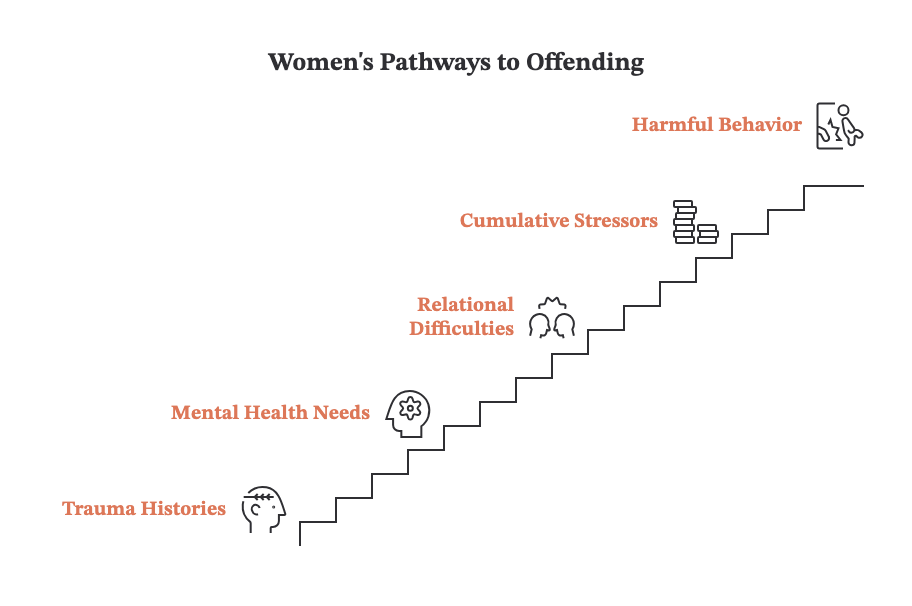
Instead, Allen and Pflugradt summarize women’s pathways to offending as cumulative: a series of overlapping and worsening stressors, often layered on top of trauma histories, mental health needs, and relational difficulties, that build until they culminate in harmful behavior. Applying a male-based cycle model to that kind of case can miss what is actually happening for the client and steer treatment in the wrong direction.
What to Use Instead
None of this means clinicians are left with nothing. Pflugradt and Allen recommend a gender-specific instrument called the WRNA, built using research on women rather than men. Pflugradt described it as “a great tool” and, ideally, “the gold standard” for gauging general criminal recidivism risk in this population. The WRNA assesses general recidivism risk rather than sexual recidivism risk specifically, since no validated tool yet exists for the latter. Because women who have sexually offended are considerably more likely to return to the justice system for a non-sexual offense, Pflugradt and Allen consider general risk assessment a genuinely useful part of a full evaluation.
The WRNA also captures factors that gender-neutral tools tend to miss, including housing safety, employment and financial stability, history of abuse and trauma, family conflict, parental stress, and current symptoms of anxiety or depression, alongside more familiar factors like criminal history and antisocial attitudes.
Pflugradt acknowledges one practical limitation: the WRNA requires purchasing a distinct package and completing dedicated training, a cost that can put it out of reach for smaller agencies. For clinicians without access to it, she pointed to the LSI family of tools as a more widely available option that includes female samples in its development, while cautioning that it was not built specifically for this population and should be used with that limitation in mind.
Whatever tool a clinician uses, Pflugradt recommends keeping general and sexual recidivism risk in one section of an evaluation and clinical needs in a separate section, rather than presenting needs and elevated risk as though they were the same thing. Referral sources and courts, she noted, can easily misread a long list of clinical needs as evidence of high risk, when the research shows the opposite: women who have sexually offended are, in her words, “a high-need, lower-risk population.”
From Risk Management to a Good Life
That distinction between risk and need opens into a strengths-based approach to treatment. Pflugradt describes the goal of programming for women as building flexibility to address “the individual or contextual nature of female offending,” gendered and strengths-based work that allows a client to “live a good life,” language that echoes the Good Lives Model (GLM) framework featured in other trainings, including The Good Lives Model with Justice-Involved Women, presented by Pflugradt, Allen, and David Prescott. This training builds on the assessment principles covered here and extends them into a fuller treatment framework centered on client strengths rather than a checklist of deficits.
Clinicians looking for a GLM-based workbook to use directly with female clients may also find Becoming the Woman I Want to Be, co-authored by Prescott, Pflugradt, and Allen, a useful companion to this assessment work.
Gendered Treatment Assessment: A Protocol for Women Who Have Sexually Offended lays out that protocol in more depth for practitioners building or revising their evaluation process.
Women who have sexually offended make up a small share of the overall population of individuals who have committed sex offenses, which is part of why the research base has taken so long to develop. But a small population is no less deserving of an accurate evaluation. As Pflugradt and Allen make clear, the path forward starts with retiring the assumption that a tool built for men, however well-validated for that population, is safe to utilize for woman.
References:
- Cortoni, F., Hanson, R. K., & Coache, M. (2010). The recidivism rates of female sexual offenders are low: A meta-analysis. Sexual Abuse, 22(4), 387–401.
- Hanson, R. K., Cortoni, F., & Sandler, J. (2026). The Sexual Recidivism Rates of Women Are Still Low: An Updated Meta-Analysis. Criminal behaviour and mental health : CBMH, 36(2), 53–62.
- Pflugradt, D. M., & Allen, B. P. (n.d.). Assessing and treating women who perpetrate sexually motivated offenses [Online training course]. Safer Society Foundation, Inc.
- Vandiver, D. M., Braithwaite, J., & Stafford, M. C. (2019). An assessment of recidivism of female sexual offenders: Comparing recidivists to non-recidivists over multiple years. American Journal of Criminal Justice, 44, 211–229.